


Since the mid-1800s, snipe hunting has been a popular prank among young campers across the United States. The goal was to get a group of friends to believe a story about a mysterious creature called a snipe, then send them out into a dark, moonless night with a flashlight, a burlap bag, and specific instructions about making weird noises and yelling, “snipe, snipe, snipe” to attract, and ultimately capture the elusive creature.
To those being duped, the snipe might have been described as a cross between a jackrabbit and a squirrel, or a squirrel-like bird with one green eye and one red eye! The descriptions and the details of the prank were limited only by the imagination of the person telling the story. This snipe-hunting prank has been a rite of passage for young campers for over one hundred years!
As a result of this popular tradition, many non-birders have assumed that a snipe was a mythical creature. I was as surprised as the next person to learn that there really was such a thing as a snipe, that it was a bird and not a mammal, and that we have them here in Michigan every year during their migration. The most commonly found snipe in Michigan is the Wilson’s snipe, named after the American ornithologist, Alexander Wilson. I didn’t know all of this until I became a birder myself!
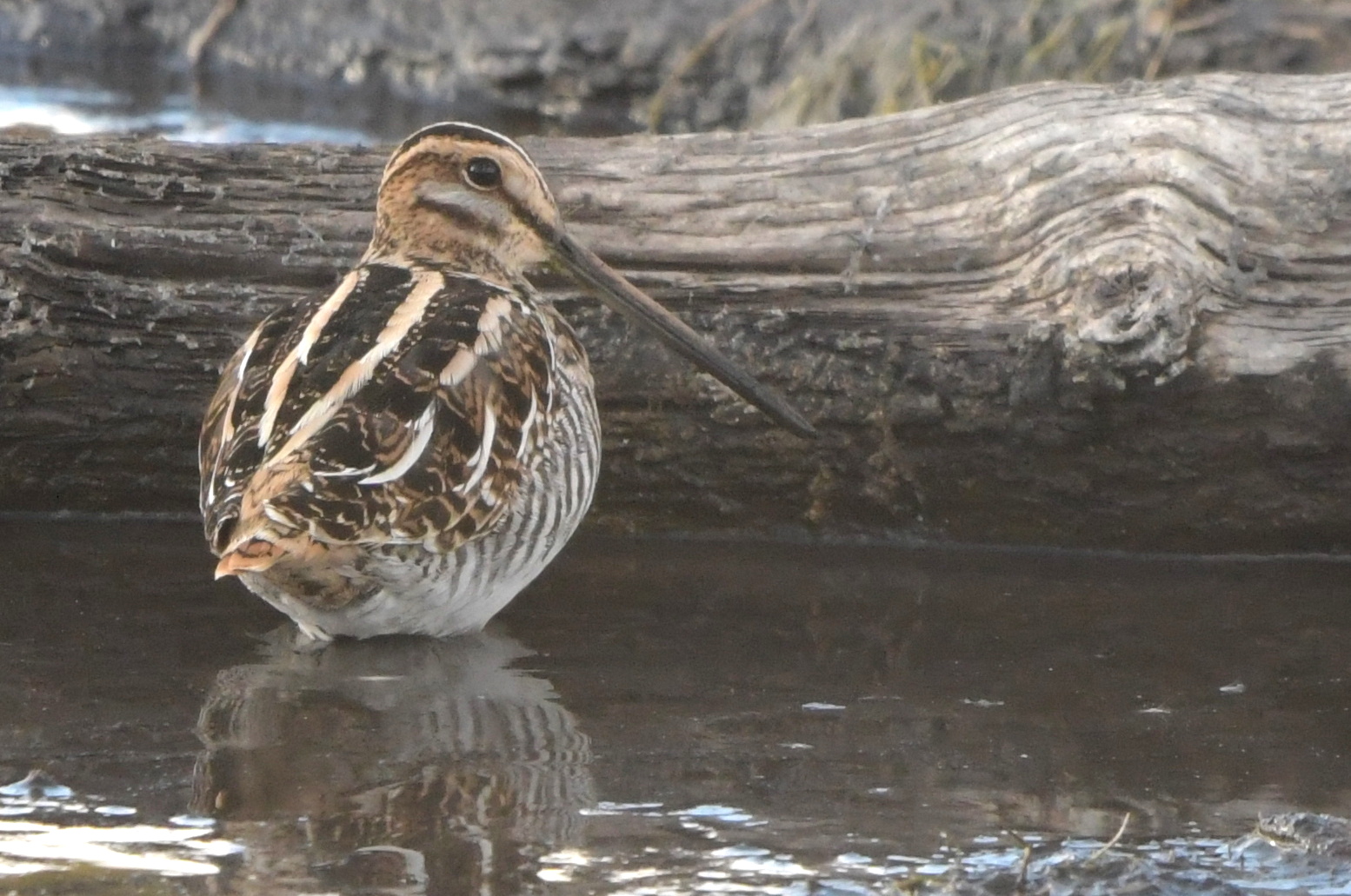
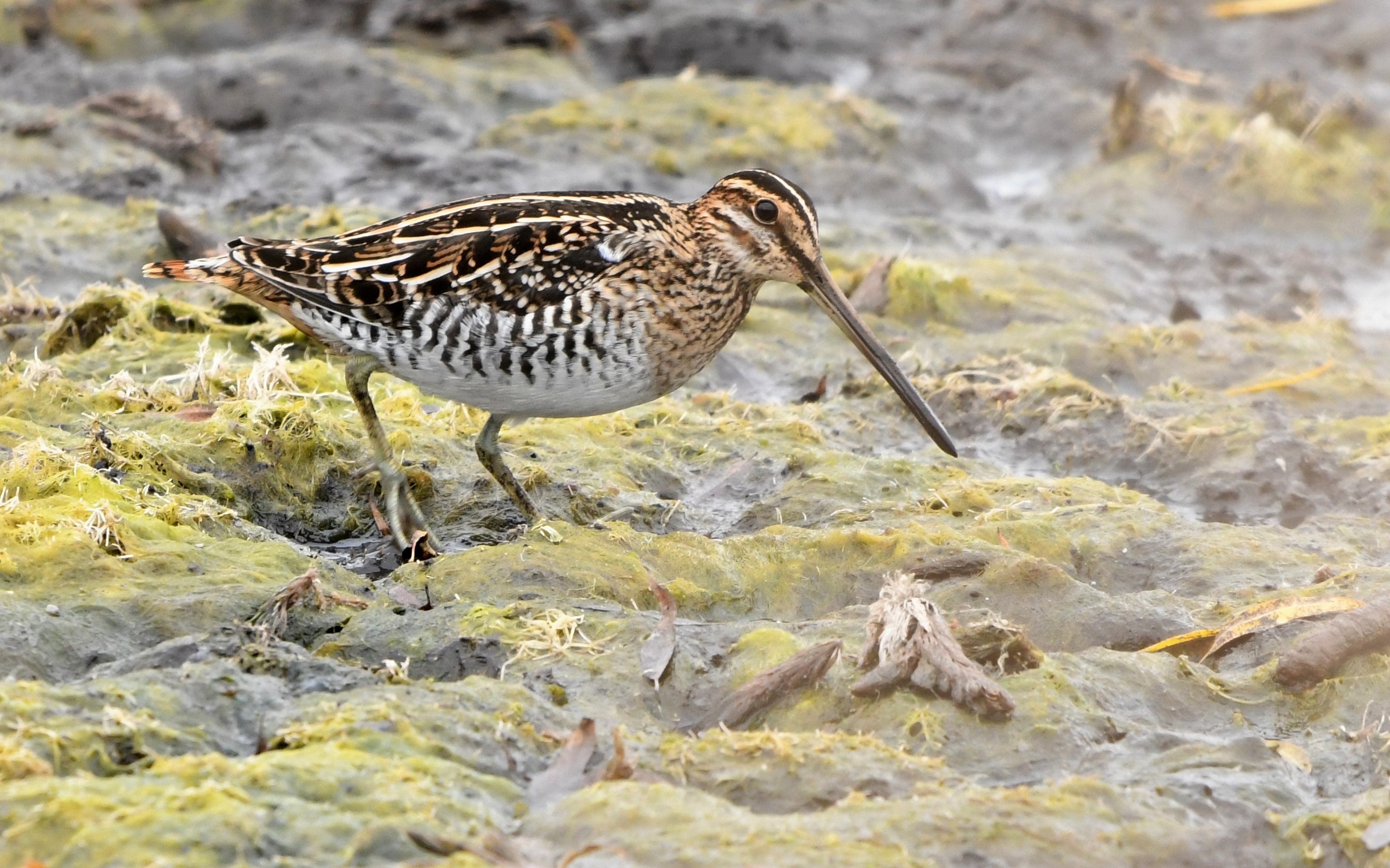
Wilson’s snipes are short, stocky shorebirds with a very long bill and a rather short tail. They’re about the size of a robin or a killdeer but with a distinctive butterball shape! Wilson’s snipes blend seamlessly into their surroundings with their intricately patterned feathers of buff, brown, black, and white, making it almost impossible to see them even on open mudflats where they like to forage. If you try to get a closer look, the snipes will quickly disappear into the air before you can even take your first step! They have eyes in the back of their heads! Well, almost. Their eyes are set so far back on their heads that they can see behind them nearly as well as in front or on the sides!
If you have a good pair of binoculars, a spotting scope, or a long lens on your camera, you might be able to get a closer look and see them foraging methodically along the mudflats, heads bobbing up and down like a slow-moving sewing machine, probing the muddy ground for insect larvae, worms, and other invertebrates.
Surprisingly, this fairly unknown little bird plays a critical role in our ecosystem. As an avid insectivore, Wilson’s snipes help control the populations of many insect species in our wetlands. This is a particularly important task in areas where insect outbreaks are threatening our plant communities. In turn, Wilson’s snipes provide a valuable food source for many predators, including larger birds, mammals, and reptiles.
The important take-away here is that these odd-looking little creatures are an essential link in the food chain, contributing to the overall health and diversity of our environment and serving as important indicators of a healthy wetland ecosystem. We owe it to them and to all the creatures we share this planet with to protect our environment from any further damage.
Saving them saves us.