


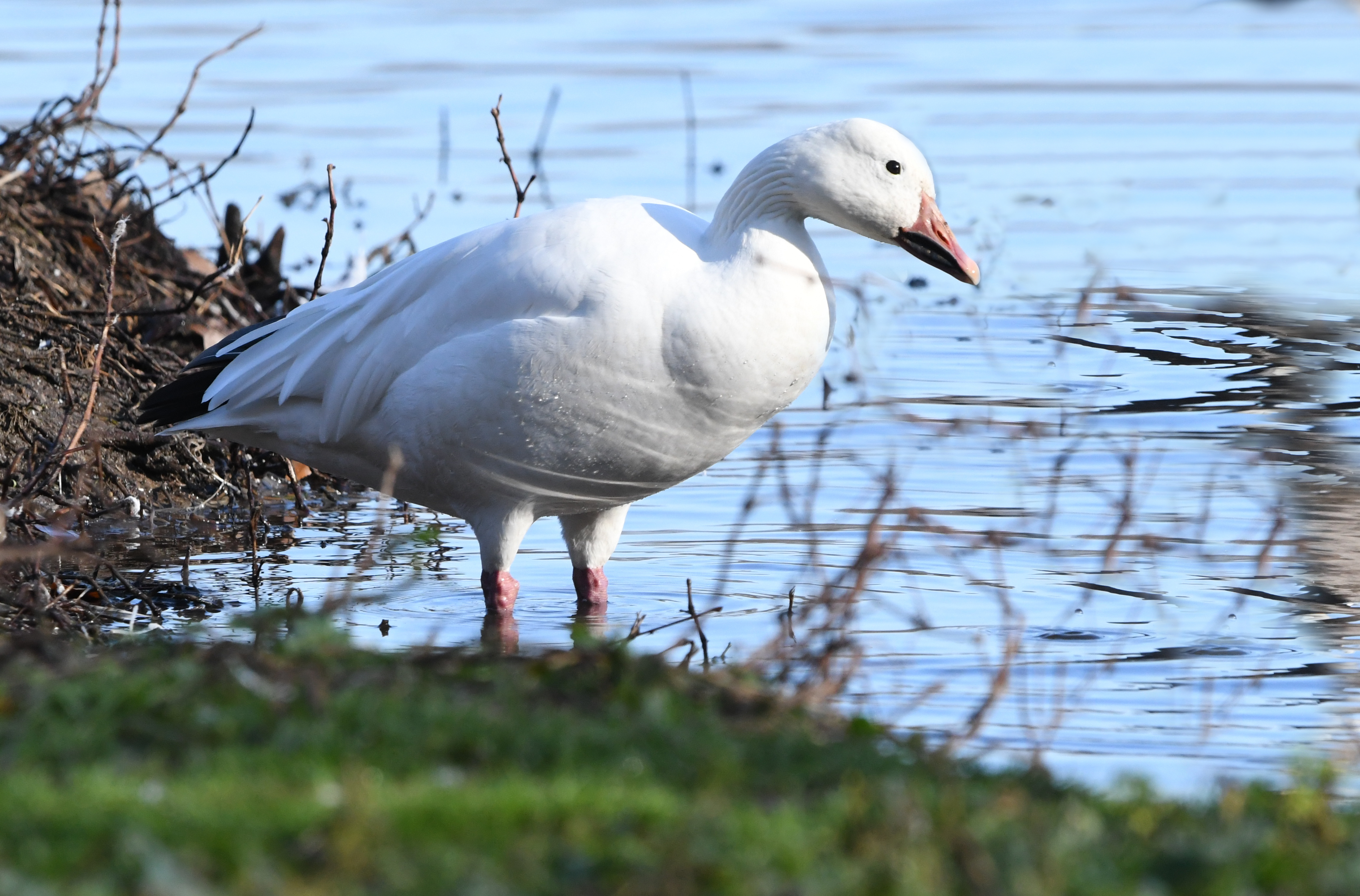
A little over four years ago, in November of 2020, I saw my very first snow goose! Snow geese are one of the world’s most abundant waterfowl species, but they are rarely seen in Michigan, which is why I was so excited when my sister-in-law told me that she had spotted one at the Kellogg Bird Sanctuary where I frequently take pictures.
The following day, I left the house for the sanctuary early in the morning with the expectation that I would stay for the entire day until I found my goose, or the place closed!
When I arrived shortly after the gates opened, Wintergreen Lake was already alive with activity! There were the usual hordes of Canada geese and trumpeter swans whose signature honking and trumpeting echoed loudly across the water. There were the less noisy, but equally abundant quacking mallards, and farther out on the lake, were the smaller, quieter buffleheads, gadwalls, and scaups. I was thinking I might have set myself up for failure by going in search of a single snow goose among so many birds!
After about two hours of standing and waiting along the shoreline, I noticed two unfamiliar birds flying in overhead! When I zoomed in on the pair, I saw that they were, indeed, snow geese! They landed on the shore not far from where I was standing and for the next fifteen minutes or so, I took dozens of pictures of these two “dark morph” snow geese before a third, “white morph” goose joined them. I felt as if I had won the lottery!
White morph snow geese have an all-white body with black wingtips while the dark morph goose, also known as a blue goose, has the same white face but a dark blue-gray body. Both versions of the snow goose have pink bills with a black line that resembles a grin, and dusky pink legs and feet. They are smaller than Canada geese but bigger than mallards.
Snow geese are a very rare sight at the Kellogg Bird Sanctuary, but for a few short months in 2022 there was a snow goose in residence. The goose had been found on a property in mid-Michigan malnourished and unable to fly. It was assumed that the bird had been in the middle of its migratory flight when fatigue brought it to the ground. The depleted snow goose was first taken to a wildlife rehabilitator in Grand Rapids and later transferred to a rehab center in Eaton County where it continued to gain strength. Ultimately, the goose was brought to the Kellogg Bird Sanctuary where, for another few months, it enjoyed the company of other birds while it continued to improve. The sanctuary is not a rehabilitation facility but does act as a safe release spot for a select group of birds like snow geese, or as a permanent residence for injured birds that cannot be released back into the wild. “Snoose” as the bird was affectionately dubbed, left the sanctuary on its own accord sometime in early June of 2023.
Snow geese don’t like to travel without the company of a flock, even if it’s a flock of Canada geese! When flying with their own kind, snow geese can form groups of several hundred thousand birds! The small group of three that I saw at the sanctuary seemed to be an anomaly. Perhaps they had been blown off course during their migration journey and became separated from the rest of their flock. Hopefully, they reconnected, or at least found a new group to join.
These amazing birds make epic migration journeys year after year flying great distances from their summer nesting grounds above the Arctic Circle to their winter homes as far south as Veracruz, Mexico. Their flying skills are definitely impressive but I found it even more amazing that, within the first three weeks of life, goslings often walk more than 2 miles a day with their parents in search of better food sources. Over the course of a brood rearing season, the goslings and their parents may walk 40 to 50 miles—all on their flat little feet that are much better suited for swimming than walking.
It’s not likely that you’ll find snow geese in Michigan, but if you ever hope to see them, look for huge, noisy flocks of mostly white, medium-sized birds scavenging large agricultural fields or hanging out near open bodies of water. You’ll probably hear them long before you actually see them because snow geese are reportedly one of the noisiest waterfowl you’ll ever encounter here in Michigan—even noisier than the very vocal trumpeter swans!
Enjoy your search!