


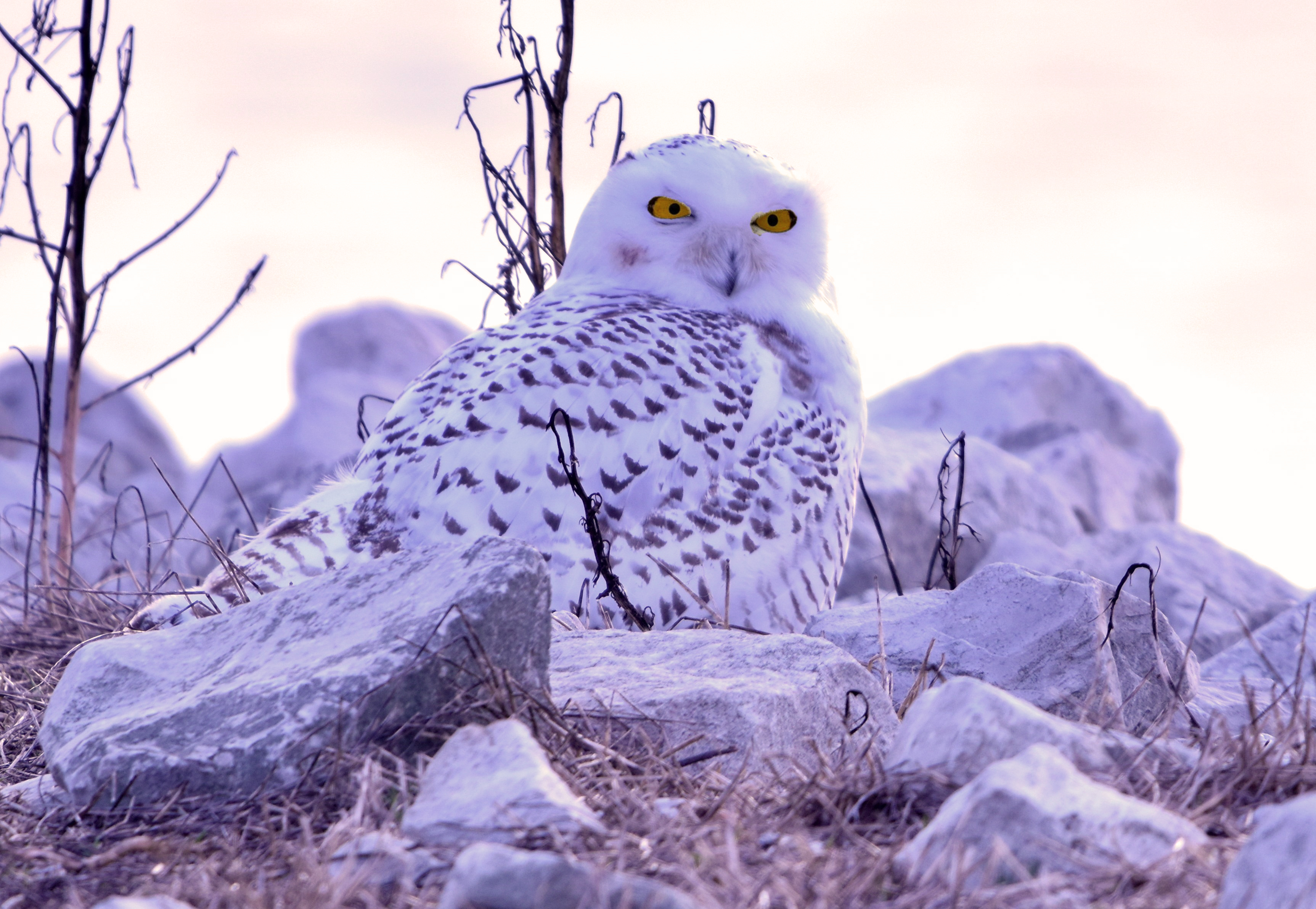
Seven years ago this past December, when I was relatively new to nature photography and relatively new to birding, I heard through the birding grapevine that there was a snowy owl sighting at the Muskegon Wastewater Treatment Plant. I had never seen a snowy owl and was eager to find and photograph one!
Snowy owl sightings in Michigan are always cause for excitement! These beautiful birds are the largest owl (by weight) and one of the most striking to be seen here in our state. As the name implies, snowy owls are mostly white, but they have varying amounts of black or brown markings on their bodies and wings. Females have markings that can be quite dense, giving them a salt-and-pepper look. Males are generally whiter than females, and get whiter as they grow older. Both birds have piercing yellow eyes.
Most of the year, snowy owls live in the Arctic tundra, but from late October to December, in a phenomenon known as irruption, some of these Arctic birds will leave the tundra. Most will go to Canada and the northern United States, as well as Asia and Europe. Snowy owls show up sporadically throughout Michigan, but the most dependable place to find them is Rudyard, a small Upper Peninsula community about 30 miles north of St. Ignace. In fact, Rudyard gets snowy owls so consistently that the town has proclaimed itself to be the “Snowy Owl Capital of Michigan”! If you set out to find a snowy owl in Rudyard, plan to be there before late March or they will all be gone!
I knew very little about snowy owls when my husband and I headed up to the Muskegon Wastewater Treatment Plant on that snowy December day with our cameras in hand and our curiosity growing by the minute. We didn’t know what to expect and were surprised to find a vast expanse of open land; 11,000 acres to be exact! How would we ever find a solitary white owl in a field of snow over such a large area?
The answer was quick in coming. Shortly after driving onto the property, we spotted a rather large group of people (mostly photographers) all facing in the same direction! I was both surprised and uncomfortable with how many people were there and how close they were to the owl perched on a pile of nearby rocks. In the intervening years, I’ve learned a great deal about ethical and humane bird photography practices, particularly in regard to owls.
In a recent article by Joe Moore on the American Birding Association website titled Snowy Owl Viewing Ethics, Moore recommends using the acronym OWL to help remember the appropriate behavior for observing these birds.
O – Observe: 100 yards away with binoculars, camera, or scope.
W – Wander: Do not ever wander close to the animal!
L –Leave no trace: Snowy Owls are sensitive to habitat disturbance, so, when they’ve found a suitable hunting area, it is important for people to leave it as is.
Those tips are a good place to start, but there’s so much more to know, like not using drones, not using artificial lights, and not stressing out the owl by spending too much time in the area. You may be the only person observing a particular owl in any given location but, over time, hundreds of people may have been watching it as well. The impact is cumulative.
It’s also extremely important to not share the location of the snowy owl publicly! When location information is shared publicly, those poor birds get mobbed by photographers and other observers, like the owl we saw at the Muskegon Wastewater Treatment Plant—before I knew better!
If you do go looking for snowy owls, there are a few things that will increase your chances of finding one. According to the Michigan Department of Natural Resources (DNR), the best months to catch a glimpse of these migratory birds is January and February. Look for them sitting on or near the ground in flat, wide-open, snowy spaces like farm fields, marshes, prairies, beaches, and airports. They often perch on rises such as the crests of dunes, or on fenceposts and hay bales. Be sure to have your binoculars ready!
It’s critically important for each of us to respect and protect these wonderful creatures. According to the International Union for Conservation of Nature (IUCN), snowy owls are considered to be at high risk for extinction due in no small part to climate change, the highly pathogenic avian influenza, and human interference.
Enjoy your search, but keep these things in mind.