


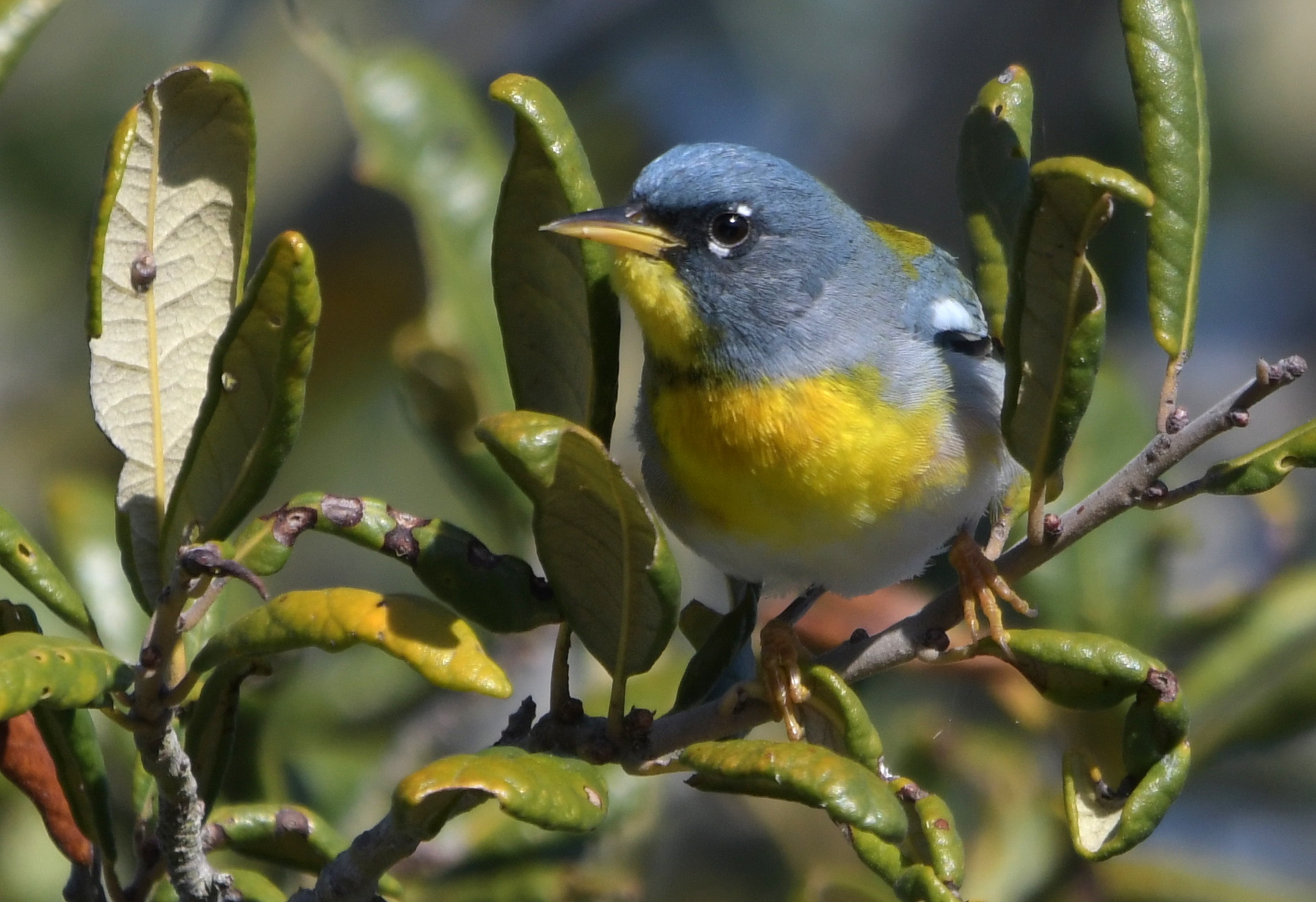
Several weeks ago, I was wondering what might be a good topic for this month’s South County News when the answer almost fell into my lap! I was visiting Florida at the time, trying to catch a picture of a very hyperactive yellow-rumped warbler that was flitting sporadically from one limb to another, making it impossible for me to get a picture. All of a sudden, a very different bird showed up in my lens; one that I have rarely seen and couldn’t readily identify. It paused just long enough for me to get a picture. Good bird!
The bird in question turned out to be a northern parula! Northern parulas and yellow-rumped warblers sometimes migrate together and, on rare occasions, they hybridize! Both the northern parula and the yellow-rumped warbler migrate through Michigan, and also breed here.
The yellow rumped warbler, also known among birders as a “butter butt,” has always been much easier for me to find than the parula. I’ve photographed the “butter butts” many, many times over the years, but the only other northern parula I’ve ever found was in West Bloomfield, Michigan three years ago during the waning days of September. Northern parulas typically migrate through Michigan from mid-May to mid-August. My September parula must not have gotten the memo!
The adult male northern parula is bluish gray overall with bright yellow chin and breast feathers that contrast beautifully with its off-white belly and flanks. It also has two white wingbars and small white arcs above and below each eye. During the breeding season, male northern parulas also have a rufous-colored breast band. The female parula’s colors are similar to the male’s but more muted. They also lack the male’s distinctive breast band. Both sexes have short tails and thin, pointy bills. Those thin pointy bills are good for capturing spiders, beetles, moths, ants, wasps, bees, and flies as well as other insects!
The breeding grounds for the northern parula extend from Florida all the way to the boreal forest of Canada, but there’s an odd break in their breeding range. These birds skip parts of Iowa, Wisconsin, Michigan, and some of the states in the Northeast. Their absence in these areas is believed to be the result of habitat loss and increasing air pollution, both of which impact the amount of moss available that northern parulas need for nesting. In the South, the parulas depend on the Spanish moss for nest building, and in the North, they are dependent on beard moss. Beard moss, also known as Old Man’s Beard, is a type of lichen that hangs from branches and looks like stringy, grey, or greenish strands of hair.
The key to finding northern parulas during the breeding season is to look for the long, wispy epiphytes hanging from the trees. During the breeding season, you will probably need binoculars to find a northern parula as their nests can sometimes be extremely high in the tree canopy. During migration, though, the northern parula will forage lower down in the trees making them much easier to find – which is how I happened upon the bird pictured here.
According to the Cornell Ornithology website, northern parulas sing two different types of songs. “The most common is a rising buzzy trill with a final sharp note. This song rises up and pinches off sharply at the end. The second song has distinct pauses in between bouts of the rising, buzzy trill. Males are the primary vocalists, but females may occasionally sing.”
If you have trouble identifying birds by their songs like I do, or just want to know who’s singing in your yard, download the free Merlin app from Cornell Lab to your phone. Merlin is easy to use and can identify the songs you record with 90% accuracy or better depending on the quality of your recording. Merlin can also identify the bird you are looking at if you have a reasonably good photo.
If you’re hoping to find a northern parula this spring or summer, your best bet will be to find a mature, moss-covered forest near water. For your very best chance of success, take your binoculars and your Merlin bird app! You will probably hear this bird long before you ever see it!
Enjoy!