



Howe is just a few miles south of the Michigan border. It was settled in 1834 and originally named “Mongoquinong,” a Potawatomi name for the prairies in northern Indiana. It was later renamed “Lima” and eventually “Howe” after John B. Howe, a local attorney.
In June, I took a leisurely backroads drive through Vicksburg, Mendon, Nottawa and Sturgis, before heading about 6 miles south on M66 which turns into State Road 9 once you cross the Indiana border. I turned east on State Road 120, admiring the stately old homes as I headed into the picturesque downtown Howe.
I parked and headed into The Gathering Place for breakfast. The restaurant was busy and serves large, tasty portions at a great price. My western omelet with American fries was delicious. I asked a couple at the next table over a few questions about Howe and a lady on the other side of me said, “I can help you!” She introduced herself as Margaret Malone and her friend, Sandy Fanning, sitting with her. They had lived most of their lives in Howe and gave me quite the rundown on the town’s history. Margaret runs an animal rescue and adoption organization and told me to make sure to stop into the used bookstore that raises money for the organization and to make sure to “buy some books!” I later stopped into the Ark Paws and Claws Bookstore and was surprised at how large and well organized it was. The thousands of used hard and softcover books were all shelved by specific categories and I purchased a few local travel books.
I would have stopped at the popular Happiness Is Ice Cream next door, but it was still full from breakfast.
I asked Margaret about the large brick buildings I noticed heading into town and she told me that this was once the Howe Military Academy. I did a little research and read that the school began in 1884 as Howe Grammar School with two boys in the former 1844 home of Mr. and Mrs. Howe.
The school became a military school in 1895 and was renamed Howe Military Academy, becoming the town’s most famous attraction. It became fully co-educational in 1988. As of September 2008, Howe was one of 28 military schools in the United States, down from a high of 125 such schools. On March 18, 2019, Howe announced it would be closing its doors due to fiscal challenges and in June 2020, the school property and its buildings were sold for $3 million to Olivet, a New York-based religious organization.
The Academy’s most famous alumni was actor John Cromwell. All of the academy yearbooks are online and in looking through a few, I found that one of Kalamazoo’s Shakespeare family members was a graduate. When I headed out of town, I drove through the grounds, past dozens of large, abandoned buildings, imagining all of the activities that took place here over the years.
I asked Margaret who was Howe’s most famous citizen and after a moment of thought, she said, “I guess it would have to be ‘Crissy the Skunk Woman.’” This certainly got my attention and after she filled me in on what she knew, mentioned that The Skunk Woman was buried just down the road at the Riverside Cemetery. I drove to the cemetery and after walking around a bit, found a large boulder with a plaque and a cement skunk to the right of the grave. The plaque said Christina Irene Hahn D’ Sullivan, 1845-1925. “Crissy the Skunk Woman” A True Child of Nature.
Crissy lived in a shack filled with animals. She wore the same clothes every day and had no running water. Her favorite animal was the skunk. She could often be seen with her favorite, “Old Rover,” perched on her shoulder. Crissy’s eccentricities started to draw attention and word eventually spread to Ripley’s Believe it or Not, which published a blurb about Crissy proclaiming her “The World’s Filthiest Woman.” She became famous and tourists drove from across the country to meet her. When cars would pull up, Crissy would come out of her shack with a skunk and do a little dance. She would then hold out a hat asking for donations.
By the time she was 70, living on her own and juggling the hundreds of visitors and the menagerie of animals became too difficult. After a state housing inspector took a look at her shack, he immediately condemned it. Howe citizens sat down with Crissy and she agreed to leave behind her persona as the Skunk Lady. They collected funds to build her a small, modern home. Builders completed the house and Crissy moved in, eventually donning clean clothes and, an event Howe residents categorized as apocalyptic, forced Crissy to bathe. After less than a year in her new home, Crissy died of unknown causes. Stories online note that she had at least two husbands.
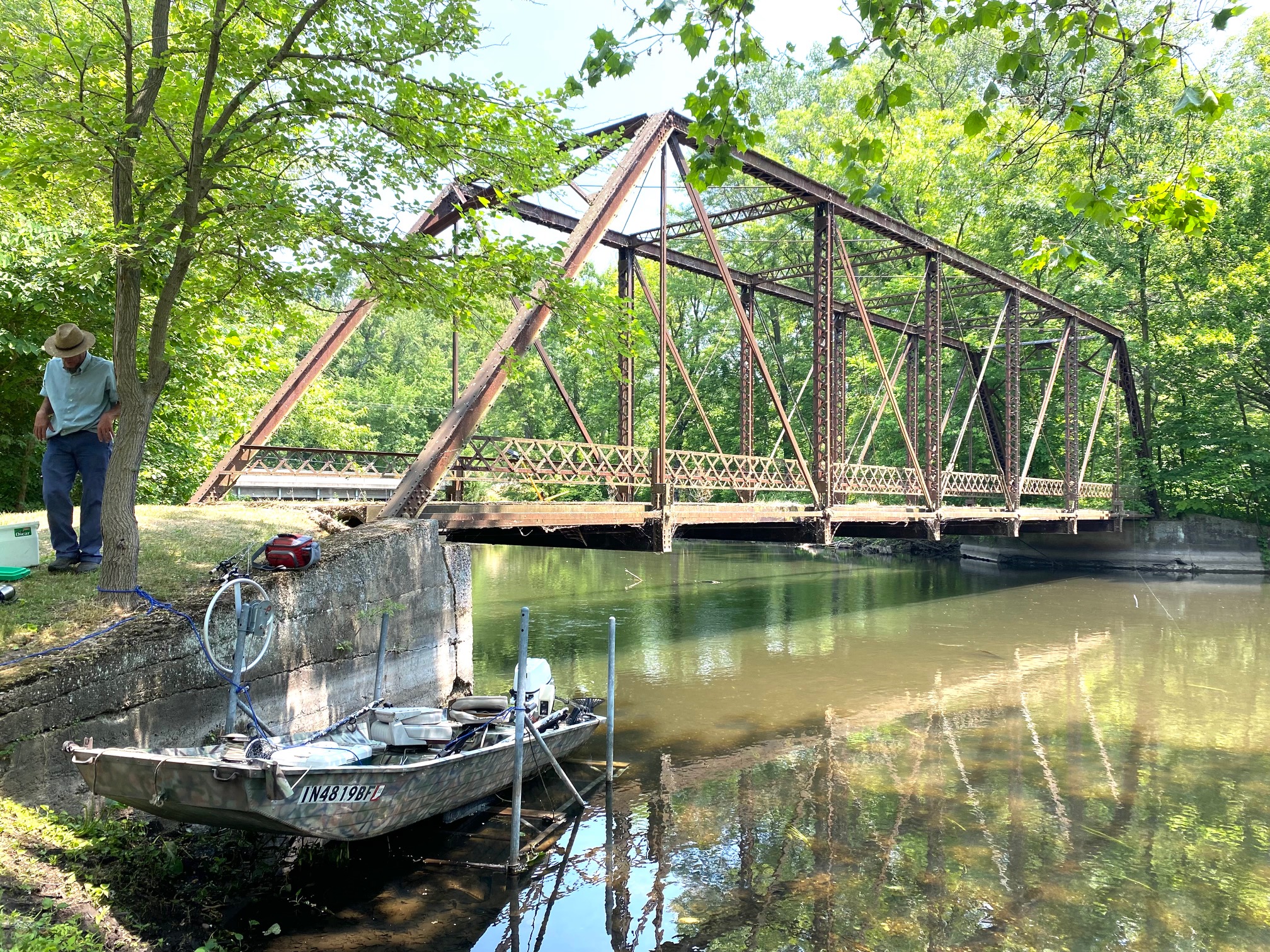
In leaving town and heading west on 120, I crossed the Pigeon River, a tributary of the St Joseph River. Just to the south of 120 is the old “Phantom Bridge,” the last remaining steel trestle bridge in LaGrange County. It has not been used in many years and leads into thick woods. I was able to find a path to the bridge and after walking across it, met a friendly Amish gentleman who was fishing for walleye and had pulled his boat up nearby.
This made my day, and I will head back down to Howe again for some more exploring!