


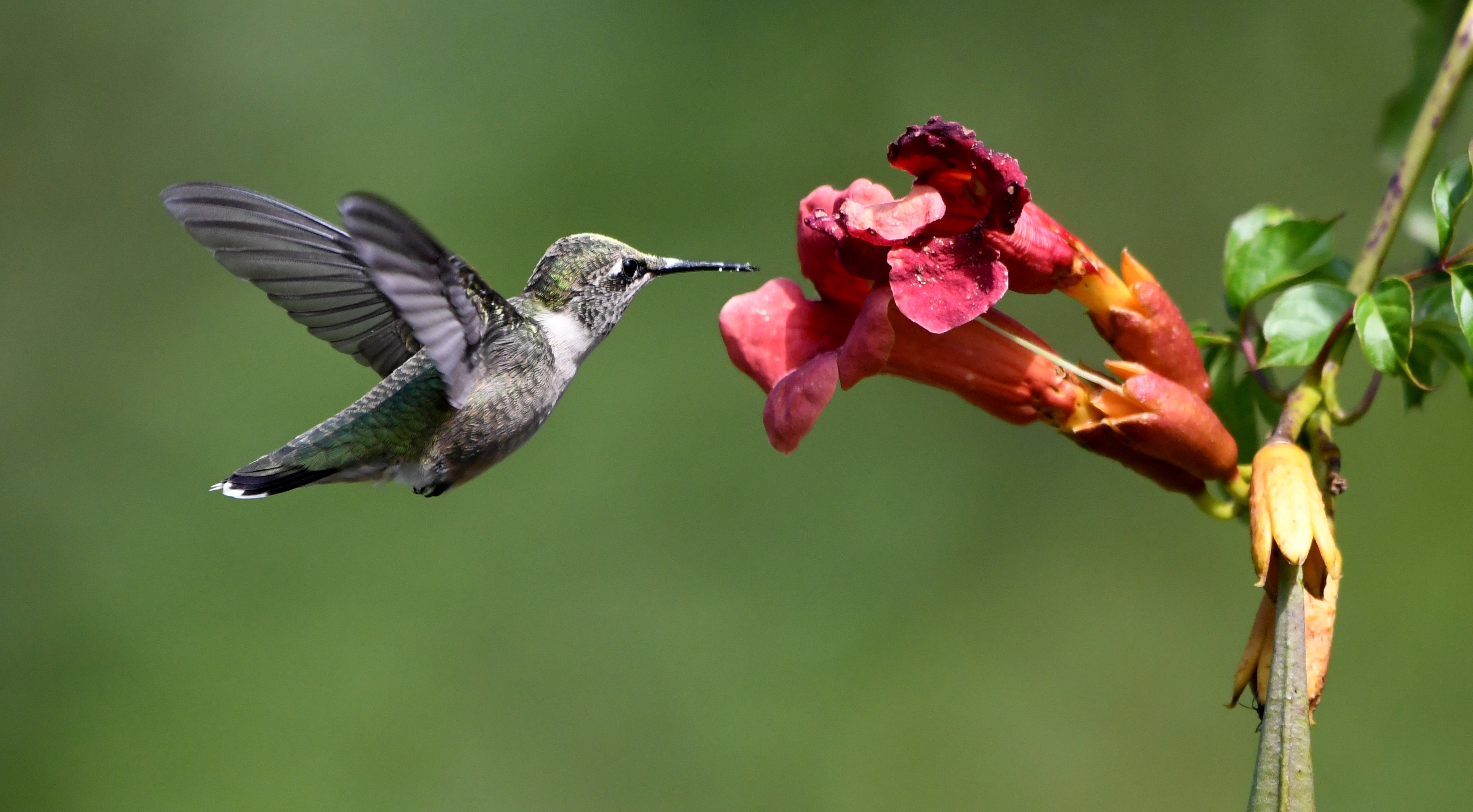
Every time I see a hummingbird, my heart skips a beat! It’s so tiny and so incredibly hardy that it’s impossible not to marvel at its very existence.
Ruby-throated hummingbirds only weigh about 2.5 grams, or the same amount as a penny! That’s hard even to imagine, particularly when you consider how far they have to migrate. Not all ruby-throated hummingbirds migrate, but the ones that do, travel to Mexico, Central America, the West Indies, and Costa Rica. Along the way, some of those birds will fly non-stop across the Gulf of Mexico, a distance of 500 miles!
To accomplish such an incredible feat, hummingbirds need to double their body mass before departure; or increase their weight from that of a penny to that of a nickel! They have to eat at least twice their weight in nectar and insects every single day, with half of their intake being sugar. Not an easy task!
By early August, some ruby-throated hummingbirds will begin their long, arduous journey south. We can help them prepare for that trip by having flowers they love in our yards and readily available hummingbird feeders at their disposal. Hummingbirds are particularly fond of red and orange flowers, especially those with a tubular shape that are easy to access—like trumpet vines! Other flowers that hummingbirds enjoy include salvia, lupine, columbine, begonia, milkweed, morning glory, bee balm, lantana, sunflower, four o’clock, and petunias.
Hummingbirds also love jewelweed, a plant that doesn’t typically grow in neighborhood gardens but can be found this time of year in areas that are both shady and damp. Jewelweed, also called “touch-me-not” (because the seed pods burst open and scatter the enclosed seeds when it’s touched), has small orange flowers and is widespread across the hummingbird’s range. The late blooming time of jewelweed (July-September) coincides nicely with the hummingbird’s early fall migration and provides valuable energy for its journey.
If you want to help the hummingbirds by hanging a feeder in your yard, make sure you use a mixture of one-quarter cup white granulated sugar (NOT powdered sugar) per cup of water. Stir the water to dissolve the sugar and never add food coloring. Then, to keep the sugar water from fermenting in hot weather and turning into toxic alcohol, make sure you change it every 3-5 days. You should also be careful about where you hang your feeder; some cats have learned to lie in wait for an easy snack.
It may take the hummingbirds in your area a few hours to several weeks to find your feeder but once they do, I expect you’ll have loyal and appreciative customers all season—and, perhaps, the next. Some hummingbirds return to the same locations and the same feeders year after year. Once they are acclimated to your particular feeder, they may actually learn to recognize you and remember you as a consistent source of food.
The ruby-throated hummingbird is the only hummingbird we typically see here in Michigan, but there are actually 15 different hummingbird species that regularly breed in the United States. To find the highest concentration and diversity of hummingbird species in the United States, go to southeastern Arizona where you’ll have an opportunity to find at least 13 different species. Or, better yet, go to Costa Rica where there are 54 species of hummingbirds!
In the meantime, start planning next year’s garden. There are so many flowers to choose from that hummingbirds love and, if you want to see these fascinating little birds right outside your window, put out a hummingbird feeder!
Enjoy!