



A quantum amplifier prototype.
A Vicksburg High School alum is making his home town proud after successfully landing on his feet in Colorado.
Logan Pauli, a 2012 VHS graduate, recently shared details about a company he helped found and how it recently raised more than $4 million in seed funding to accelerate development of its next-generation quantum amplifiers.
Will your high school classmates be surprised to learn you are involved in such a technical and difficult-to-understand career?
“Honestly, probably not. With all the AP classes, the science and band classes I took, the fact I am in the deep science of quantum physics will not. The start-up component might surprise a few people, though.”
How did you further your education after high school?
“I went to Michigan Technological University for four years, where I studied physics and computer science. I then moved to Baltimore for a year for a PhD program in physics, but ended up dropping out after a year due to poor performance – gifted yet lazy doesn’t work as a strategy in grad school. From there, I moved to Grand Rapids and got a job as a back-end software engineer for Farmers Insurance. I spent five years working within that field and started a contracting company. During this time, I also obtained an MBA from Grand Valley State University. In 2022, I moved to Colorado to get a master’s degree in quantum engineering from the Colorado School of Mines. I was a non-thesis master’s student with a focus in radio frequency hardware/electronics.”
Do your parents (Carl and Denice) understand what you do?
“Well, my explanations are usually met with a blank or confused look. But, after a little bit of conversation, I can simplify it down to a point where they say they can somewhat understand it.”
So, what, exactly, do you do?
“I’ll give an example that involves the operation of an electric guitar. You play a note; that induces an electrical signal and a chord, and that signal goes out to an amplifier. The goal of that amp is to take the small signal and make it louder and bigger but without distorting the sound. So, what the start-up that I’m doing does is, we build amplifiers. We take incredibly small electrical signals, like on the size of individual atoms, and we make them bigger in a way that you can actually read and detect them, while distorting the sound as little as possible. What we do, however, has nothing to do with audio, it’s all electrical. We take a small electrical signal and we make it a big electrical signal.”
People in what field benefit from your labor and expertise?
“The biggest market for us is quantum computers, which is much more sci-fi than a desktop computer. Someone in the 1990s realized if a computer can be built out of quantum-physics devices, they’re going to be so much more complicated but they can also solve much more complicated problems. In reality, no one has built a working quantum computer, yet. What we do is we sell parts that are used in these computers. Potential customers include IBM, Intel, Microsoft, which are all trying to build quantum computers, so we could sell them the parts to help them build quantum computers cheaper and faster.”
You were successful in securing financial help for Bifrost Electronics, the company you co-founded.
“Yes, Bifrost Electronics is a Colorado-based quantum startup that has raised $2.5 million in seed funding to accelerate development of its next-generation quantum amplifiers. While at Mines, I started the company with my friend, Connor. Initially it was just the two of us and an idea. We wrote a grant to the state of Colorado and got $56,000 as start-up money to develop a prototype. Quantum computing is a thing Colorado is trying to push right now, so people, at least in Denver, have usually heard of quantum computing despite not knowing anything about it.”
Do you have a goal? Like, is something big going to happen at some point and when that happens you’ve reached mission accomplished?’
“There are three ways this can go as a start-up.
A – Someone loves what we’re doing and they don’t want anyone else to have it, so they would buy our company and our technology, and we would walk away with a bunch of money.
B – If we just stay standardized and operating, and we just start selling devices to make cash flow and then pay dividends, then we can run this as a small company and make profit on it.
C – This one’s a little out there, but we make an initial public offering. We just get so big that eventually it gets put on the stock market.
Our long term goal is to be the biggest hardware supplier to quantum computing. Selling electronics to tens of countries and hundreds of companies. We’re starting with a single revolutionary device. But we’ve got an entire roadmap of different technologies we plan to release.”

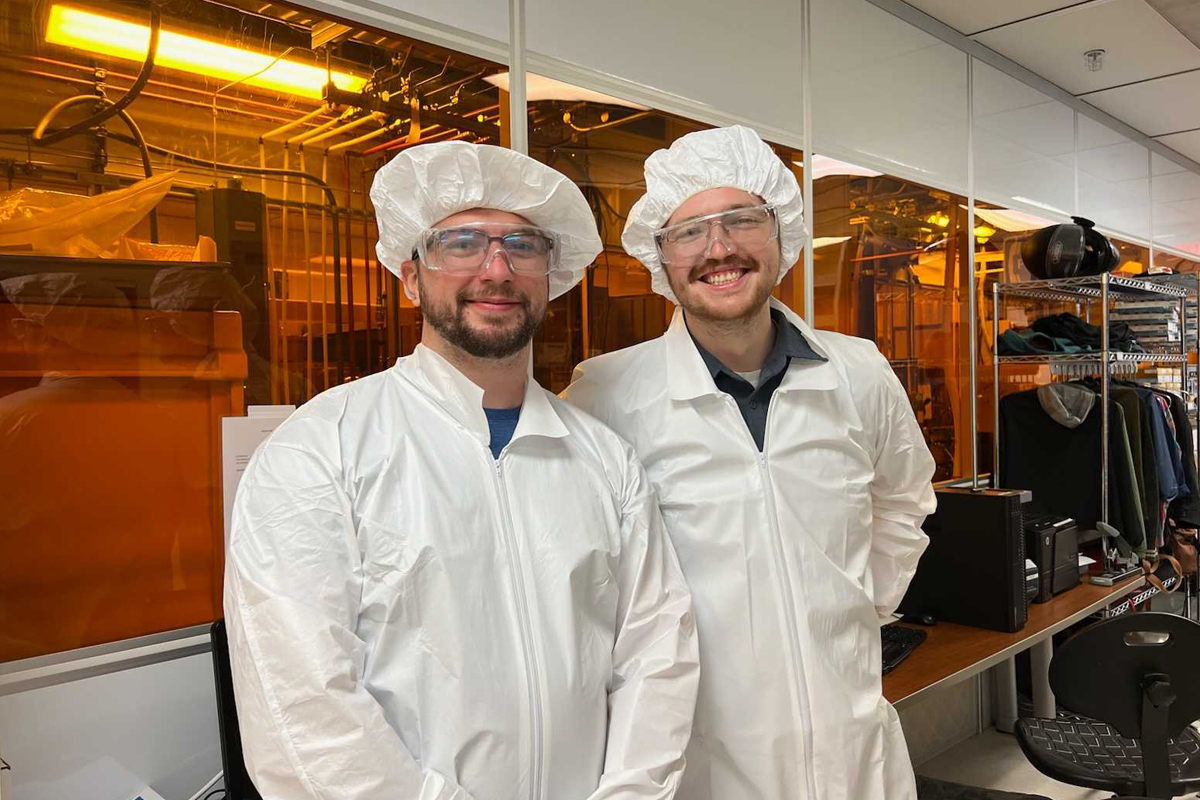
Logan Pauli.
Are any of these options likely to occur in the next six months?
“We still haven’t released any products yet; we’re still in the design, engineering and prototype stage. Within six months, though, we should have products out the door or right about to go out the door. Nothing is going to happen until that point because no one would buy us as a company if we’re not making products yet. An IPO would be years and years away, however, but I’m feeling pretty confident about our technology because everything we’ve tried so far works.”
Were you a fan of the TV show ‘Young Sheldon?”
“No, actually. But a group of German physicists eventually got me over my dislike of ‘Big Bang Theory.’”
Pauli, a four-year band student who cited director Ben Rosier as a teacher who had a strong impact on him, lives outside Boulder, Colorado.