

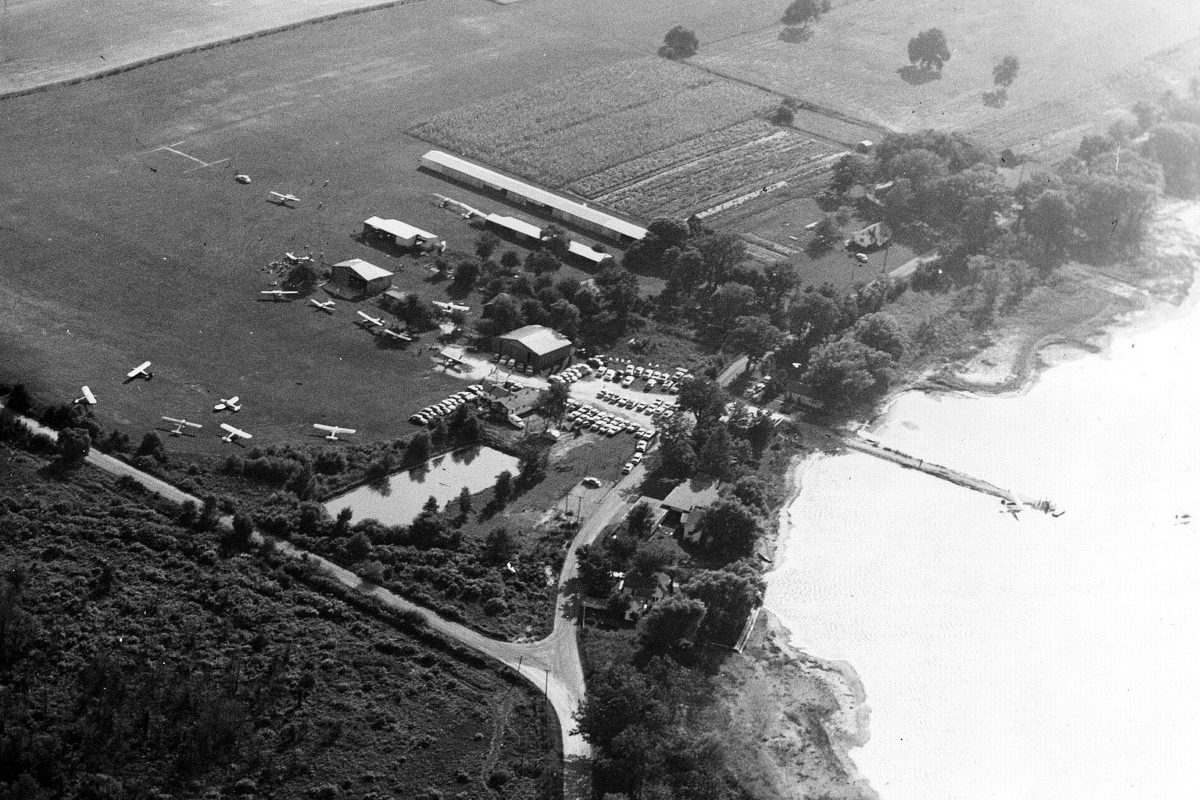
An aerial view of Austin Lake Seaplane Base, circa 1955. Photo courtesy of Vicksburg Historical Society.
Moses Austin became the lake’s first white settler in 1833. He erected a log shanty for living quarters and established a tavern and store. Austin’s business venture quickly became popular, and soon the lake was referred to as Austin’s Lake, which later changed to Austin Lake. The population around the lake gradually grew to include several farms and a station stop for the north-south Grand Rapids & Indiana Railway.
By the mid-1920s, Alfred Woodhams owned 200 acres at the south end of the lake. He and his sons, Irving and Francis, developed the land into a successful farm but Irving wasn’t a farmer. He had become fascinated by the important role airplanes played in World War I. While the Wright Brothers flight at Kitty Hawk took place in 1903, it wasn’t until American military pilots came home from the war that the idea of using aircraft for civilian purposes grabbed the public’s imagination.
Returning pilots understood from their first-hand experience that airplanes possessed the potential for more than military use. But how could they convince the public? Many of the pilots wanted to keep flying, so they bought their own planes and made a living for themselves by putting on flight demonstrations at events sponsored by cities and towns.
One such event was held in Vicksburg in 1919. According to the Vicksburg Semi-Weekly Commercial, a World War I veteran by the name of Faucett along with his mechanic flew a “Curtiss Aeroplane” into Vicksburg, landing in a “…field owned by H. O. Kern at the east end of Rose Street, three blocks east of Union Depot.” From this improvised airfield Mr. Faucett offered anyone interested the opportunity to take to the air for a 15-minute flight for $15. The passenger could choose where he wanted to go – and most wanted to fly over their farm, hence the term “barn storming” became a name linked to these pilots who participated in similar events.
But back to Austin Lake and the Woodhams family: Irving didn’t take his first airplane ride until 1924, but when he did, he was hooked. He bought a plane, started taking flying lessons in early 1925 and received his pilot’s license in the fall of 1926 – a license signed by Orville Wright, then chairman of the National Aeronautical Association.
By 1918 the United States Post Office was shipping mail by air, and thanks to events like the one in Vicksburg people were beginning to be convinced airplanes would eventually offer a safe and comfortable alternative to rail travel. Not wanting the Kalamazoo area to get left behind, a group of aviation enthusiasts, including Woodhams, began promoting the idea of building a local airport. The idea caught on, and in May of 1926 the City of Kalamazoo bought 383 acres near Portage and Kilgore Roads. Lindbergh Field Airport was completed in 1928. It was granted Michigan Airport License No. 1, though its name was soon changed to the Kalamazoo Airport, and in the early 1930s Irving became its manager.
But in 1939 he decided to develop his own airfield on a portion of the family farm. Known as Austin Lake Seaplane Base, it was a site for small aircraft equipped with pontoons, wheels or skis. The airport encompassed the area north of Mandigo Road and west of 23rd Street, part of which contains a Bex Farms LLC housing development today.
Irving’s brother Francis joined the venture as a mechanic while continuing to operate what was left of the family farm. Irving’s wife Dorothy also became a commercial and private pilot. In addition, she ran the office, raised their daughter Sharon, and helped in all aspects of the day-to-day operation of the facility. She also participated in the promotional Women’s Air Derby which began in 1939 and later became known as the Powder Puff Derby, a national event that inspired many women to become pilots.
In 1940 Civilian Pilot Training started at Austin Lake airport, followed by the Navy V5 Program. Hundreds of future pilots started out there later completing their advanced training with the military. World War II ferry pilot Sue Parish learned to fly from Irving in 1942. Eloise Smith, who learned to fly from Irving during his tenure at Kalamazoo airport, went on to train Navy amphibian and seaplane pilots during World War II. Irving was also active during the war with the Civil Air Patrol and retired as a lieutenant colonel. After the war, Eloise worked as a flight instructor at Austin Lake Airport until the Woodhams retired in 1963, when she moved her business to the Kalamazoo field. Other owners of the Austin Lake Airport came and went over the following years until it was permanently closed around the end of 2000.
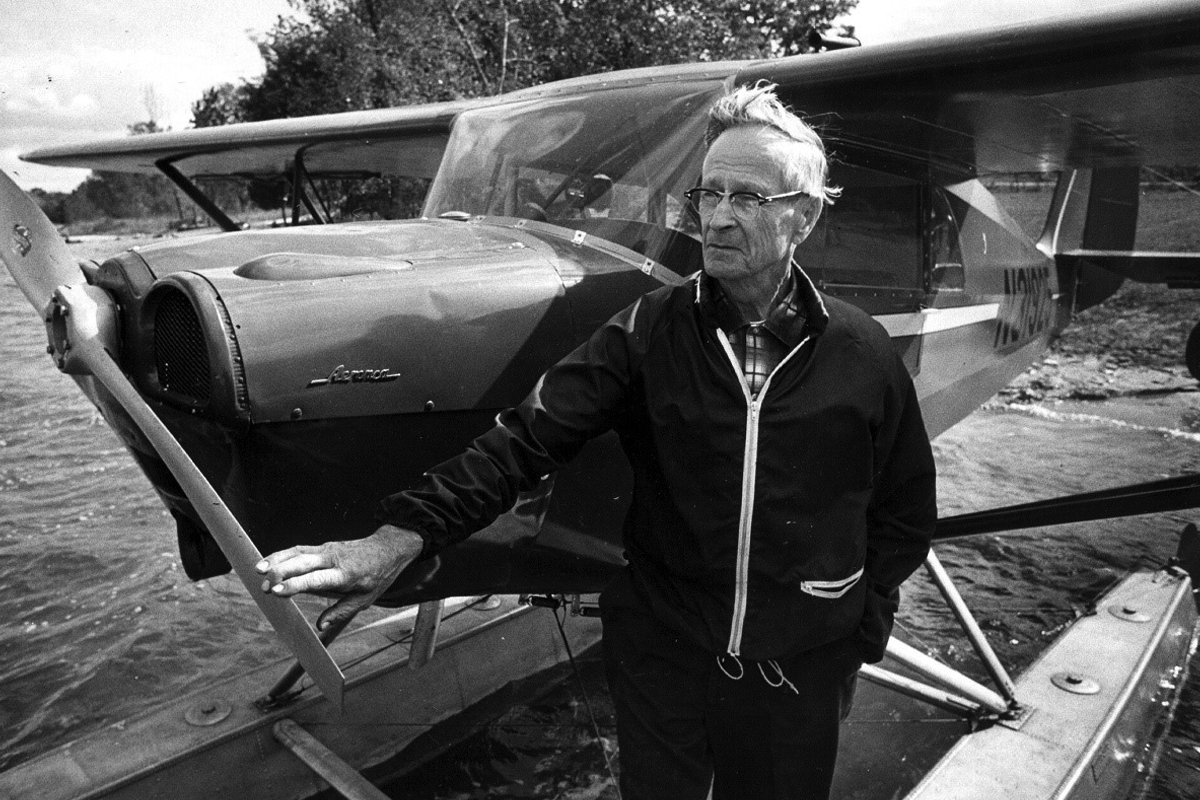
Irving Woodhams flew for 60 accident-free years, accumulating over 14,000 hours – all in small airplanes. He held Commercial License Number 790, with multiple ratings as a pilot, flight instructor, mechanic and FAA examiner, among others.
All that remains of the airport are a few steel buildings once used as hangars or storage sheds north and west of the housing development. A Facebook page administered by Zach Joseph includes photographs of these remaining buildings. What was left of the original Woodhams’ farm has now also been developed into housing, and the name “Woodhams” is now mostly associated with the residential street bearing the name.
But history DID happen on the shores of Austin Lake.
Irving Woodhams died in 1993 and is buried at Mount Ever-Rest Cemetery.