

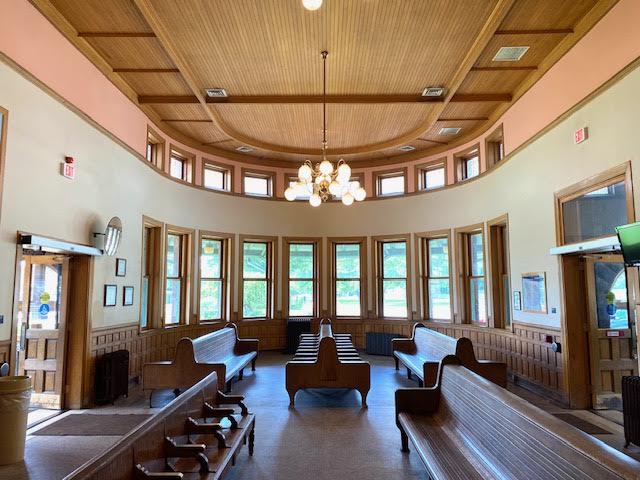
The historic Niles train station.
Recently I jumped in my car and headed southwest through Marcellus, Thompson’s Corner, Volinia, Summerville, Pokagon, Dowagiac and Niles.
My first stop was in Marcellus, whose first settler in the area was John Bair, who came in October 1832. Early on, the citizens wanted to call it Cambria; however, on June 16, 1843, the township was officially named Marcellus after the Roman emperor, Flavius Marcellus.
In the winter of 1870-71 the Peninsular Railroad came through Marcellus, adding new life to the small township. A depot was built, and by 1911, ten passenger trains stopped at the depot every day.
In the early 1880’s Marcellus had grown to include: 2 churches, 3 dry goods stores, 3 groceries, 2 drug stores, 2 meat markets, 2 hotels, a bank, 2 harness shops, a hardware store, a furniture store, a restaurant and a newspaper. During its heyday, Marcellus was also home to two theaters, a bowling alley, and a pool hall.
Just west of Marcellus is Thompson Corners, a small spot at the corner of Marcellus Highway and Lawrence Road with a few old buildings and Volinia, at the intersection of the Marcellus Highway and Gard’s Prairie Road.
Further west is the 580-acre Fred Russ research forest and Newton Woods, named after George Newton. Newton’s Victorian mansion (George Newton House) survives on the Marcellus Highway near the woods and was named as a registered Michigan Historic Site in 1974. It is open May-September 1-4:30 p.m. the first Sunday of each month.
I continued on along Dutch Settlement Road to Dowagiac. The name comes from a Potawatomi word meaning “fishing near home and water” and it is the headquarters of the Pokagon Band of Potawatomi Indians. It was incorporated as a city in 1877.
Dowagiac was also the final destination for the first group of orphans brought to the Midwest from New York City on the Orphan Train in 1854. The 45 children arrived in Dowagiac on October 1, 1854.
Dowagiac gained national attention in June 1964 after police began investigating multiple reports of what became known as the Dewey Lake Monster. The story gained national attention after local residents reported seeing a large, hairy creature with glowing eyes. Police searched the area of the alleged sightings and found nothing. However, reports caused curious thrill-seekers and monster-hunters to besiege the community that summer.
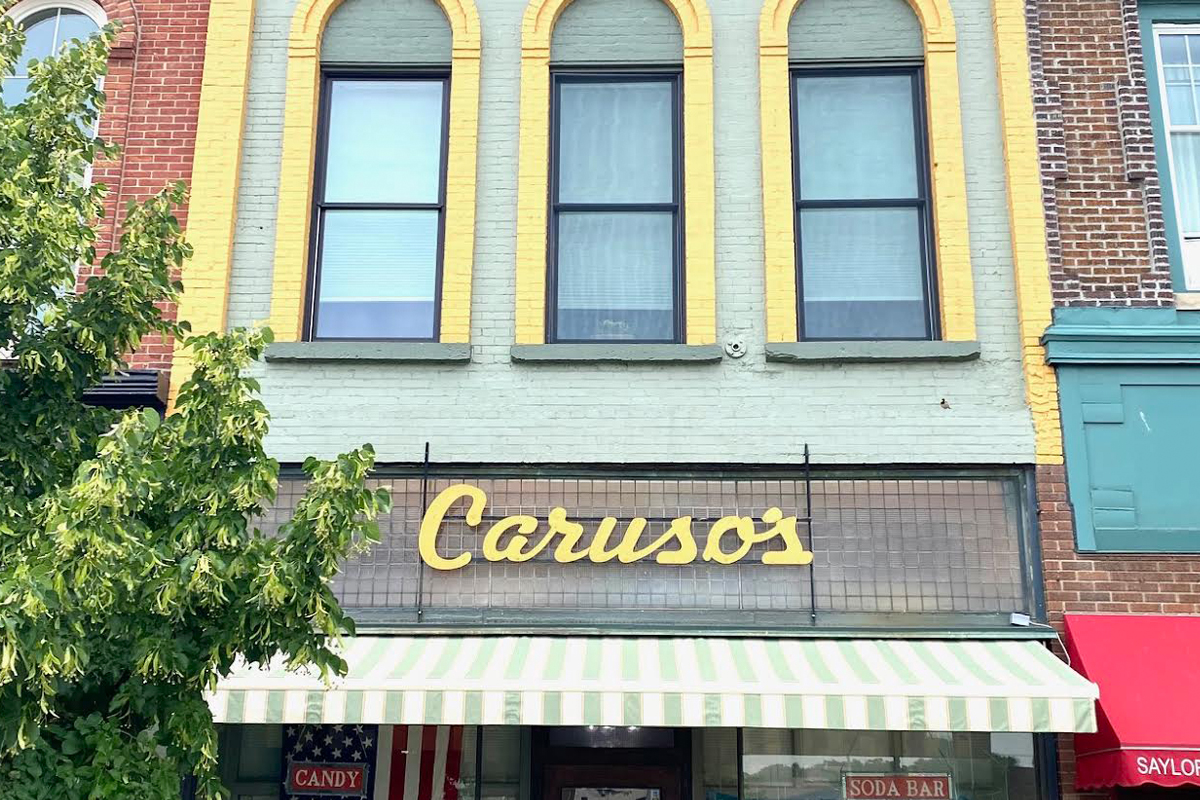
The town has many wonderful businesses to explore, including Caruso’s Candy and Soda Shop, which is family owned and operated since 1922. A visit to Caruso’s is like stepping back in time. I had a nice chat with third-generation owner, Julie Johnson.
Popular downtown restaurants include Wood Fire Trattoria, Oak and Ash Barbecue and Catering, and The Wounded Minnow, located in a classic old building with Heddon fishing lure displays.
James Heddon is credited with the inventing of the first artificial fishing lures made of wood in the late 1890s. The Heddon Company was founded in 1902 to sell the lures, originally made by hand in the Heddon family kitchen. In 1904, Heddon built a large factory in Dowagiac. By 1950 the Heddon brand name was very well known and also made rods, reels and other fishing gear. The company was sold many times and now many of the popular lures (Meadow Mouse and River Runt) are manufactured by EBSCO.
Vintage Heddon lures are highly sought after and Dowagiac now has the Heddon Museum with more than 1,000 lures, 140 reels and 150 rods on display, including an original James Heddon frog, one of the most sought-after of all collector lures.
I love bookstores and was happy to see Olympia Books that I stopped into 20 years ago, still in town. They specialize in used and rare books.
Dowagiac is also home to several prominent old houses including the Lee Mansion that resembles a European castle surround by a stone fence.
Niles was my next stop, which is a city in Berrien and Cass counties near the Indiana state line.
Niles lies on the banks of the St. Joseph River at the site of the French Fort St Joseph which was built in 1697 to protect the Jesuit mission. After 1761, it was held by the British and was captured in 1763 by Native Americans during Pontiac’s Rebellion. The British retook the fort and it served as a trading post. During the Revolutionary War the fort was held for a short time by a Spanish force. The occupation of the fort by the four nations of France, Britain, Spain, and the United States has earned Niles the nickname “City of Four Flags”.
Harnessing the power of the St. Joseph River led to Niles’ industrial development. In 1871, work was completed on the first permanent dam.
The Niles train station was built in 1892. This classic station, listed on the National Register of Historic Places. was used as a filming location for “Continental Divide”, “Midnight Run” and “Only The Lonely”.
The Riverfront Park in Niles stretches about a mile and a half along the St. Joseph River. Many festivals and events along the river include the Niles Riverfest, the Bluegrass Festival and the Hunter Ice Festival.
The Saint Joseph River Park, which includes part of the original Fort St. Joseph is being excavated by archaeologists from WMU. In the summer they host an “Open House” that allows patrons to visit the dig site and see displays of some of the artifacts.
I spent some time walking around downtown Niles admiring the old buildings, stopping in two of the large antique malls and had a great grilled chicken wrap with sweet potato fries at the Niles Cafe.
There is great history in this part of the state, and it was well worth the trip.