

A six-community fire-fighting association is now down to four members.
With the April 1 departure of Brady and Wakeshma townships from the South Kalamazoo County Fire Authority, the new-look agency is moving forward with Prairie Ronde and Schoolcraft townships, and the villages of Schoolcraft and Vicksburg as its remaining members.
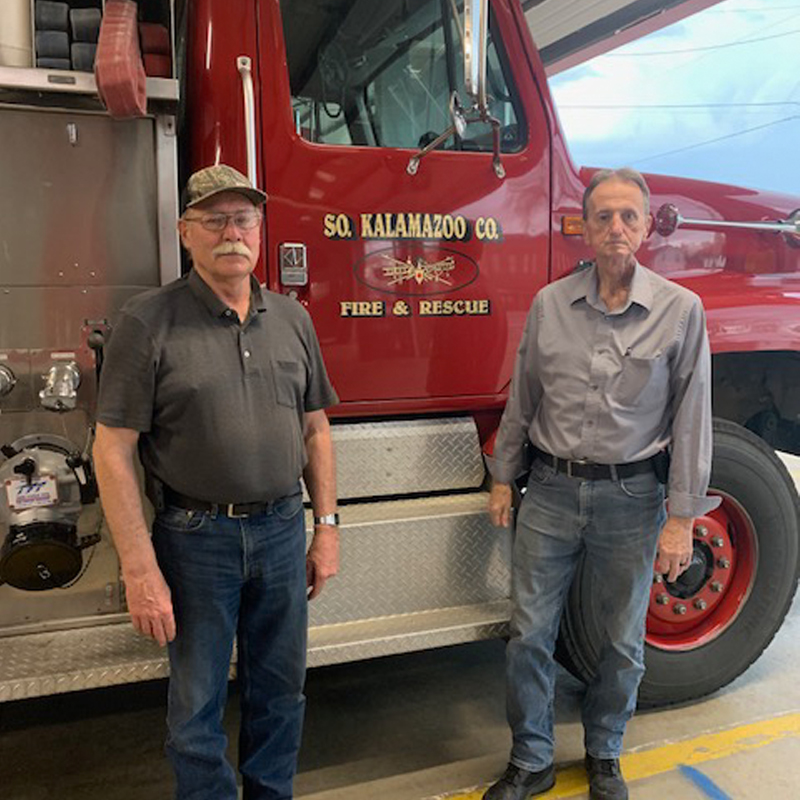
The authority’s board chairman, Mike Tomlinson, and Chief Tracy McMillan recently sat down with South County News to discuss what the changes mean and what impact, if any, they will have on the remaining four entities.
South County News: How did the subtraction of two entities unfold?
Tomlinson: “According to our articles of incorporation, we require 12 months advance notice from any partner if they plan to leave the authority. So, back in early 2025, Brady Township was first to notify us, then Wakeshma followed maybe a month or two later.”
SCN: Were you blindsided by Brady and Wakeshma pulling out of the alliance?
Tomlinson: “Ultimately, Brady had conversation with Pavilion Township and thought that Pavilion could provide fire service to Brady for a better price. Wakeshma turned to Climax Township Fire Department and felt that was a better fit.”
SCN: What is the history of SKCFA?
Tomlinson: “What drove it was having Vicksburg and Schoolcraft (villages), and then having Schoolcraft Township left hanging in the middle. They were being covered by two village fire departments. Eventually, a guy named Bob Thompson asked if we’d be interested in forming as a group. He got in contact with Michigan State University, and with guidance from MSU, we all sat down and talked for six months, and put together the authority, the bylaws and how our payment structure would work. That structure is still in place today.”
Tomlinson said the agency’s original lineup did not include Wakeshma Township. It was included, however, at its request when SKCFA was established.
Tomlinson, representing Prairie Ronde Township, said he is one of the few people still involved in SKCFA from when the agency was established in 1999.
SCN: It sounds like Wakeshma was an afterthought, initially.
Tomlinson: “Wakeshma came forward after all the organizational part of this took place and asked if they could be a part of it. Some of that conversation centered on the fact Wakeshma didn’t have a lot of money, it had manpower issues, equipment issues and they had to come up with $10,000 to upgrade their turnout gear before we would accept them in the authority. The rest of us didn’t feel it was fair to have to buy them new turnout gear. They had everything to gain and nothing to lose, otherwise.”
SCN: So, were there any hard feelings when Brady and Wakeshma came forward last year and stated they were planning to opt-out?
Tomlinson: “No, absolutely not. We had no issues, we didn’t ask them to leave. They followed the articles of incorporation. There was a path created when we put this whole thing together and they followed it.”
Tomlinson said another bylaw within the original compact required that an agency that exits the authority also leaves behind its equipment to the authority, and that equipment stays with the authority.
“It was a very up-front departure. We still talk, we’re still on friendly terms and we acted as a six-member board all the way through the adjournment of our March meeting,” he said. “Everybody left our last meeting with a smile, a handshake and a piece of pizza.”
SCN: Are all finances in order, or does Wakeshma or Brady have an outstanding balance to the authority?
McMillan: “Three years ago, we ordered a new truck. We’re getting it June 16, and it’s paid off and everything. Had the language not been in there, they could have left and we would have been stuck paying for it as a four-way entity. As it is, they had to pay their share of it. The only benefit they will ever get out of that truck would be in a mutual-aid situation.”
The truck came with an $850,000 price tag, Tomlinson said.
SCN: How much were Wakeshma and Brady paying annually into the authority?
Tomlinson: “Wakeshma? Maybe $80,000-$90,000. Brady? Maybe about $170,000 a year. But what you need to understand is even though we don’t have their financial input, we no longer have to respond to calls there.”
Furthermore, Tomlinson said after the new truck arrives, SKCFA will be in a position to sell some of the equipment turned in by Wakeshma and Brady, helping out the authority’s bottom line.
“Probably six or seven months into our new year, we’ll know where we’re at because all that cost (related to coverage of Wakeshma and Brady townships) is gone. Yes, we’ve lost the revenue, but we’ve also lost the cost of servicing those two townships. Financially, we’re well aware there’s a fixed overhead; we’ve got buildings, we’ve got trucks. But equipment-wise and personnel-wise, it’s almost the same to take care of what’s remaining as it was before. We’ve cut our service area in half.”
McMillan said about one-fourth of the agency’s calls annually came from Wakeshma and Brady combined.
SCN: For residents in those entities that are left, will there be any noticeable changes to service, taxes or anything else?
Tomlinson: “Service is not going to change. Absolutely not. Now, that’s not to say there’s never going to be a change in the money that’s needed to continue operating at our current level. But for now, we feel we’re in an excellent spot all the way around.”
SCN: What is your annual operational budget?
Tomlinson: “We’re right around $800,000. But that should come down a couple hundred thousand dollars. Our personnel is right around 30. They are paid-on-call positions.”
On an unrelated note, Tomlinson said he would like to see cadets, aged 14 to 21, consider working with SKCFA’s Explorer program to eventually deepen the agency’s pool of employees.
SKCFA Board meets at 6 p.m. the third Wednesday of the month at the ambulance building just north of Sunset Lake Elementary.