


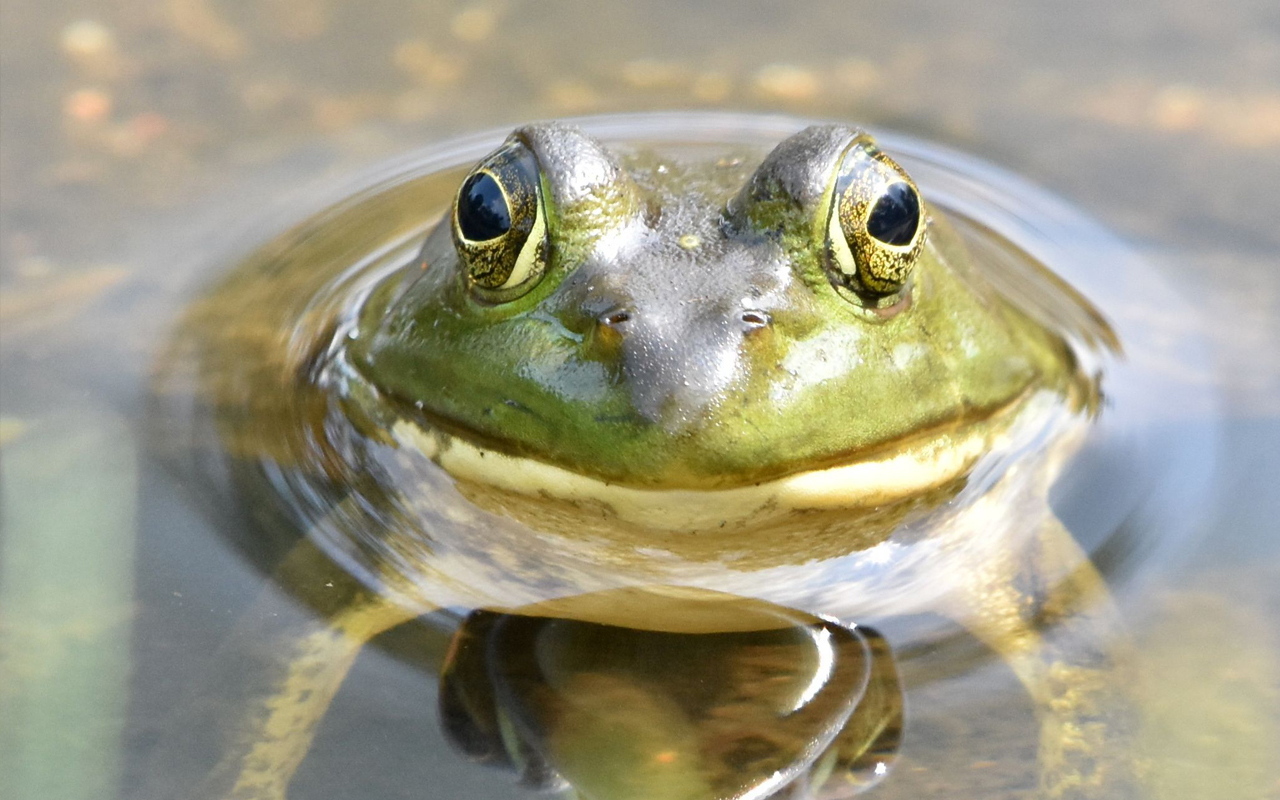
The American bullfrog is, hands down, my favorite amphibian. Just look at those big, beautiful eyes, and that captivating smile! What’s not to love?
This favorite amphibian of mine will be looking for love soon; bellowing out loudly across the ponds, making its presence known, hoping to attract a mate. But only the boys will be making the noise.
The sound of a bullfrog is most often described as “jug-o-rum, jug-o-rum” and is so loud that it can sometimes be heard from a mile away! In more precise terms, that mating call has been recorded at a booming 119 decibels; as loud as a chainsaw, a leaf blower, or a high-volume rock concert!
The girl frogs will be listening carefully. They’ll be choosing a mate based on the acoustic quality of that call; preferring the louder, faster, deeper-pitched sounds that belong to a healthier, more genetically superior male.
The whole process is a bit like “speed dating.” The males gather in large, noisy groups called choruses, with the most dominant male holding the prime, central location in the pond. The females then spend their evenings navigating through the chorus of males before choosing a partner to engage in the “mating embrace.”
Once the frogs have paired up and “lovemaking” begins, the female will lay 10,000-25,000 eggs at a time and disperse them as a large floating mass on the surface of the water. Surprisingly, only a few of those eggs will survive to adulthood. Most of the eggs, plus the developing tadpoles and froglets, will become food for herons, turtles, snakes, fish, and even the bullfrogs themselves!
Bullfrogs are highly cannibalistic creatures who not only eat their own young, but virtually anything else they can catch and swallow, including small rodents, ducklings, turtles, snakes, insects, and baby muskrats!
Frog dating and cannibalism aside, I find it particularly interesting to note all the different ways in which the word “frog” has become embedded in our language to describe various human conditions!
Take the idiomatic expression “mad as a box of frogs”; a British saying that was popularized in the 1990s to describe someone who was utterly chaotic, irrational, or insane. The phrase paints a vivid picture of a box full of jumping, unpredictable frogs to represent a frenzied, disorganized mind. I can relate to that!
Or what about the odd directive to “eat the frog;” a phrase often attributed to Mark Twain, but should be credited to Nicholas Chamfort, an 18th century writer, who got the ball rolling with this missive: “A man must swallow a toad every morning if he wishes to be quite sure of finding nothing more disgusting for the rest of the day.” At some point in history, the word “frog” was substituted for the word “toad” and the directive was shortened to just “eat the frog.” The phrase gained popularity as a time-management strategy with the book “Eat That Frog!” by Brian Tracy in which the word “frog” is defined as your biggest, most important task—the one you dread more than anything else. By tackling that job first, you eliminate the worst possible thing of the day.
Have you ever seen someone “frog marched”, or forced to walk forward while their arms were being held tightly behind their backs? How does this “perp walk” have anything in common with frogs?’ The phrase originated in 19th-century London when police officers carried drunken or resisting prisoners face-down, with each of four officers holding on to a different limb. To some observers, the prisoner being carried resembled a splayed frog, and the term “frog march” was born. The carrying technique was extremely painful and subsequently replaced with the walking version we know today but the descriptive phrase remained.
There are many more interesting and humorous frog expressions in the English language, but I’ll leave you with just one more: “boiling the frog”; a metaphor about failing to react to a slow, gradual crisis until it is too late. It describes how a frog, placed in a pot of lukewarm water that is slowly coming to a boil, fails to perceive the danger until it can no longer change the outcome. The story serves to depict a problem that is slowly becoming worse but without anyone taking notice and is often used to describe political, environmental, or corporate mismanagement.
In today’s global environment, if we slowly adapt to each minor increase in temperature without taking heed, we are the frogs in the pot as our environment slowly becomes uninhabitable.
Don’t be that frog!