The Vicksburg Foundation launched “In Support of Community: The History of the Vicksburg Foundation” on May 3 at the Vicksburg Community Center. This book explores the history of the Foundation in context to the community it serves.
Those gathered at the event included the Foundation trustees, author Leeanne Seaver, and community leaders who contributed stories and photos for the book. Remarks by Seaver, Foundation President Rudy Callen, and former president Bill Oswalt, a trustee since 1978, were followed by a reception featuring food from Mackenzie’s Bakery and drink from the Distant Whistle.
“The people of South County were so incredibly helpful in making this historical documentation a reality,” Callen said. “The Vicksburg Foundation is made up of people volunteering their time and skill sets in support of this community. This book is about that community. My hope is this book stands alongside ‘Water over the Dam’ and ‘A Tale of One Village’ as the years pass.”
“In Support of Community” will be available for check-out at area libraries including Vicksburg and Schoolcraft, or for on-line purchase at Amazon.com. It can also be purchased at the Vicksburg Historical Society in Vicksburg’s Depot Museum (cash only) with all proceeds going to that organization.
First of all, let me be honest with you. Not one speck of research was done by me for this article. I simply picked up an old issue of Antique Week and there it was – the answer to several linguistic questions bugging me for years, explained right there in an article from an Ohio genealogical association.
I had always wondered why we say certain things. Where did sayings and terms like “chew the fat” or “upper crust” originate, anyway? We all know what they mean today, but where did these sayings come from? I just knew the answers were buried somewhere in history – and this article explained ‘em all!
Since early America’s roots are firmly planted in European soil, it’s no wonder the true origins of many common sayings came over on the boat along with our ancestors, some as early as 1500. And, if the explanations for them are accurate, they give us a little glimpse into their daily lives in another time and place.
“Don’t throw the baby out with the bath water.” Now we use that phrase to caution someone not to get carried away and do something that will spoil everything else. But in an earlier time, the meaning was much more literal. Families took their yearly baths in May, filling a big tub with hot water to be shared by all. The men had the privilege of bathing first, followed by the women, followed by the children. Babies were bathed last. By then, of course, the water was so dirty you probably COULD lose someone in it, thus the caution: Don’t throw the baby out with the bath water.
“It’s raining cats and dogs.” Many early European houses had thatched roofs – thick straw, piled high on the roof timbers. The roof provided a relatively warm hideaway during cold weather, so all the dogs and cats (and rats and mice) in the area tended to hole up in the roof. When it rained, the thatch would become slippery, and occasionally a cat or dog would slide off the roof, and it would rain cats and dogs. Things could fall THROUGH the roof as well, posing a real problem in the bedroom where bugs and other droppings could really mess up a nice clean bed. Eventually someone came up with the idea of making a bed with tall corner posts from which a sheet could be draped over the top. And there it was – the beginnings of the four-poster bed with canopy.
“Chew the fat.” Most of us recognize this phrase as meaning to sit around and talk for awhile, but why chew fat? Why not chew the bread? In a very early day pork was expensive, and hard to come by for the common man. Since it was a sign of prosperity to have quantities of pork on hand, when guests came over sometimes the host brought out a hunk of bacon and hung it up to show it off, sort of like an expensive painting or a hunting trophy. It was a sign the man of the house could really bring home the bacon. The host cut a little off his hanging trophy to share with his guests, who would then sit around and chew the fat – ugh!
“Upper crust.” Bread, like bath water, was allocated according to status within the family. Workers or servants received the often-burned bottom of the loaf, the family ate the middle portion, and any guests present at the table got the top portion, or the upper crust.
“Saved by the bell.” We have all been saved by the bell – but not THIS way. When England was starting to run out of suitable places to bury their dead in the 1500s, the decision was made to dig up previously interred coffins, place the bones in a house designated for that use, and reuse the grave when needed.
However, in re-opening these coffins, one out of 25 were found to have scratch marks on the inside, suggesting that just maybe these unfortunates had not really been dead at the time of their burial. To avoid this kind of mistake in the future, they began tying a string to the wrist of the supposed corpse, running it up through the coffin and through the ground and then tying it to a bell. Someone was hired to sit out in the graveyard the night after a burial to listen for the ringing of the bell. While working the graveyard shift, he might hear a bell tinkle, meaning that someone’s life was about to be saved by the bell. If no sound was heard, well, the buried corpse was obviously a dead ringer.
Is any of this really true? Who knows? However, it does make one feel pretty sure that while its lots of fun to look back on the “good old days”, maybe they weren’t all that good after all.
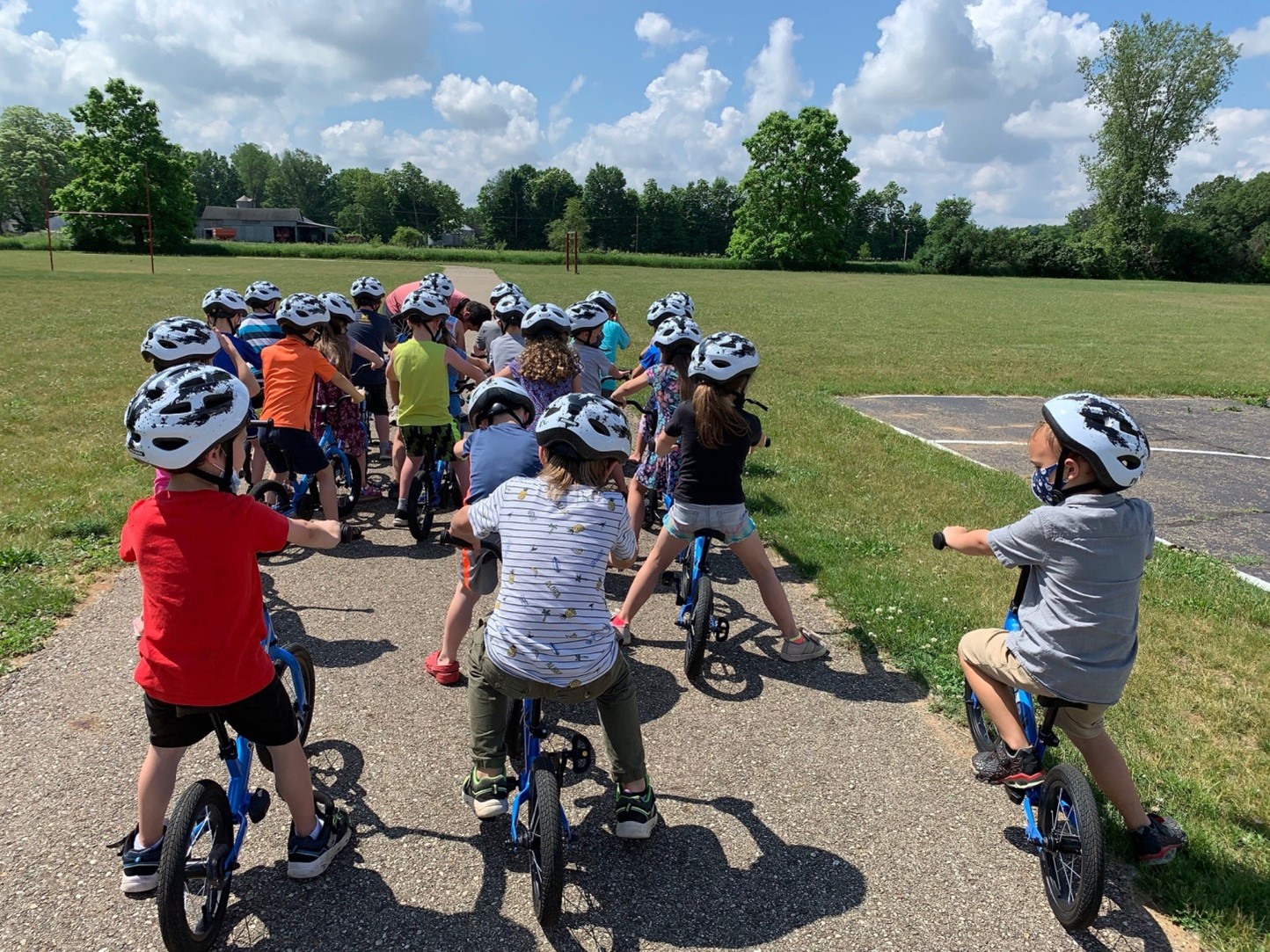
Kindergarteners at Indian Lake Elementary School in Vicksburg get ready for a ride in 2021. Photo by Paul Selden.
Inspired by the success of the All Kids Bike Kindergarten PE program in Vicksburg schools, neighboring Climax-Scotts and Schoolcraft school districts have received funding from The Vicksburg Foundation to bring the program to their elementary schools as well.
The innovative program includes an eight-lesson curriculum, PE teacher certification, 25 balance bikes with pedal conversion kits, helmets and support for five years from the Strider Education Foundation. The program can be conducted entirely on school grounds or inside a school gymnasium.
“This will especially benefit many of our students and their families who may be struggling during these unusual times,” said Superintendent Doug Newington of the Climax-Scotts district. “It would be great to provide the opportunity for all of our kindergarteners to learn to ride a bike. It will benefit them for the rest of their lives.”
Schoolcraft Superintendent Rick Frens agreed. “All Kids Bike is an incredible way to teach our students a life-long healthy hobby at an early age. Riding a bike is a great way to stay active and enjoy being outside, and our kids need healthy habits more than ever. Bike riding is also a fun family activity.”
Bike Friendly Kalamazoo is acting as the area’s local fund raiser, helping schools apply for grants and raise the money from local supporters. “The program will help our most precious resource learn to ride safely, and give them a fantastic opportunity to exercise, as well,” said Bill Adams, Bike Friendly’s vice president and chair of its fundraising committee.
Vicksburg PE teacher Sawyer Duncan was one of the first to implement the program in Michigan, in 2021. “While riding a bike seems like a skill that everyone learns, that is not always the case. This program teaches students balance, coordination, perseverance, bike riding and safety. As Bike Friendly Kalamazoo’s Education Chair, my goal is to spread this program to area elementary schools so that every student in greater Kalamazoo knows how to ride a bike safely from a young age.”
Vicksburg Superintendent Keevin O’Neill praised the program. “The All Kids Bike program was easy to integrate into our physical education curriculum and is relatively easy to adopt in any school that has a playground, indoor gym, or safe space in a parking lot. Most importantly, the students thoroughly enjoy the program.”
Information about Bike Friendly Kalamazoo’s All Kids Bike Kindergarten PE Program will be updated at bikefriendlykalamazoo.org. The organization is a 501c3 Michigan nonprofit organization whose mission is to help make the greater community even more bicycle friendly.
The Hays as seen on their wedding day and 50 years later.
Larry and Karen Hay of Vicksburg recently celebrated their 50th wedding anniversary in the Outer Banks, N.C., with their children. Karen Tuttle and Larry Hay were married April 6th, 1972 in Kalamazoo. Larry is a 1969 graduate of Three Rivers High School, a Vietnam veteran who retired from the Marine Corps and GM/American Axle. Karen is a 1971 graduate of Vicksburg High School. She was a full-time mom and worked briefly at Three Rivers Library. Their children are Jason, who teaches in Vermont and has a daughter Amili; Mathew, an information technologist who lives in New York with wife Kate and daughter Rosalyn; Sarah, a dental assistant who lives in Three Rivers with husband Matt Montcalm and sons Matthew and Brody; Amanda, who lives in Athens and has a daughter, Madison Tulla, and a son, Austin Hay. Amanda’s husband was the late Kurt Austin.
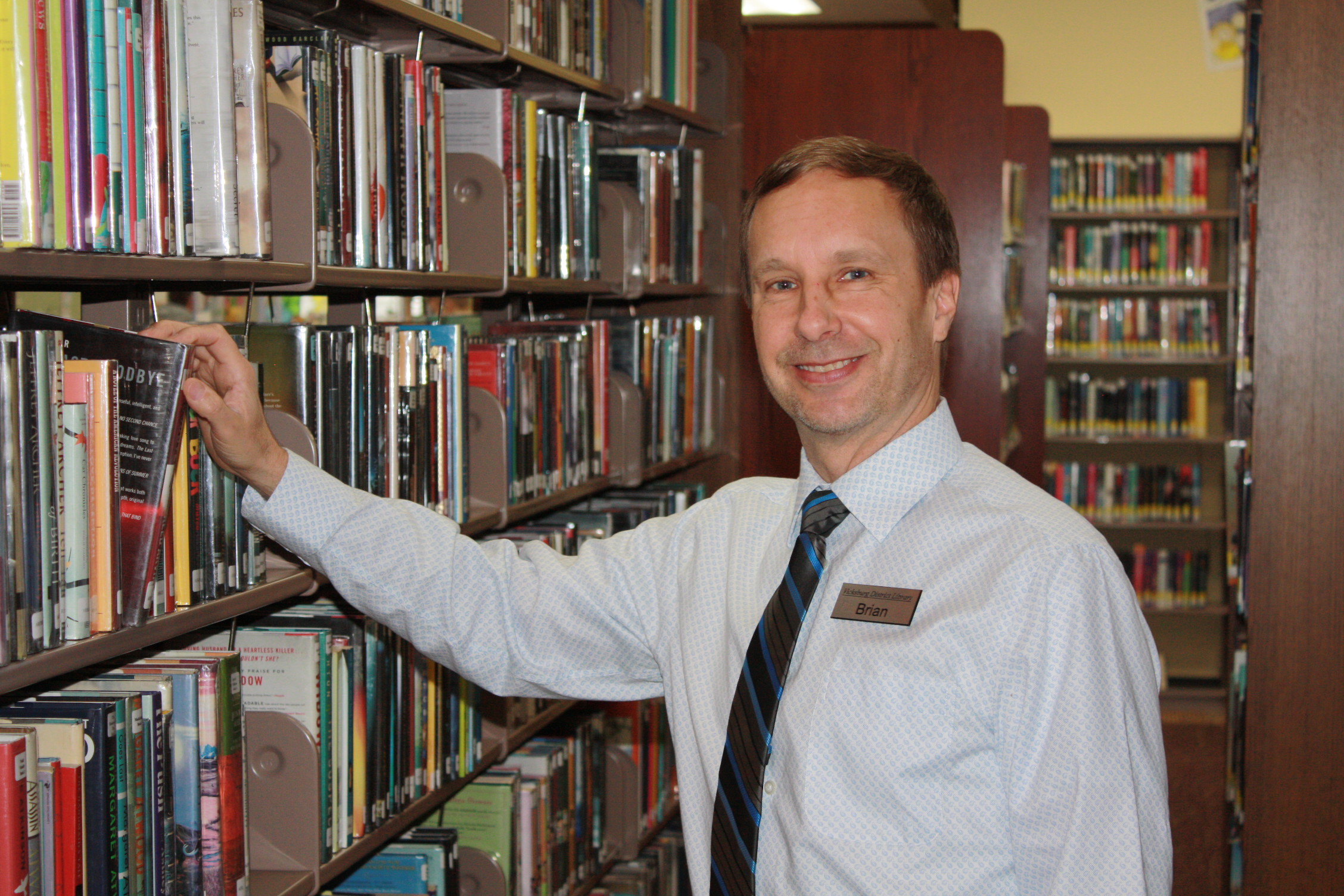
Brian Walny, Head of Reference and Circulation at the Vicksburg District Library, will be hosting the monthly book club.
By Brian Walny
As weather warms and operations continue to return to “normal,” the programs and activities at Vicksburg District Library are blooming. All in-person programming was on hold because of the COVID-19 pandemic.
We are thrilled to bring back the in-person book club! Hosting a book club is one of the library’s oldest and dearest traditions, and having it return in spring, the season of renewal, just feels right. Offering traditional programs like our Book Club or Writers’ Roundtable helps establish the library as a place where the community can congregate and enjoy opportunities to learn, socialize, develop relationships, and connect with one another in an increasingly virtual-driven world.
One of my greatest joys in life is reading, and I’ve always enjoyed reading book reviews and criticisms to help me decide what to read next. Book critiques can be very helpful in discovering your preferences and save you time when choosing your next book. For me, pacing is huge, and I tend to lose interest in slow-paced stories. If something is slow, I might not like it, and if it’s fast-paced, there’s a better chance my easily distractible brain will be able to stay engaged.
Learning how to critique and find what elements work or don’t work for you can serve as a guide as you look for new materials. It’s good to understand these things about yourself and to be able to express how a book or movie made you feel.
Reading can be a social activity. It is wonderful to share an opinion about a book you have just read. The idea for our newest book club is to meet regularly to talk about books we like and determine what the other members have been reading. We will decide on a theme/genre to read for each meeting, like books about love, death, food, family, etc., and everybody will bring the book they chose and read. This relaxed approach to our club allows us to explore different genres that we have never delved into before and to talk about our love of reading. This is in contrast to a structured book club where members read an assigned book they may not like.
The library is adding new titles all the time: fascinating new biographies, science fiction, mysteries, thrillers, romance and more. Somewhere among all those new releases are titles that interest you but might not be easy to find on your own. We can help with that!
Meetings are held 9:30-10:30 a.m. on the first Thursday of each month in the lower level of Vicksburg Library. Drinks and snacks provided! Call 649-1648 or e-mail Brian at bwalny@vicksburglibrary.org for more information.
The graduating class at Vicksburg High School named its top twelve students. Back row, left to right: Gage Stenger, Logan Jones, Owen Bishop, Kenny Dark, Grace Johnson, Lauren Lahrke, Maya Peters, and Max Dinzik. Front row, left to right: Andrew Painter, Kayla Miller, Grace Romig, and Clare Wilson.
By Jef Rietsma
Vicksburg High School upperclassmen will have a chance to be a part of a new forensic science class making its debut in the fall.
A proposal to add the subject to the high school’s science program was pitched by biology and astronomy teacher Rejean Kangas and touted by Principal Adam Brush.
The two discussed the merits behind the class when they addressed board of education members April 11.
Brush said the district is always looking for electives that engage students, so his interest was piqued when Kangas approached him about considering the addition. Kangas had taught the course at Hackett High School during his tenure there.
“It seemed awesome … I talked with a couple other high school principals in the area and they said it is a great third science course, it is a great elective, it is very hands-on,” Brush said.
Kangas, who currently teaches biology and astronomy at VHS, said some of the different units covered include entomology by studying maggots from pig carcasses and the process of maggots turning into flies. Kangas said there is a crime-solving component that focuses on hair analysis, and studying foot impressions and tire treads at accident scenes, for example.
“There’s over 18 units and there’s four to five activities for each one, at least,” he said. “I talked to Les Latham, our physics teacher, and his brother works for the crime scene lab in Kalamazoo, so I’m really looking forward to working with the local crime scene unit.”
The course will require a prerequisite of biology, chemistry or physics. The district has opened three sections based on student interest, Brush said, noting the subject has the potential to be a two-year course.
Due to that addition, the district plans to drop astronomy, Brush added. He said the cost to offer forensic science in place of astronomy is pretty much even.