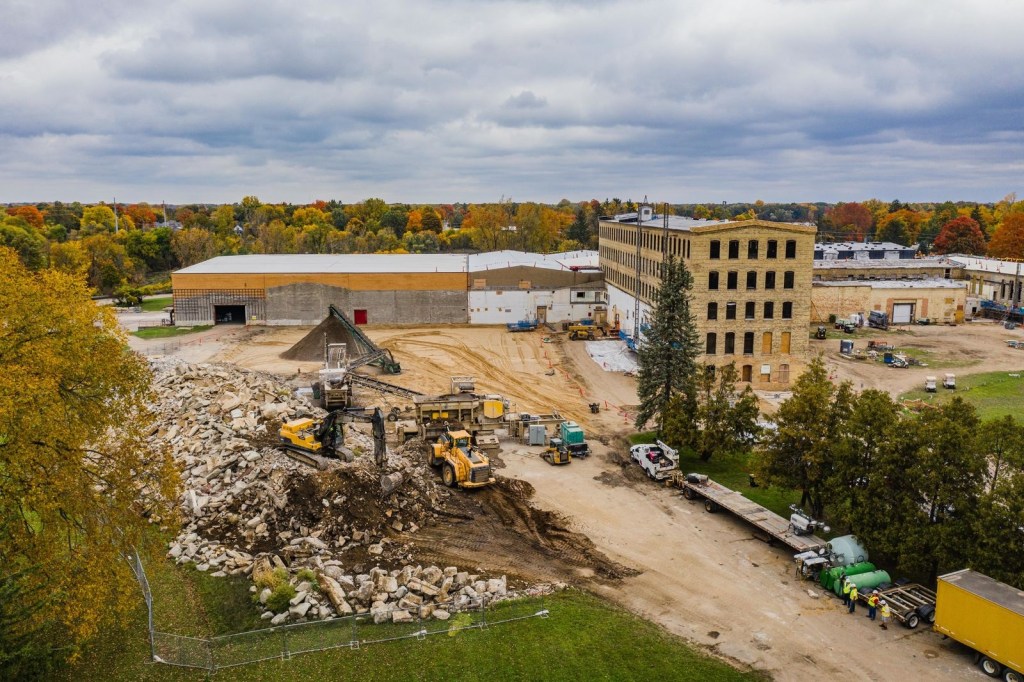
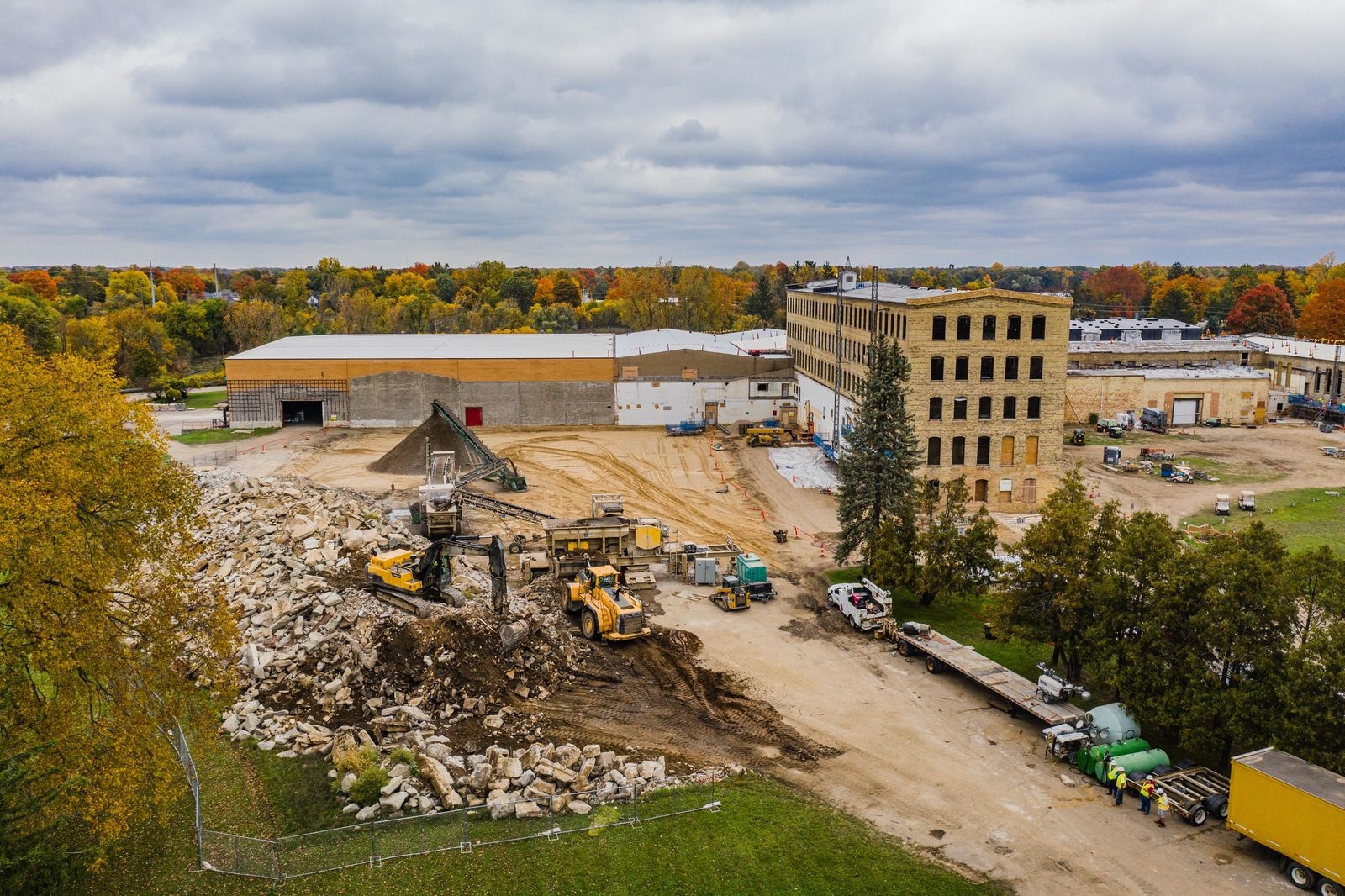
The pile of rubble in the foreground encounters several crushing machines to become the pile of aggregate in the background. Photo by Taylor Kallio, Alterra Media.
Jackie Koney, the Mill’s chief operating officer.
By Rob Ball
Add “waste not, want not” to redevelopment of the Mill in Vicksburg. Since Oct. 12, a disassembly line of several machines has been crushing concrete left from the demolition of several buildings on the site.
When the crushing is complete, resulting 1-inch aggregate will be used to subsurface parking lots and driveways as redevelopment proceeds. The finished site will include several entertainment venues, a brewpub and brewery museum, dining and lodging.
Mill representatives told village residents in September via email and social media that the crushing operation would begin shortly. “We assumed it might make noise,” said Jackie Koney, the Mill’s chief operating officer. “We wanted to let the community know it was happening.”
There was another reason to tell area residents about the project, Koney said. People were curious. “So many had asked about the big rubble pile.”
The Mill received no complaints, she said.
Frederick Construction’s site superintendent, Ken Coombs, said the large chunks, some containing steel reinforcing rods, are dropped into the first machine, which crushes the chucks to 4-inch pieces and removes some of the steel. A conveyor moves the crushed material into the next machine, which crushes to two inches and removes more steel. A third machine removes the remaining steel and a fourth machine crushes to the final 1-inch size.
Although the crushing isn’t visible, steel removal is: Material emerging from the first machine moves on a short conveyor underneath a magnet. Loose steel on that conveyor visibly jumps up a few inches to the magnet and is ejected into a tangled heap on the ground below.
The crushing project is expected to end this month.
The anticipated total of 1-inch aggregate, a little whimsy included: Weight – 10,000 tons, equivalent to 1,550 elephants. Volume – 7,143 cubic yards, equivalent to 500 dump truck loads. Enough aggregate for 1.8 miles of road, 14.6 miles of sidewalk.
And it’s not enough. More elephants-worth will be needed. How much more hasn’t been determined. “We’re still designing,” Koney said of the site planning.
Most of the concrete has come from foundations of half a dozen buildings demolished since the project began last year. They include Building 17, used mostly for storage and shipping-receiving, a water filtration building, and others used for fire suppression, a powerhouse and a research lab.
Two other mounds closer to W Avenue and the creek are contaminated soil headed for special landfills.
Reuse of the concrete isn’t the only ongoing conservation effort. Koney said water from leaky roofs caused deterioration of interior wood beams and flooring. The wood is being removed carefully; as much as possible will be repurposed. “There’s a chance some wood can be used somewhere else. It could be used for interior design, furniture, some wall decoration.”
And if not used in construction, Koney said, it might be held for a woodworker to turn into products for sale. Some of the machinery is also being saved, perhaps for a display about the mill operation.
Salvaged brick is finding new uses, some of it in a retaining wall along the creek. “We haven’t had to buy new bricks. We’re using bricks from a race track being torn down in Chicago.”
There’s more to conservation than reuse of materials on the site: “We’re pretty sure we’ll use geothermal instead of standard heating,” Koney said. But solar power is a no-go. It’s prohibited for use on buildings on a historic registry.
And on the 80-acre site west of the buildings, Vicksburg High classes have planted a pesticide-free edible forest and pollinator garden. A local farmer has placed beehives on the site. And this year, Koney said, the High School has received a grant to continue the project.
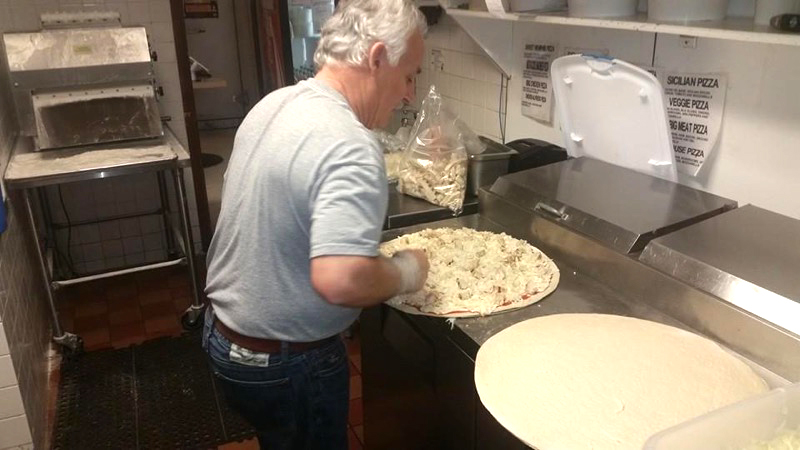
Gaspare enjoyed working the pizzeria even after retirement.
Todd Glenn (in the white backwards hat) and the Scavone family in 1992.
Training and support employees received in the restaurant led to a ‘funnel’ of successful businesses and pizzerias in the Portage and Kalamazoo area. Many … had worked in their youth for the Scavones.
By Kathy Oswalt-Forsythe
Some people leave a lasting mark on a community and the people around them. Gaspare Scavone, known locally as simply “Jasper,” and his wife Bina were people like that.
The Scavones learned their work ethic during their early years in Sicily. It was there Gaspare learned to work hard at whatever he could find, eventually meeting and marrying his beloved Bina in 1977. Soon after their marriage, the young couple emigrated to the United States where they joined Bina’s family already operating a pizzeria in Kalamazoo. Gaspare and Bina started Scavone’s Pizza on Burdick Street. In 1983, they bought Jaspare’s Pizza in Vicksburg.
Todd Glenn, the present owner of Jaspare’s Pizza in Vicksburg, worked for the Scavone family while in high school. He remembers his time working with them fondly. “Gaspare and Bina were hard-working people. I’ve never heard anyone say a bad word about them.” Glenn remembers Bina bringing the Scavone children to the restaurant after school and described the environment the Scavones created as firm but also nurturing. Glenn is confident the relationships the Scavones built with employees and customers solidified the business’s success.
Gaspare continually offered guidance to his teenage employees, saying things like “Go to school. Study hard.” According to Glenn, the training and support employees received in the local restaurant led to a “funnel” of successful businesses and pizzerias in the Portage and Kalamazoo area. Many of these restaurant owners had worked in their youth for the Scavones.
Bina died in 2004, and not long after, Gaspare sold the business. He traveled extensively, met and married Alla Aleksa, and returned to the area. And until recently, Gaspare was still a familiar face in the restaurant, often coming into work and visiting with Glenn and the employees. After a difficult illness, Gaspare died in mid-September. Glenn and his employees still can’t believe he’s gone.
The Scavone’s life together is a love story of commitment to their children, extended family and community. It’s also an inspiring story of possibilities: of building a successful business, of mentoring employees, and of encouraging future business owners.
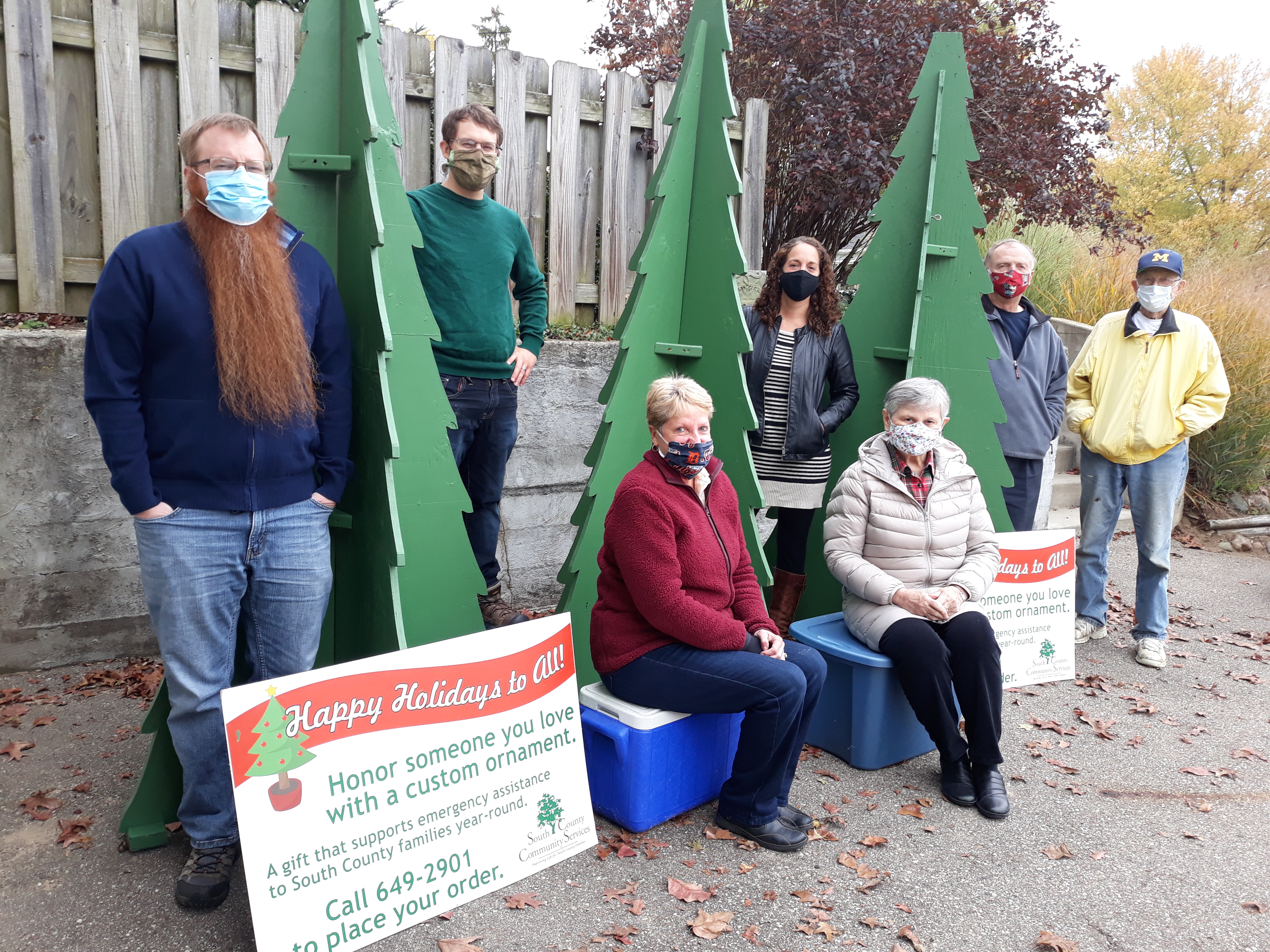
South County Community Services staff and volunteers with the refurbished trees.
By Danna Downing
South County Community Services (SCCS) has a long history – over 40 years – of being available to serve families who live in the six townships referred to as “South County.” Typically, a third of these residents live below the poverty line or have serious difficulties meeting basic needs such as food, utilities, housing, transportation and health care expenses on a dependable basis. Holidays are always a special challenge for families with limited resources. This year, with the pandemic, more families than ever are needing help.
The Tree of Life fundraiser was developed eight years ago to support seasonal and yearlong needs of those who have trouble making ends meet when life-altering circumstances create new challenges for their families. The intention of Tree of Life is to provide community members a way to express love and appreciation to family and friends while giving the gift of timely emergency assistance to those who need it most. A decorated ornament and recognition of affection and respect in the South County Newspaper is an affordable gift that never requires a gift exchange after the holidays – that’s a frequent observation from those who purchase ornaments.
For 2020, the trees have been refurbished and brand-new hand-decorated ornaments will be available for purchase. “We are excited to announce that the Village of Climax and the Climax United Methodist Church are partnering to sponsor a tree at the four-corners in the Village of Climax,” said SCCS Executive Director Drew Johnson. The agency has always enjoyed strong support from area churches and at the township and municipality level. However, this year, Donna Smith, project chair from Climax, reminds us, “it is more important than ever to be sure all residents know that there are resources available to help during these critical times.” It is also important for those in a position to donate some relief to know that SCCS is a United Way agency dedicated to connecting the funds raised with the families who have the greatest needs. The Ladies Library in the Village of Schoolcraft is also sponsoring a tree again this year in front of its historic building just to the south of the Schoolcraft post office. The contact person in Schoolcraft is Jackie Skinner.
Call 269-649-2901 to obtain an order form, place an order or learn more about this project. There is a downloadable order form online at southcountycs.com as well. Persons who would like to help decorate ornaments are also welcome to call the same number.
Christiansen with his book and a sampling of Berry’s memorabilia.
By Kathy Oswalt-Forsythe
Bill Christiansen met Neil Berry in October 2013 when Berry was 91. Christiansen had recently met Berry’s daughter, Linda, and when she mentioned that her father was the “oldest living Detroit Tiger,” Christiansen had no qualms about asking to meet him.
The meetings and research that followed became a book: “The Shortstop from Kalamazoo.”
In preparation for this first meeting, Christiansen combed eBay for any memorabilia suitable for this former Tiger player to sign. To his surprise, when he handed over a vintage photograph of a play at the plate, Berry was immediately able to recognize the team and face of the catcher he had played against 65 years ago. He remembered his life in amazing detail. His anecdotes were colorful and razor-sharp.
Neil Berry was a star athlete for Kalamazoo Central and made the majors in 1948. Berry is not a household name, even among the most ardent Tiger fans, but he played with or against many of the greatest players in the game: Satchel Paige, Jackie Robinson, Yogi Berra, Ted Williams, Bob Feller, Hal Newhouser and Don Larsen, to name a few. Through the ups and downs of his seven-year major league career, Berry witnessed many unique or onetime events in the history of the sport. Berry was playing shortstop when the shortest player in the history of the major leagues made the only plate appearance of his short (pun intended) career. Berry witnessed a teammate throw a no-hitter in his first major league start, and another teammate set a record with 12 consecutive hits. Berry’s favorite game forced the first playoff game in the history of the American League.
From that first meeting, he shared his stories and scrapbooks with Christiansen almost weekly until Berry passed away in 2016. These scrapbooks had been dutifully and lovingly compiled by Berry’s wife Gloria. She collected every word the press wrote about him starting with his high school days until his final days playing major league ball. From the perspective of the sportswriters of the time to the hours of recorded conversations from the “oldest living Detroit Tiger,” Christiansen presents the life and times of “The Shortstop From Kalamazoo.” More information is available at neilberrybook.com.
Generous Hands and South County Community Services will once again be partnering to support local families during the upcoming holiday season. Due to COVID-19 concerns, there will be no group holiday celebrations this year. Instead, gift bags and other goodies will be made available to all the families who are enrolled.
Families with school age children who return their registration forms by early November will be eligible for holiday gifts for their children. Church groups and other community groups will be providing these gifts.
The two agencies will not be confirming these arrangements by phone or mail this year but will instead be contacting families in mid to late November to schedule pickup/delivery of gift cards, food certificates and gift bags.
For more information or to donate towards these gifts, please contact Sheri Louis at Generous Hands or Austin Wiggins at South County Community Services, both at 269-649-2901.
“Kindness is like snow. It beautifies everything it covers.” – Khalil Gibran
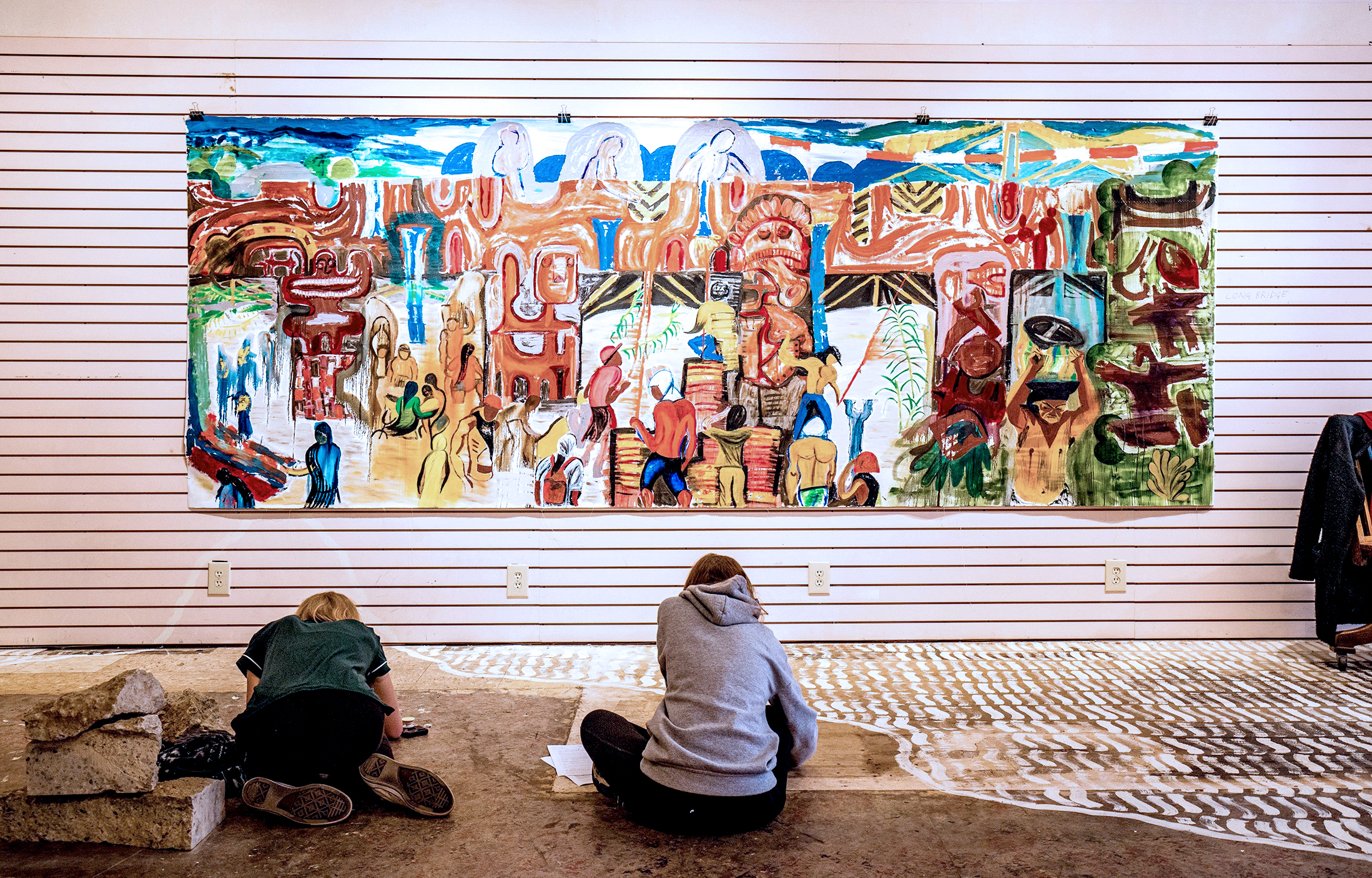
VHS kids in the Natalya Critchley exhibit. Photo by Taylor Kallio, Alterra Media.
By Jake Munson
The dust is beginning to settle for the Vicksburg Cultural Arts Center, hot off the latest entry in the Destination Series: Destination Venezuela. Amid a global pandemic, four art exhibits were featured in the heart of downtown Vicksburg during a grand opening of the event, accompanied by the delectable Venezuelan food truck from Sammy Arepas. Though the sun was covered by a cloudy sky, nearly 100 participants came together to light up the sidewalk of Oswalt Park with a variety of brightly colored chalk art designs, many of which celebrated the Venezuelan culture. Aside from the food truck, this entire event was free!
Along with the physical exhibits – with social distancing and mask policies enforced – the VCAC also had the opportunity to host several virtual events through Zoom, a video-conferencing program, which included a virtual poetry presentation, a “meet-and-greet” Q&A session with Rufus Snoddy, one of four featured artists, and a panel presentation and discussion about the Humanitarian Crisis in Venezuela.
In addition to the exhibits and online presentations, students from the Vicksburg High School Spanish and Advanced Placement Art programs participated in a field trip to experience Destination Venezuela. They visited the exhibits and interacted with two of the artists, Natalya Critchley and Héctor Fuenmayor. One of the most compelling parts of this field trip for many of the students was the Tattoo Art exhibit, with each featured design from Cicatriz Venezuela telling the difficult story of intense, personal experiences of life of those living in the current political and societal tumult of Venezuela. Sammy Arepas was able to return for the students to experience the Venezuelan flavors as well.
Students enjoyed this experience. Their feedback included these statements:
“It allowed for a small town to experience different cultures and struggles.” It immersed them “in another culture, and I like how we got to experience it.” What struck many students was “That this is happening right now and [nobody’s] really talking about it.”
With Destination Venezuela finishing out the scheduled programming for 2020, the VCAC has moved on to the next chapter with the decision by the Board to vacate the physical space and move to a virtual model for the time being. The VCAC Board will be spending the remainder of 2020 to develop and plan artistic and cultural opportunities for 2021 and beyond.
The organization is also looking for new board members who are passionate about arts and culture. More information about board leadership and the organization, readers can go to the VCAC website at vicksburgarts.com or call (269) 200-2223.