by Justin Gibson | Apr 10, 2019 | Community, Vicksburg
-

-
-
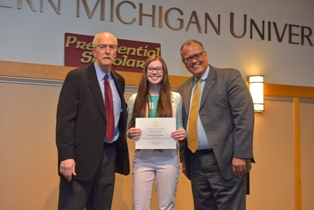
Nikki Callen receives her commendation award from WMU dignitaries.
Nikki Mei Callen of Vicksburg was one of 46 students at Western Michigan University recognized as a Presidential Scholar at a convocation in late March. At right, she’s flanked by Faculty Senate President Richard Gershon, left, and WMU President Edward Montgomery. Callen, the daughter of Rudy and Fawn Callen, was recognized as the “presidential scholar in teaching, learning and educational studies.” The convocation program notes that the scholars “are chosen by the faculty on the basis of academic and/or artistic excellence in their major programs, as well as their overall promise of success. In addition to being exemplary scholars, the students being honored… are notable for their involvement in our broader community and impact upon society. They are volunteers, athletes, musicians, researchers, actors and entrepreneurs. These are true leaders in every respect…” Callen is completing student teaching at Portage Central and will graduate in April. She’ll miss the graduation, her father said. She’ll be running a marathon that day.
by Justin Gibson | Apr 10, 2019 | Community, Vicksburg
The winners are pictured below.
-

-
Prizes for the Peoples’ Choice in chili were awarded to Vicksburg High School’s Pathways program with Rick Place accepting from Mandy Miller, president of the Chamber of Commerce that sponsored the Chili Cookoff on March 9. Their winning recipe was developed by Rachel Spalvier-Kruse’s grandmother. They made eight gallons and ran out with only an hour to spare before closing.
-

-
Jaspare’s Pizza was the Judge’s Choice for the Chili Cookoff’s contest. Mandy Miller, president of the Vicksburg Area Chamber of Commerce awards the plaque to Todd Glenn, the owner of Jaspare’s, and Jaspare Matranga on the right.
by Justin Gibson | Apr 10, 2019 | Community, Vicksburg
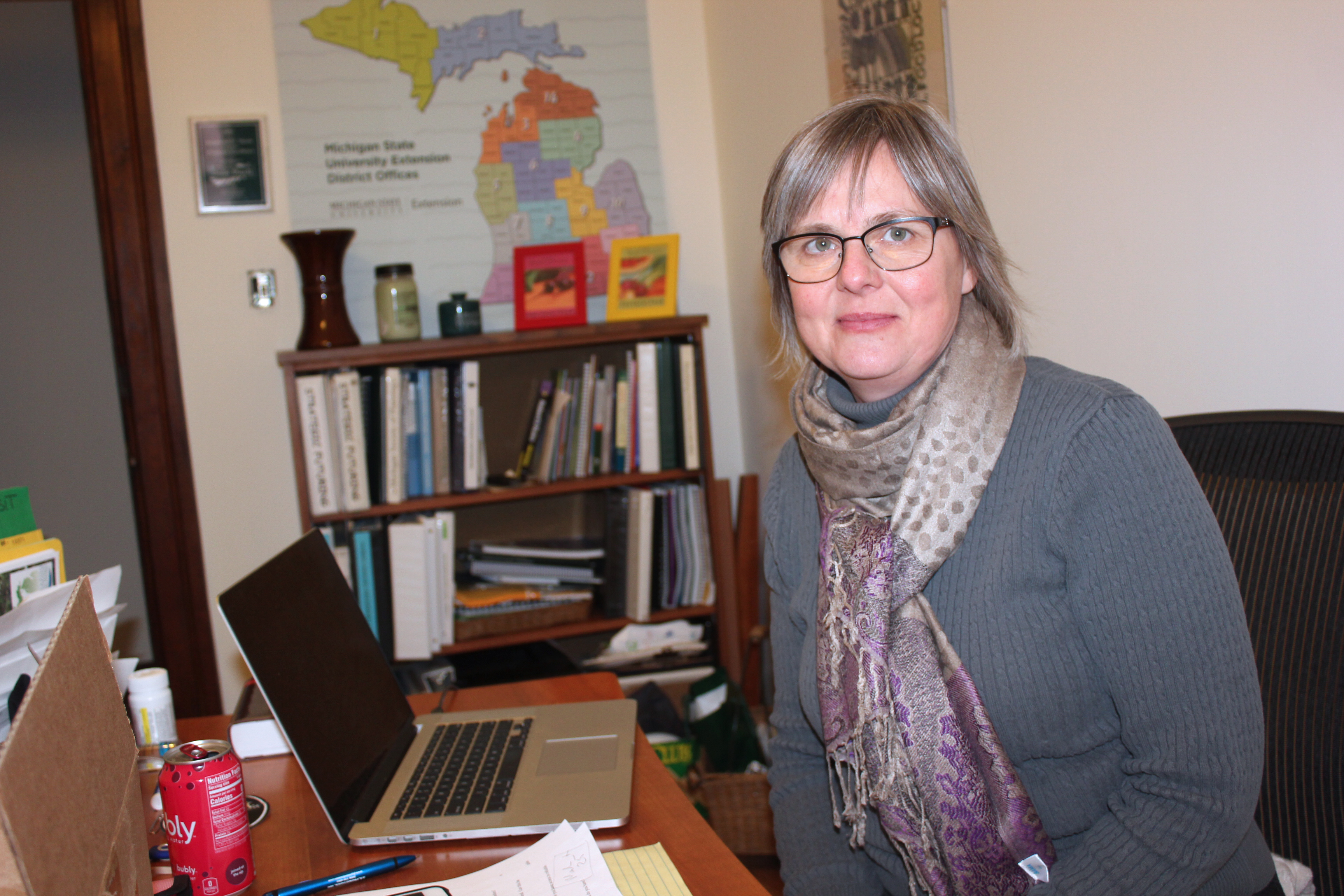
Michigan State University’s Agriculture Extension District Director Julie Pioch in her office on the second floor of the Vicksburg Community Center.
By Sue Moore
A little-known nook and cranny office upstairs in the Vicksburg Community Center houses a well-known Michigan State University Extension district director, Julie Pioch, and administrative assistant, Laura Trombley.
They’re known throughout a seven-county area of southwest Michigan that comprises District 13 of Michigan State’s Extension service. And Trombley is known in six more counties.
Pioch administers the MSU Extension offices and the staff who deliver an array of programs as an arm of MSU’s resources. They include agriculture and agribusiness, nutrition and health, community, food and environment and youth development.
Why locate this office in Vicksburg? It’s in the middle of a district which includes Berrien, Branch, Calhoun, Cass, Kalamazoo, St. Joseph and Van Buren counties. In a 2010 restructuring, MSU Extension divided Michigan’s 83 counties into 14 districts. At that time the district office found a home within a Kalamazoo MSU Extension office on the former Nazareth College campus. But when that office moved to downtown Kalamazoo, there was no room for Pioch. She looked for space for a single office, settled on Vicksburg and brought Trombley, her administrative assistant, with her. Trombley’s territory also covers six counties to the east: Hillsdale, Jackson, Lenawee, Livingston, Monroe and Washtenaw.
The programs of MSU Extension have evolved over the years. But its core mission is to bring research and evidence-based education from the university to local communities throughout Michigan. “We bring knowledge to life, with education for every sector of this economy,” Pioch said. This is the most important outreach offered by all of the land-grant universities across the United States, with MSU being the first in 1855.
“A few years back we were mission drifting,” Pioch said. “The change from having a county director in all 83 counties to just 14 district directors covering a wide expanse of geography tidied things up a bit. The reorganization is still firmly rooted in education and research. The districts are the connectors for the local Extension offices in each county.
Trombley is the administrative liaison for her 13 counties. “We don’t do bug identification, soil testing or 4-H enrollment out of our Vicksburg office but we provide administrative support to the professionals in our county offices who do,” she said.
The 14 ag educators from throughout the seven-county district offer dairy education, farm financial management, swine education, fruit and field crops education, integrated pest management, and support to Kalamazoo’s greenhouse industry, Pioch explained. Other programs that are more commonly known include master gardening classes and 4-H. There is also an emphasis on food, health and nutrition, water quality and public policy through the Institutes headquartered on the MSU campus in East Lansing.
Pioch began her career in 1994 as a resource recovery agent for the Extension office in Van Buren County where she taught composting and developed community recycling programs. She is a graduate of Western Michigan University with a masters’ degree in industrial psychology. Her expertise with MSU evolved into economic development, community food systems and public policy and she served as the county Extension director in Van Buren until the reorganization. Pioch is a resident of Paw Paw. Trombley moved to Vicksburg in 2017.
The big change came when many extension educators focused their expertise and began to serve statewide; the local funding formula shifted. That formula is focused on grants, state appropriations, county investments, federal cooperative extension dollars with a small amount from the MSU general fund. Funding totaled $85.35 million in 2017.
“We are having a big district meeting on April 30 at the Community Center,” Pioch said. “It will be fun for my staff to come to Vicksburg and see what a great environment this building offers. I liked its funky atmosphere from the start. It’s a very productive office space.”
by Justin Gibson | Apr 10, 2019 | Community, Vicksburg
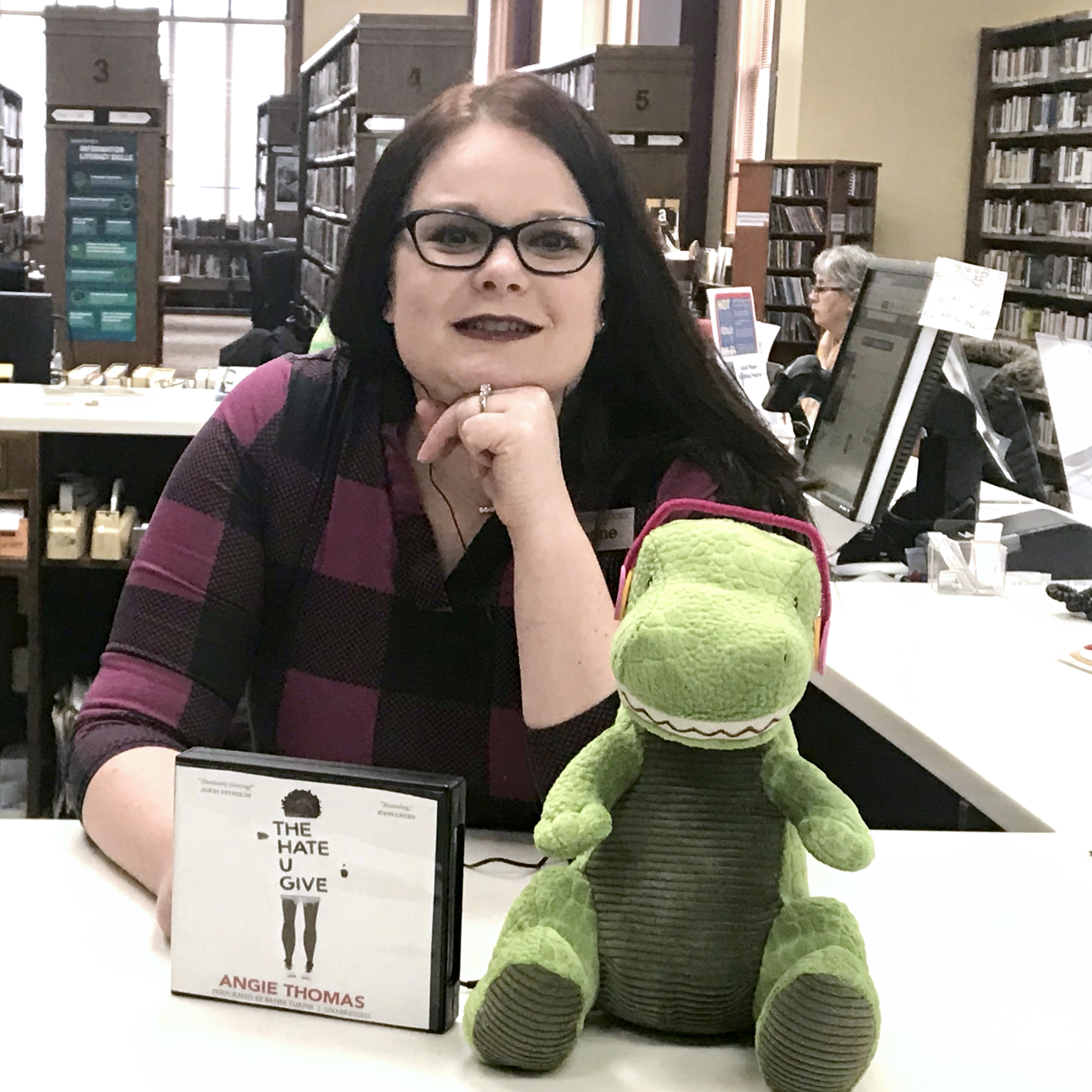
A stuffed Tyrannosaurus rex with headphones displays OverDrive information during a recent audiobook display at the Vicksburg District Library in January.
By Adrianne Schinkai, Head of Reference and Circulation Services, Vicksburg District Library
In an age of full, busy schedules, audiobooks are providing consumers a way to get in their fill of reading and information while they are constantly on the go. Eric Hansen, director of the Vicksburg District Library, demonstrates this during his own commutes to and from the Grand Rapids area each day. “I estimate that I have listened to more than three dozen audiobooks while driving to work at the library,” he says.
Audiobooks started out as books on audiocassette, better known as books on tape, but soon adapted to the compressed format of compact discs. This allowed for more data in a conveniently sized item until the downloading of audiobooks on electronic devices debuted. This also provided ease of access for users. “Audiobooks on CD are a great choice for people who have questions about technology and would like to keep things simple,” Hansen comments.
The audiobook collection of the Vicksburg District Library includes over 1,200 titles on CDs. Patrons are allowed to check out the titles as they would books in print. But the collection also includes audiobooks that can be borrowed and downloaded through the OverDrive app, which adds 2,700 titles.
The user accessibility of OverDrive is something Hansen is proud to promote. “OverDrive audiobooks give readers the opportunity to check out books without physically visiting the library. We love to have patrons visit our location, but this is a good option for home-bound patrons or patrons whose work schedules preclude them from visiting us.” Patrons can use OverDrive from the convenience of their home as long as they have their library card number and an internet connection. As part of the Southwest Michigan Library Cooperative, patrons are able to access audiobooks as well as ebooks through the online application.
As audiobook popularity rises, publishers are adapting their various items into the format. This has led to some well-known names being tapped to narrate works of both fiction and non-fiction. British actor Stephen Fry is known for his narration of JK Rowling’s Harry Potter series. Dennis Quaid recently performed in The President is Missing for James Patterson. And a current bestseller, Michelle Obama’s Becoming, is read by the former first lady herself.
The cost of an audiobook depends on various factors, just as it would for a print book. The longer the book, the more information there is to hold on a disc or in a file. Hansen adds, “With audiobooks, it is important to remember the cost of renting a recording studio and hiring an actor or professional reader to read the book aloud. In the case of especially long books…the cost of producing an audiobook will be much more significant than producing a short book.”
A novel on CD could be anywhere from five discs to beyond. For example, Obama’s Becoming clocks in at 19 hours of listening on 16 discs, which will run a buyer about $25 to $40. Purchasing the downloaded version tends to be more affordable as there is no material cost and the title can be stored in the cloud for future use.
by Justin Gibson | Apr 10, 2019 | Government, Vicksburg
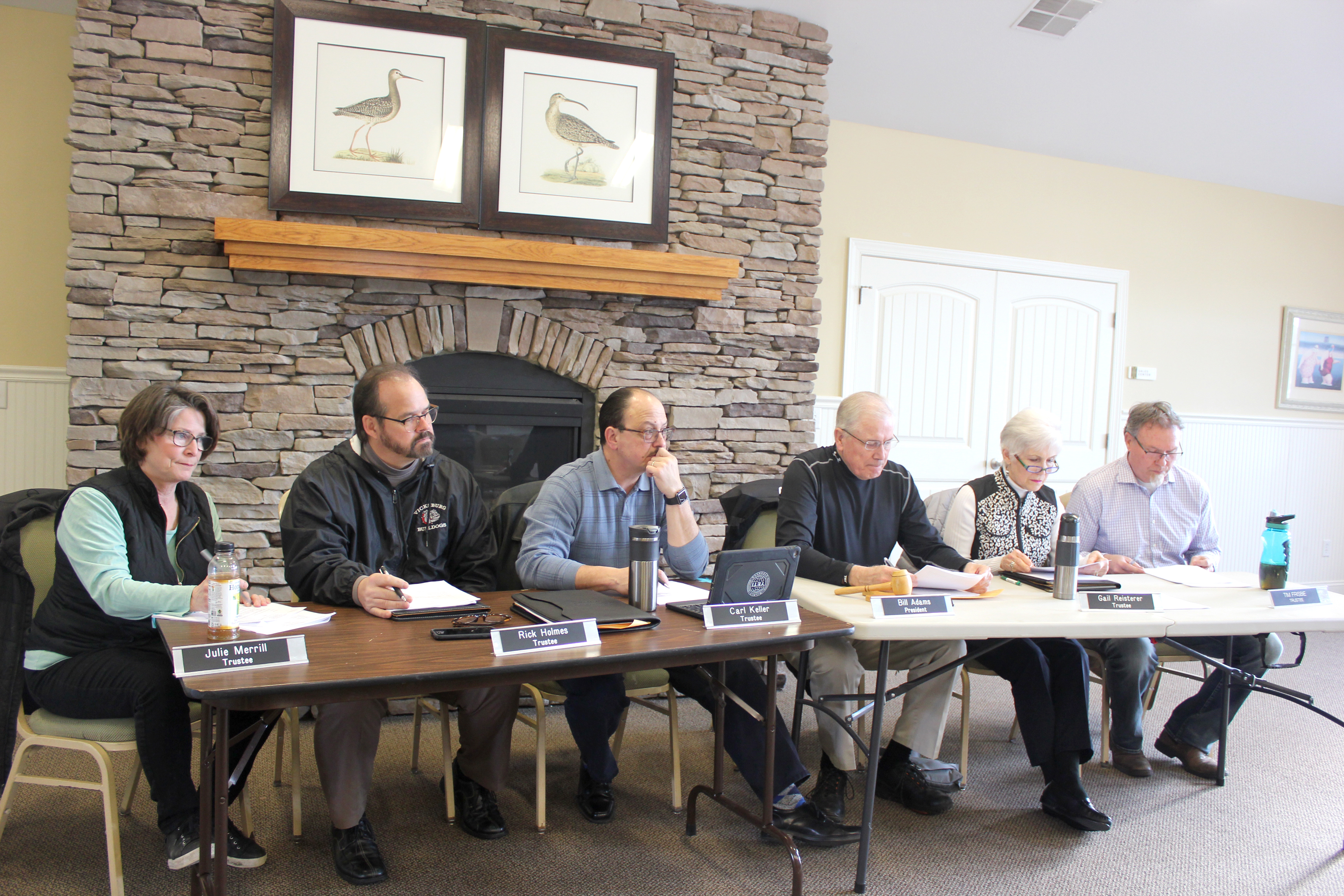
Members of the Vicksburg Village Council held their March meeting at the Centennial community room in the Allen Edwin development on 22nd Street. They are from left to right: Julie Merrill, Rick Holmes, Carl Keller, Bill Adams, Gail Reisterer and Tim Frisbie. Colin Bailey was absent when the picture was taken.
By Sue Moore
The first official steps were taken by the Vicksburg Village Council toward a $13.6-million bond issue to replace aging sanitary sewers, storm sewers and water lines. The money is being requested as a low-interest loan from the U.S. Department of Agriculture’s Rural Development Program.
The bonds would be repaid from sewer and water bills in the village over a 40-year period. Major construction is expected to take place from July through September, 2020.
The council also voted to apply for a $250,000 grant funded through a Michigan Department of Transportation (MDOT) Economic Development Category B Program. Mike Swartz of Prein & Newhof, the village’s engineering firm, explained that this was a new program to help with resurfacing local roads. The money is being asked for reconstruction of Mill, Washington, Pearl and Spruce streets in conjunction with the proposed sewer and water line projects.
Many meetings have taken place with utility companies who might have an interest in the project to determine if they might want to coordinate with the big dig in the village. Merchants in downtown stores also have been consulted since Main and Prairie streets will be impassable during these three critical months.
In addition to this major construction project, the village is also accepting $250,000 from the Kalamazoo Area Transportation System (KATS) to begin construction on an extension of the village trail. The village would be required to match the amount with about $50,000 . The extension would go from TU Avenue north to the Schoolcraft township line. Eventually the trail would connect with Portage and Kalamazoo County trails that stretch from South Haven to Galesburg and Battle Creek. The 1.3-mile village trail extends from North Street in the village to TU Avenue.
Matching funds for the trail will come from the Downtown Development (DDA) Vision Campaign conducted in 2015-2016.
Village Manager Jim Mallery explained to the council members that sewer and water rates had not been raised since 2003-04, and thus haven’t kept up with the costs of maintaining the system. The council also approved $19,000 for an alarm system for the lift station pumps that would help sound alerts if there is a critical failure in one of the seven locations.
A contract from ITRight for an information technology upgrade was also approved at $5,500. Last year the village spent $14,800 for IT services, Mallery told the council. The three-year contract represents a nice savings, he said. One goal of these improvements is to provide on-line live streaming of village council meetings.
With all of these decisions that directly affect the work of the Department of Public Works employees, Mallery took time to praise the four members of the staff who attended the meeting. “The way they keep the streets and sidewalks up is really special. They made critical repairs to the village plow trucks when the big winter storms blew in last January. Their teamwork and willingness to get the job done is exemplary,” Mallery said.
Dirk VanKrimpen, a resident on the east side of Sunset Lake, voiced concern about the high lake level. He believes the lake is being contaminated by the homes on the west side of the channel going upstream to Gourdneck Lake that do not have village sewers. He believes boards controlling the lake level need to be lowered so more water will flow through Portage Creek.
by Justin Gibson | Apr 10, 2019 | Schools, Vicksburg
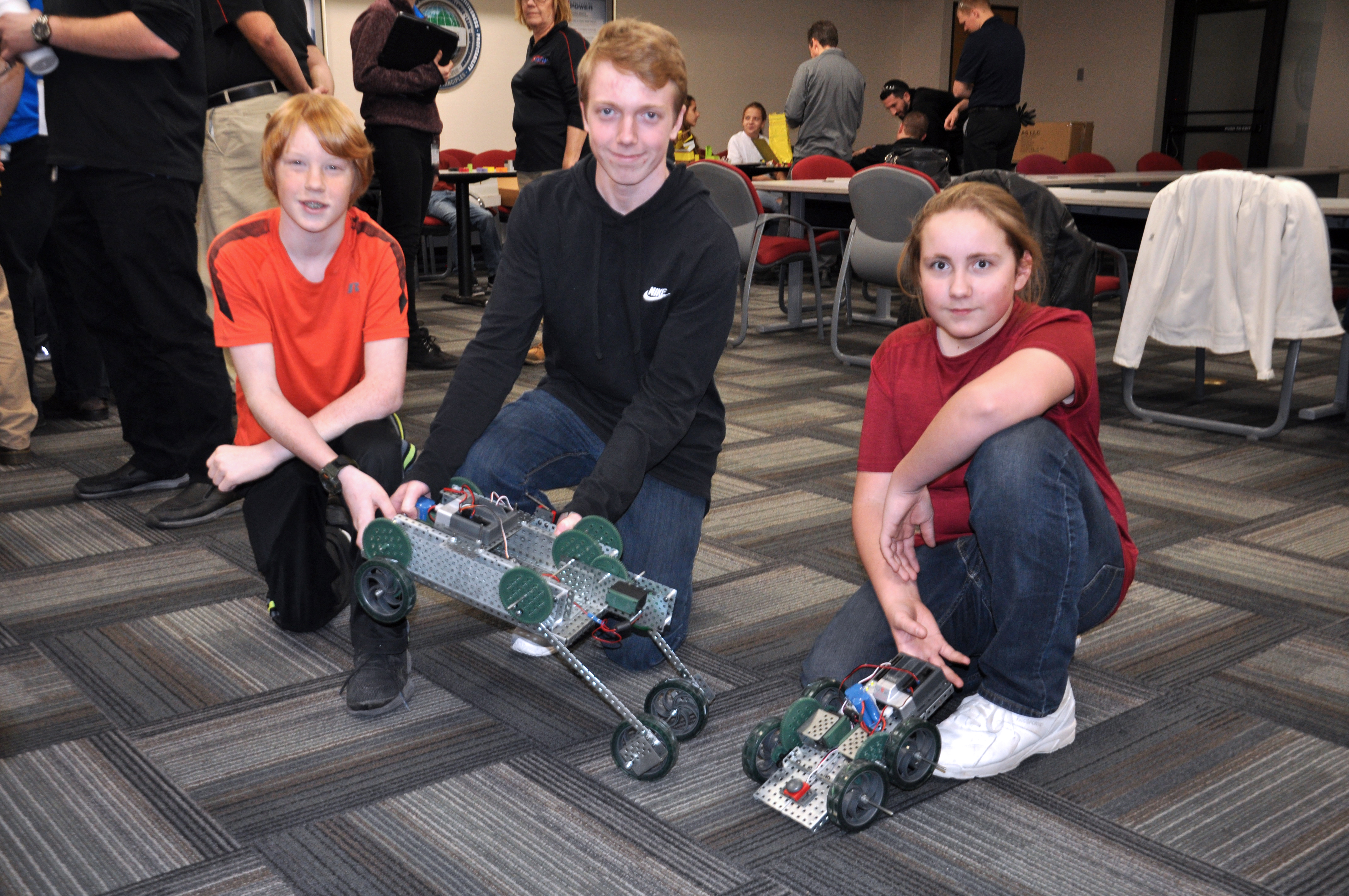
Vicksburg 7th graders Reed Tassell, Brendan Kelly, and N.J. Topash show off their robotic engineering projects at American Axle.
By Travis Smola
Project Lead the Way (PLTW), a science, technology, engineering and math (STEM) program at Vicksburg schools, recently exposed seventh grade students to real-world careers available in these fields with a visit to American Axle & Manufacturing in Three Rivers.
The visit included a tour of the factory floor. Students brought with them a variety of engineering and robotics projects they’ve been working on since January to share with the employees. American Axle has been a supporter of Lead the Way since the beginning. Debra Kolberg, STEM teacher consultant project manager at KRESA, helped organize the event. The projects the students presented ranged from simple pull toys and robots programmed to perform simple tasks to orthotics designed for someone with cerebral palsy.
“They learn in the way that they learn best, which is by doing,” Kolberg said. “They’re very excited about it.”
Seventh-grader N.J. Topash built a robotic dragster he programmed to travel a certain distance before stopping. He excitedly explained to the engineers what he learned about gear ratios. The project also helped him learn about one key element engineers deal with every day. “I learned that timing is key to everything,” Topash said. “You can have something that works, but the timing, if that’s off, it will make everything off.”
One of the major ideas behind Project Lead the Way is simply to show students career options. These options don’t always have to focus on further education after high school. Kolberg said American Axle serves as a good example of the options available because it hires workers with high school diplomas and those with four-year college degrees.
PLTW has a heavy focus on critical thinking, communication, collaboration and problem solving that will be useful to the students no matter what they end up doing. “Since we don’t know the future, when these kids get up to the working age, we don’t even know what kind of jobs there will be when they’re here,” Kolberg said. “What they need more than head knowledge is skills.”
Teacher JoEllen Pollack agreed. She previously worked on PLTW at Climax-Scotts before coming to Vicksburg. “What we’re trying to do for the middle schoolers is to get them excited about engineering,” Pollack said. She noted the students learn valuable skills like coding, mathematics and science, but soft skills like problem-solving and teamwork may be even more valuable.
She said members of a group often have different ideas about what they’ll do for their project. They then go through a design process where all the pros and cons are weighed before work ever begins. “It’s a way of learning through interaction and play and cooperative learning, doing rather than just memorizing facts,” Pollack said. She also said she’s hopeful other local businesses will want to do similar events with PLTW.
“I think this is what inspired what I want to be now,” Clara Centofanti said. The seventh grader is an aspiring engineer. She’s not sure what she wants to specialize in, but the visit gave her a chance to explore more real-world options. She said it was encouraging to see how the things she is learning now can apply to a real-world career in the future.
“You see a truck, or a car and you think ‘Oh, that’s just something I use,’” Centofanti said. “But now you get to see the real science and technology and engineering behind it.”
American Axle employees were equally impressed by the projects the students came up with. Brian McDaniel, Senior Manager of Human Resources, challenged the students to build an axle for next year and a robot that could throw foam stress cubes the company gave to the students.
Manufacturing Manager Mike Waldrop, also impressed, said the students were displaying knowledge and skills he didn’t learn until four to five years later in high school. “By the time they hit college, they’ll be way beyond where we were 30-plus years ago,” Waldrop said. “For the future of the company, opportunity for local kids who may want to stay in the area, it’s excellent. Anything we can do to help support it is great. I enjoy seeing these kids come in and help demonstrate what they know.”