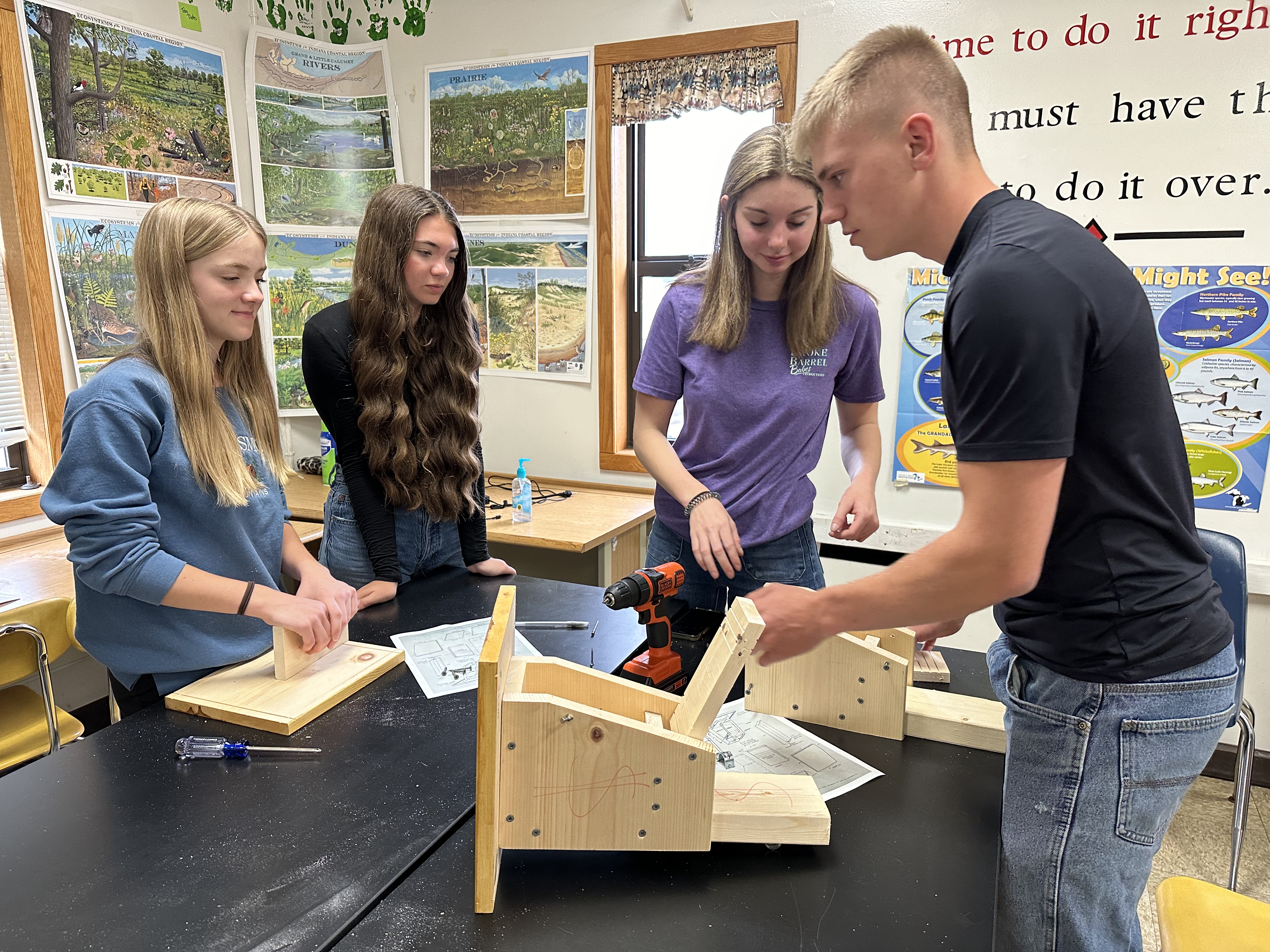
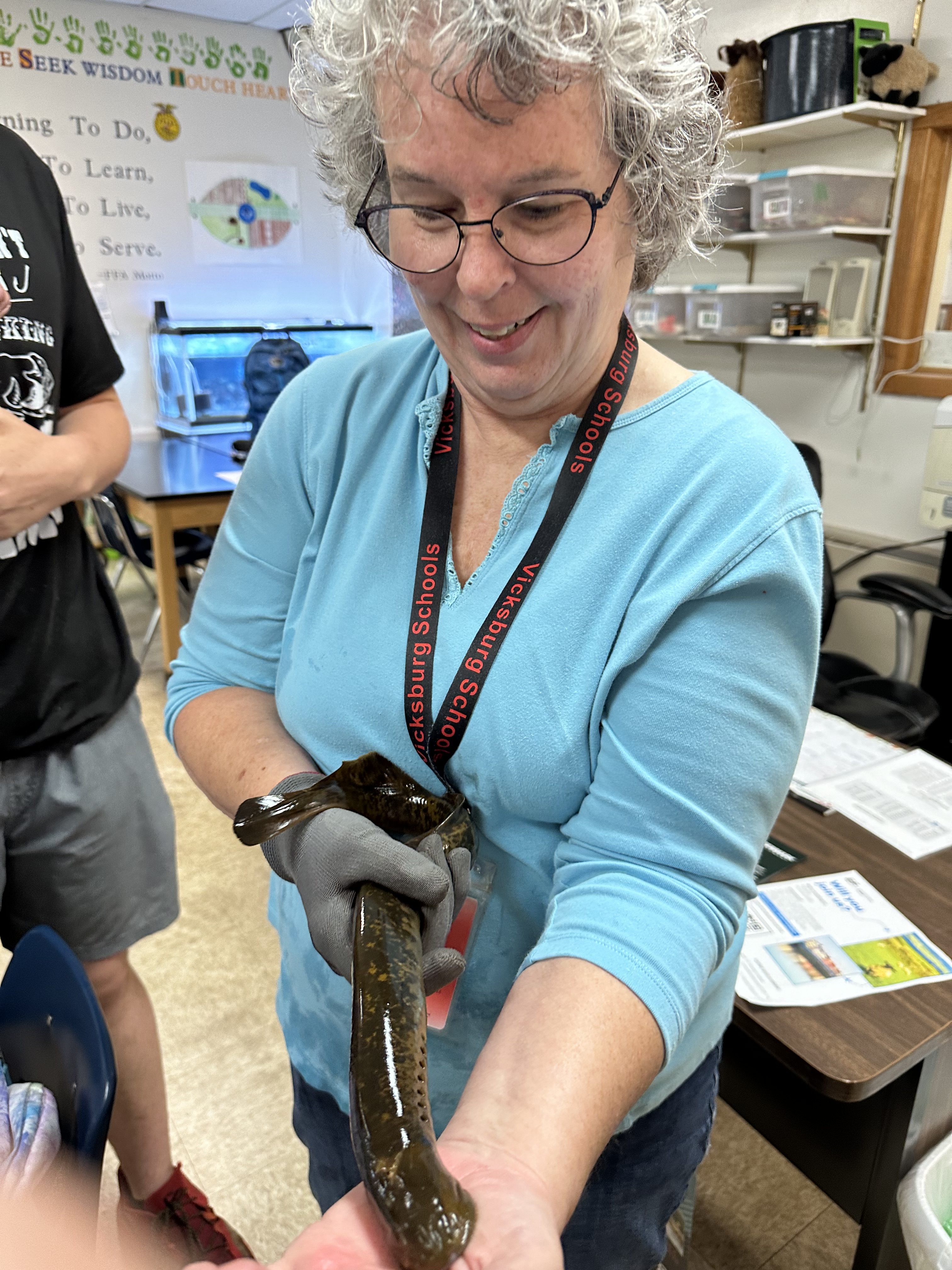
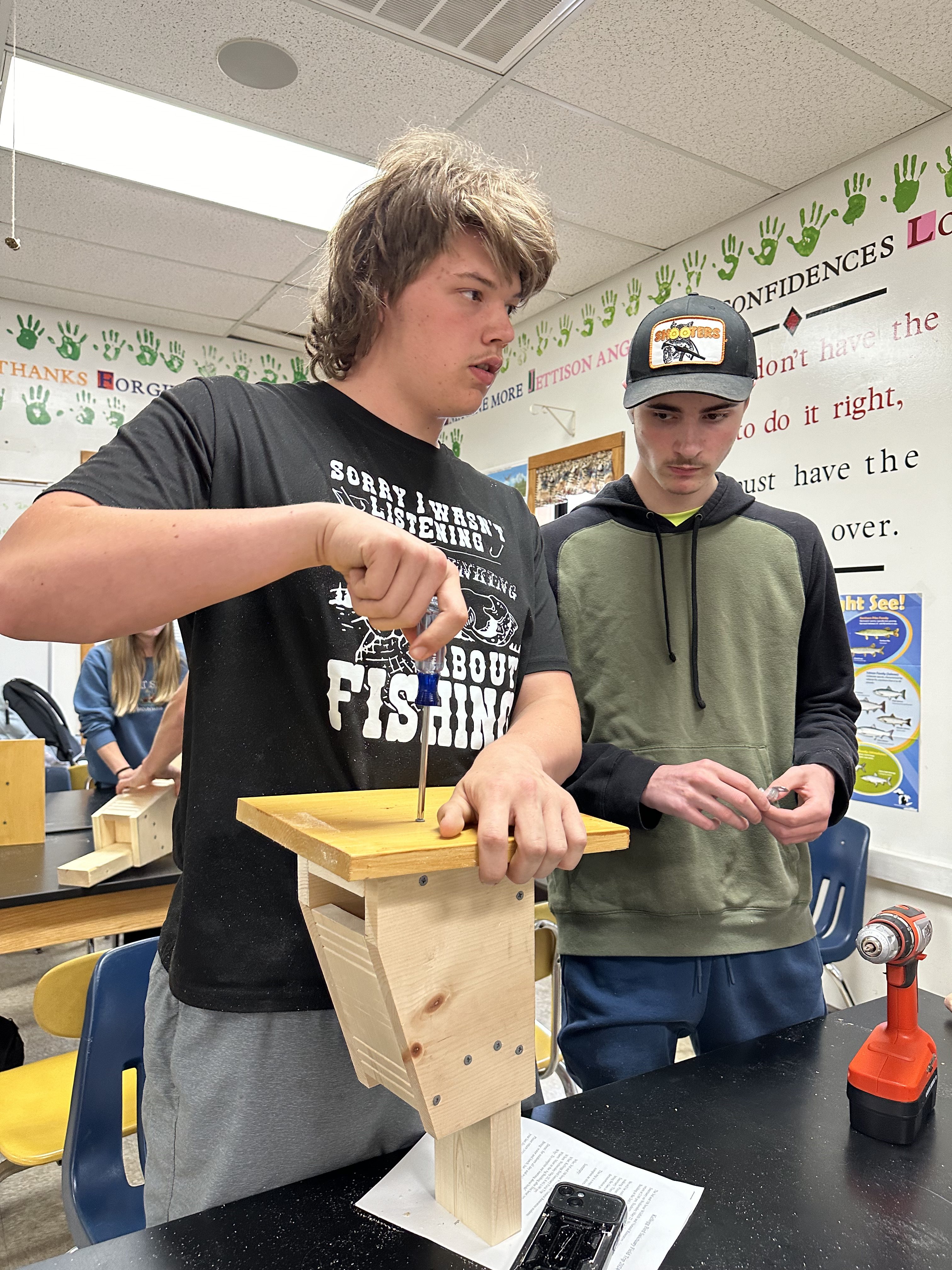
Left: Arabella Crist, Kenzie Horning, MacKenzie Pryor, Caleb Culbertson, students in the Wildlife and Natural Resources class, assemble Eastern Bluebird boxes. Middle: Teacher Dr. Noreen Heikes shows the class a sea lamprey that was provided by the DNR for instructional purposes. The DNR traps this invasive species when they are spawning and at the end of its life cycle. Right: Keegan Searles and Xavier Cleveland work together on a house for Eastern Bluebirds that will be placed in the native prairie at The Mill.
By Penny Briscoe
Learning about birds is important and especially relevant in today’s environmentally fragile world. To increase student awareness, Dr. Noreen Lowe Heikes’s Wildlife and Natural Resources classes spent two weeks this past May learning how and why to appreciate and understand them.
The instruction included some of the special characteristics of the nearly 10,000 different species in the world, including the aerial mating rituals of the bald eagle and the stealth and speed of the peregrine falcon.
“Most of the focus was on typical birds found in our back yards—like robins, chickadees, and bluebirds,” said guest presenter Penny Briscoe (and writer of this article). “I was motivated to spend time in the classroom because it is so important for kids to understand the environmental relevance of birds.”
Heikes believes introducing birds to youth is a great way to encourage and reinforce watchfulness. “The bird unit really teaches them to look around and to look and listen closely,” she said. She believes the general population just doesn’t make time to listen and look closely at their outdoor surroundings.
Along with the basics about birds, the unit included using technology to enhance bird enjoyment. A bird walk near the school with a classroom set of binoculars gave them practice using the free Merlin smartphone app available through Cornell University. Merlin assists with identification through inputting physical characteristics, photos, or songs of birds that are spotted.
The students also hiked to The Mill to erect eight bluebird boxes they had assembled in groups in the classroom. Donated as pre-cut kits by Rick Briscoe and made in his woodshop, they will help bring more nature to the native prairie planted there last year. “Our vision has always been to create a place where interesting things seem to be around every corner—the sort of place that resonates with lifelong learners,” said John Kern, director of Creative Programming at The Mill.
Following the classroom unit, students enjoyed a field trip to Kellogg Bird Sanctuary where they were able to apply what they learned. A field representative introduced them to even more species and bird habitats. “The kids were 100 percent ‘in’ while there—asking many questions and contributing input throughout the day,” Heikes recalled.
“Birds are, of course, a big part of the ecosystem, and they are a species that dramatically shows what is happening in nature,” she said. “Of course, the students all have heard about climate change, which contributes to their being anxious. It definitely allows them to see what they can do to help the situation, like building and placing birdhouses. When I work with my students and see how much they care, it makes me confident about the future.”
She noted that many of her students take the Wildlife class for fun, and to get their science credit, but they also discover there are careers they can pursue related to so many environmental areas. “Day to day, I sort of feed off their energy, and it makes me happy.”
“So many of my students don’t have a background related to birds, and it’s fun to introduce the material,” she said. She believes you have to take kids out in nature, and once outside it’s a start to appreciation. “Many of them are only outside to go to or from their cars, or outside for organized sports.”
If she could give her kids anything, it would be curiosity, said Heikes. “There are moments when curiosity overcomes reluctance or fear of the unknown, and that’s when you’ve got their attention.” Heikes believes one clear answer to introducing the young to nature is through active grandparents. She says this can help parents who are often too busy to enjoy the natural world themselves. “They don’t have to preach, just be out with them—there’s a tie there.”
Besides Wildlife and Natural Resources, Heikes also teaches Veterinary Science and co-teaches Animals and Plants with Laura Hayman, focusing on the “animal” portion of the class. The classes are part of the Kalamazoo Regional Educational Services Agency and are taught in Vicksburg.
Now in her 15th year of teaching, she is well prepared with a doctorate in veterinary medicine from Michigan State University and a master’s degree in teaching from Western Michigan University. Her interest in animals was developed in her childhood while growing up on a farm in Vicksburg, where she graduated from high school.
To see students “get it” is what brings her the greatest joy. “Teachers live for that. And I like to see what students ultimately do in the world with the knowledge,” she said.
Heikes has a lot going on in her programs, including several local hands-on collaborations, which she said are critical. The students in the veterinary science class have worked with Crichlow Alligator Sanctuary—handling, performing health checks, and microchipping alligators. They also vaccinate and perform health checks of sheep at Gull Meadow Farms, and participate in the regenerative grazing program at The Mill with Tending Tilth owner Lauren Burns. Students trim hoofs of the sheep, perform health checks, and vaccinate. Also at The Mill is an opportunity to learn about and care for bees, including tending a hive there. “A lot of what we do we couldn’t do without The Mill,” said Heikes.
When The Mill first began its project, she and Chris Moore, a Vicksburg High School classmate, connected and began a collaboration. According to Kern, “After meeting Noreen Heikes the first time, we knew that we had the rough version of a good idea, so we decided to continue the conversation. At the second meeting, she showed up with six pages of ideas for things that we could do, especially focusing on 16 acres of ag land that we decided could be set aside as pollinator habitat,” explained Kern.
“We decided that, in whatever ways possible, we would use The Mill and adjacent property as a sort of learning lab—providing students with legitimate hands-on learning opportunities,” he said.
The veterinary science course Heikes teaches has included five trips to South Africa, including one this July. The students work with animal experts there and are introduced to caring for elephants, rhinos, zebras, giraffes and cheetahs. Other foreign collaboration includes an animal and plant class that is heading to Ireland in 2025. Heikes stressed that students involved in these projects must demonstrate that they have an excellent knowledge of the concepts behind each operation they perform, and they must be completely competent.
This wooden sign is about to be replaced with a digital one.
By Jef Rietsma
Vicksburg Community Schools Superintendent Keevin O’Neill kicked off the board of education’s July meeting on a high note.
With help from the Vicksburg Foundation, the district is expected to purchase a digital sign to be placed along South Kalamazoo Avenue outside its administrative building.
O’Neill said the need for such a communication has long been a part of his “want list” for the district. He said Kalamazoo Avenue is a heavily traveled route in the village, and a digital sign will communicate important information to passing motorists and pedestrians.
He said Vicksburg Foundation has offered $20,000 to help offset costs to purchase and install the sign.
Following the board’s July 8 meeting, O’Neill elaborated on the situation.
“A few months ago, the Vicksburg Foundation had reached out to me about some other ideas and we got to talking about how we’d like to put a digital sign outside the administration building,” he said. “I indicated we are going to approach some other groups to see if they would help fund this as well and eventually the figure $20,000 came up.”
The district has a small amount of bond money on hand to contribute toward the project, he noted.
O’Neill said he was optimistic the project would go out to bid by the end of July. He estimated total cost of the sign, including labor and electricity, at about $40,000.
An effort will be made so the visual appearance of the sign complements the historical look of the administrative building.
“Because of how old the administrative building is, we’d like the base of the sign to hopefully match the VAB a little bit so it kind of just blends right into the landscape here,” he said. “We’ll see what the experts can come up with.”
O’Neill said he is happy to see the project finally has traction and is likely to become a reality.
“Ever since I’ve been superintendent, I’ve been wanting the district to have this and it feels like, for whatever reason, we’ve not been able to make it happen … it’s just something we need and should have had by now,” he said. “I’m super excited about it and super grateful for the partnership with the local foundation.”
The new sign is expected to be in place and operating at some point during the 2024-25 academic year.
In another matter during the meeting, O’Neill said the district’s high school summer school program has concluded and was deemed a success. Meanwhile, the elementary summer program continues through the second week of August.
He said a new incentive at the elementary program involves up to eight different charms which students can add to a necklace for completing various tasks weekly.
“It’s been a hit,” he said. “And when you couple that with what the Big Read Machine and some of the things the library is doing this summer, it’s been really great to hear about all the success experienced by our elementary kids.”
Also, O’Neill said as of July 8, the district has 150 kindergarten students registered and 32 signed up for its BK classroom. Both figures are consistent with 2023-24 enrollment.
Finally, O’Neill said aside from a few positions at Pathways High School the district has completed its hiring for the coming school year.
The Vicksburg Foundation has approved a “Paving the Way” grant to Schoolcraft businesses affected by US-131 reconstruction, Village Manager Cheri Lutz told the Village Council at a July meeting. The money will be dispensed to businesses by the village, which is finishing preparation of criteria and procedures for the project.
In other business:
Michigan law allows communities to set limits on what they will spend on employee health care to 80% of the total, with employees paying the remainder. They can also set a hard cap on what they will spend, or opt out of such limitations entirely. The council opted out of the limitations, as it has done for the past dozen years.
Lutz confirmed that the structures at 203 East Pine Street have been removed and that the lot has been cleared and leveled.
Police Chief Scott Smith said that due to increased volumes of vehicles using 14th street as a means of bypassing the designated detour route during the last week of June, they were called to an accident each day at the corner of East Eliza and 14th Street. He also advised that he will be working with school administration in preparation for the opening of the new school year as the detour traffic will continue to be a challenge at the intersection of 14th and East Lyons streets. Village police continue to do what they can minimize the continued impact of the additional traffic in the village as the roadwork continues.
Trustee Mastenbrook said that at a recent South Kalamazoo County Fire Authority meeting the city of Portage thanked the Authority for its assistance during the recent tornado.
Council President Michael Rochholz reported that there are no updates regarding the Lockport Township water initiative. Lockport and nearby townships are considering expanding that township’s water system to make the area, including the US-131 corridor, more attractive to development. Rochholz also reported he had recently met with Kalamazoo County officials to improve communications between the Council and the County.
Schoolcraft village and school board voters will see uncontested races on the Nov. 5 general election ballot. Vicksburg-area voters will see contests on both village and school board ballots.
Both village and school board elections are nonpartisan.
On the Vicksburg Board of Education ballot, eight candidates are seeking two seats beingvacated by long-time trustees Virgil Knowles and Carol Lohman. They’re Lisa Hostetler, Rick Burmeister, Kathy Miller, Alex LaPorte, Lucas Hillard, Michele O’Neill, Elizabeth Castleberry and Jaime Buikema. Terms are for six years.
Incumbent Ron Centofanti, appointed to the board last year to fill the seat vacated by former trustee Jennifer Buikema, is running unopposed to finish her term ending Dec. 31, 2028
There are no challengers on the Schoolcraft Village Council. Incumbent President Michael Rochholz, appointed to fill the remainder of former president Keith Gunnett’s term when Gunnett resigned, is unopposed for a new two-year term. Incumbent Kirk Bergland is running for reelection to a four-year term. Shawn Rance and Jennifer Doorn are running for four-year council terms to replace Rochholz and Russell Barnes, who is not seeking reelection.
In the Schoolcraft school board election, incumbent trustees Christopher Blodgett and Wade Rutkoskie are unopposed for six-year terms.
On the Vicksburg village ballot, incumbent council President Timothy Frisbie is seeking re-election to a four-year term. Five residents are vying for three four-year terms: Incumbents Ryan Wagner, Gail Reisterer and Dennis Olsen and challengers Joe Rounds and Jessica Cox.
None of the candidates in the school and village elections had withdrawn by a July 26 deadline.
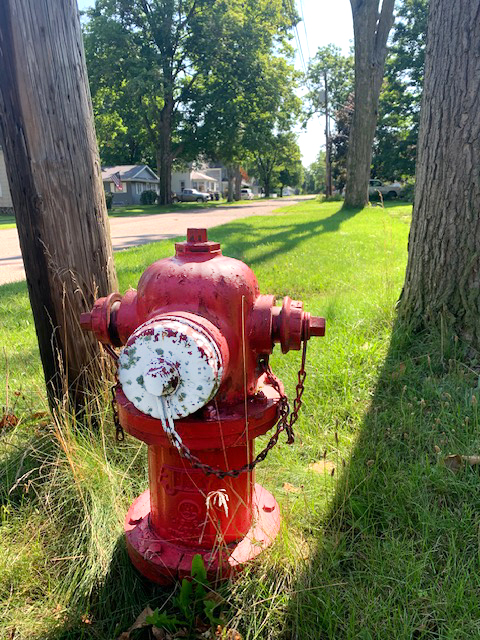
The area of Elm and State streets is included in the area where water lines will be replaced during a $2.5 million project starting later this month.
By Jef Rietsma
A $2.5-million two-season infrastructure project in the northeast quadrant of Vicksburg is set to start later this month.
Village Manager Jim Mallery said crews will be installing new water mains and lead-free service lines in an area north of Vicksburg Middle School. By mid-September, Mallery said preliminary work such as tree removal will be completed and the process will be in full swing.
Mallery said work will be suspended in November and resume in the spring. Completion is expected in May.
In all, 110 homes will have lead-free water service lines from water mains to their home plumbing. Mallery said the new 4-inch mains will replace 2-inch pipes. The work will be done in an area bounded by Rose, Richardson, Wilson and Prairie.
“Ninety-some percent of the water mains in that area were installed in either 1935 or 1955, so they’re between 69 and 89 years old – original pipes, in many cases – and definitely near the end of their life,” Mallery said. “These new pipes are made of a material called ductile iron and are scheduled to last up to 100 years.” Some residents in the area had service lines replaced as part of a water main project a few years ago.
Work will be performed by Jackson County-based Concord Excavating. Mallery noted the new system will be installed under sidewalks rather than under streets. As a result, future work won’t tear up the road pavement.
Mallery said the current water pipes will remain in place; there’s no point in removing them.
Each of the 110 residents impacted by the project signed a consent form, allowing the village to install a service line from the curb to their inside plumbing, Mallery said.
“Our obligation stops at what they call the curb box, but we’ll go ahead and extend the pipes to their house hookup from the curb box if they sign the consent form,” Mallery said.
The village received a $1.2 million grant – nearly half of the project’s cost – through Kalamazoo County.
A similar project, estimated to cost $5.1 million and service 170 residences, is on the radar for 2026 at the south end of the village. By the end of that project, the village will have replaced more than half of its lead-line services, Mallery said. He expects the village expects to receive about $4 million in grants to help reduce the impact on local coffers.
For comparison, the downtown infrastructure project cost $9 million.
Michigan legislators in 2018 required municipalities to replace their lead service lines within a 20-year period. It is urging communities replace 5 percent a year to ensure full replacement by the 2038 deadline. The legislature did not provide funding to meet its requirement.
“We’re six years into this now, which means you’d be at 30 percent if you were doing 5 percent per year on average,” Mallery said. “After the 2026 project, we’ll be over 50 percent and it then becomes very manageable. We’re in a lot better shape than many other communities.”
South County Sewer and Water Authority will reconsider sharing with Vicksburg the use and costs of a new larger pumped-sewage line.
Vicksburg has planned for a larger pipe to keep up with increasing flow. It’s shared an existing pumped-sewage line, a “force main”, with the authority for years. The pipe carries sewage from a pumping station at Spruce Steet north on Sprinkle Road and through Portage’s sewer system to Kalamazoo’s sewage treatment plant.
The authority, which serves about 635 customers in the Pickerel and Indian Lake area, has no immediate plans for major expansion.
Its board in a late July meeting “directed me to investigate our ability to stay in our own line and not join Vicksburg in a new line,” said Executive Director Frank LaPierre. Sticking points, according to LaPierre, were Vicksburg’s call for a “buy-in” payment and a connection cost. The $1.373 million connection cost alone “is a financial hardship for us as we also forecast necessary capital improvement costs of $750K to upgrade our system.”
LaPierre said the authority instead will reexamine the existing line for useful remaining life. If the authority joins the village in use of a new line, the old one would be filled in.
Attorneys representing the authority and the village will look for compromises, LaPierre said.
The authority’s members are Brady, Schoolcraft and Pavilion Townships, although sewage disposal customers reside only in Brady and Pavilion. The authority doesn’t operate a water system.
LaPierre said Lockport Township and its engineers will describe plans to expand their local water system into the US-131 corridor early in September at a Schoolcraft Village Council meeting. Schoolcraft has long sought a safer, more dependable water supply.
A water system is considered a requirement to encourage more commercial and industrial development in and near the corridor. Officials in northern St. Joseph County townships are also pricing out a wastewater treatment plant which might follow the water system and serve the same region. Schoolcraft properties with no sewer system or treatment use septic fields. Most leaders and residents have shown little desire to add a sewer system.