Brady Township residents, worried that their deteriorating paved roads may be converted back to gravel, voiced their concerns to the township’s Board of Trustees at a Sept. 1 meeting which included an annual update from the Road Commission of Kalamazoo County.
The concern in part stemmed from inclusion on the road commission’s five-year plan of half a mile of asphalt pavement on 33rd Street north from YZ Avenue to be pulverized and returned to a gravel road in 2022. The proposal also includes similar treatment for another half mile of 33rd St. from XY south in 2023.
The plan, covering years 2022 through 2026, proposes no other conversions of paved roads to unpaved gravel roads.
There was never a formal plan dealing with that part of 33rd St., Supervisor Tracy Locey said. She acknowledged that while 33rd is on the five-year plan, “It is not set in stone yet. There are some options that the township can consider … it’s just a plan at this point and it’s not in our contract for this year.”
The board after hearing from more than 20 residents about the possible pavement-to-gravel plans agreed to reinstate a township roads committee to review road needs, funding, and make recommendations to the township trustees.
Residents raised concerns about dust, safety due to an inability to stop quickly, health and quality of life, harm to vehicles and possible reduction of home values.
Scott Oswalt, a 33rd Street resident, said he and his neighbors formed a Facebook group called “Brady Residents for Better Roads.” He cautioned that any road converted from paved to gravel is going to create a new set of problems of their own.
“Dirt roads are hard to maintain, they’re muddy in the spring and fall and probably most of the winters, they’re dusty, they’re not able to be salted in the winter and they’re hard to plow,” he said. “I fear for the safety of our residents driving these gravel roads in the winter. My farm employees and I drive these roads every day in the winter … up and down hills, around corners. I request a pause on any plans until we can figure out what the heck we do.”
The roads committee will have three to five members. Those interested in serving can find a resident’s interest form on the township’s web site at bradytwp.org later in September.
Locey said the township takes road-related direction and guidance from the road commission. Still, she added, the five-member board of trustees has ultimate say in issues relevant to the roads under its jurisdiction.
“We can always say, ‘No, we think your plan is horrible, now go figure something else out,’” Locey said. “But right now, the township hasn’t taken any action as to what we’re going to do.”
Locey said the road commission has rated the stretch of 33rd Street using a formula and determined it to be in “extremely poor” condition.
“You no longer can just throw down asphalt or do that chip-seal like they did recently on Sprinkle Road, it’s well past that,” Locey said. “Unfortunately, Brady Township, along with every other township out there, has trouble with having enough money for roads.”
Locey said Brady Township is allocated about $90,000 annually from the road commission. The funds, however, are issued on a matching basis. So, to receive $90,000, Brady must put up $90,000. She said as far back as she can remember, Brady Township has always budgeted to meet the matching funds.
Locey said the township asked voters for a property tax dedicated to roads in 2002. It failed. “We don’t have that option (for road funding).”
She speculated the cost of tearing up the section of 33rd Street and reconstructing it would easily fall outside the township’s budget.
Locey said turning formerly paved roads into gravel routes is not unprecedented. She said examples can be found as close as nearby Wakeshma Township.
“I understand what the residents’ challenges are … they live on a road that was paved and now maybe it’s not going to be paved,” Locey said. “I understand their frustration. We had several members of that area attend our board meeting about a week ago and I know that they’ve also gone to some road commission meetings. But I think they feel like they’re not getting everything that they want. Unfortunately, I can’t just say, ‘I’m going to write the check and redo your road.’ It would be great if I could.”
The Road Commission’s managing director, Joanna Johnson, and its engineering and public relations director, Mark Worden, gave a half-hour presentation that covered all aspects of the agency, its funding and operations.
Johnson said the road commission is not trying to make life miserable for Brady Township residents. “We absolutely and totally agree with you that all roads matter and we all want the same thing,” Johnson said. “We don’t need to fight. We are actually here to work together.”
Johnson and Worden appeared to answer many of the questions residents had expressed earlier in the meeting. Johnson said reestablishing the township’s road committee was a logical next step. Worden noted Brady Township’s options are:
• Do nothing and continue operating with the same approach as it has the past 20 years.
• Apply a special assessment of each property on a project-by-project basis.
• Pass a township-wide special assessment.
• Offer a township road millage for voters to approve or reject.
A five-year plan of road projects for Brady Township for 2022-2026 lists projects estimated at approximately $180,000 in each of those years, with the Road Commission for Kalamazoo County paying half from its distribution of state funds, the township paying half from its general fund.
The five-year plan also lists unmet needs totaling $1.7 million.
The agency assigns a number from 1 to 10 indicating quality of road segments in each township, with a 10 assigned to new pavement, a 1 to a road in poor shape. The road commission has proposed to pulverize pavement on a few of those lowest-rated segments, returning them to gravel roads.
An advertisement in this issue of the South County News, placed by a group of Brady residents opposed to reversion of roads to gravel, includes the road commission’s list of 18 township roads in grades 1-4, calling them “poor to failing.”
The roads listed are those shown with red lines on a road commission map of the township. “Red doesn’t mean failed,” said Mark Worden, the road commission’s engineering and public relations director. “Until we deem them as failed, they’re just in poor condition.”
When a road is designated as “failed,” Worden said, owners are notified and invited to a meeting in the township hall to discuss the matter. If needed, warning signs may be posted.
In 2022, the plan proposes work in Brady estimated at $181,750: chip-sealing a quarter mile of X Ave. at a cost of $7,250, filling cracks and chip sealing portions of 30th, 29th and 28th streets totaling three miles at a total cost of $152,000 and pulverizing half a mile of 33rd St. north of YZ Ave. at a cost of $22,500, making it a gravel road.
In 2023, it proposes filling cracks and chip sealing half a mile of 32nd St.at a cost of $27,000, pulverizing and surface paving half a mile of 34th St. from V to VW at a cost of $143,000, and pulverizing another half mile of 33rd St. south of XY Ave. and returning it to gravel, all at a total cost of $192,500.
In 2024, it would fill cracks and chip seal a mile of 32nd St. for $40,000 and gravel, pulverize and resurface half a mile of 34th between W and VW for $143,000.
In 2025 and 2026, the plan proposes preventive maintenance only.
The total estimated cost of the work proposed over the five years: $936,550.
The unmet needs list proposes surface paving of five roads and returning three more to gravel: YZ Ave. from 33rd St. to 34th, 33rd St. from XY to X Ave. and ZY from 32nd St. to 4,140 feet east of 33rd.
Worden was asked approximate per-mile costs of several kinds of road treatments. Reconstructing a mile of asphalt costs about $300,000; returning to gravel, about $40,000; chip-sealing, $20,000-35,000.
Children and staff return to classrooms this fall, brimming with edgy excitement. As I begin another year of teaching, you would think the nervousness would subside; after all, I’ve been instructing in a high school classroom for over twenty years. But each year, I am as excited and nervous as I was every fall as a student.
At summer’s end, we stuffed our tanned feet in new school shoes, and fresh-smelling and well-scrubbed from our Sunday-night-baths, my brothers and I climbed the steps of the bus and perched on the “jumper seat,” the first-row bench at the front of the bus. At the next stop, we moved to a seat somewhere behind us. This was an efficient system, as it saved time.
We chugged down the dusty backroads to Fulton Elementary School with one of three bus drivers: Mrs. Bailey, Mrs. Gorsline, or Mrs. Lewis. They kept us safe and seated. They knew our parents and our names, and they anticipated problems before they started. They could look up at their slanted mirror, see their charges behind them and correct behaviors with just an eyebrow. As a person who works with young people (and have raised three kids of my own) I now recognize this as a spectacular skill: Those women never raised their voices – they just controlled us with careful, continual surveillance. (There was also the unspoken threat of a phone call home, to which this generation’s parents said, “If you get in trouble at school, you will be in ten times more trouble when you get home!” I’m sure that contributed to the effectiveness of the raised-eyebrow discipline strategy.)
I loved school – every part of school – which is probably why I became a teacher.
The squeak of freshly waxed floors. A new teacher smiling at the door. The desks with a compartment for belongings. The world map hanging on the board and the excitement of learning. I loved a sharp pencil and a crisp sheet of paper. I loved a book and the quiet turning and shuffling of pages. I loved the smell and colors of a new box of crayons with all their tips intact. I loved the light coming in our classroom windows and the playground waiting beyond the double doors.
Our elementary didn’t have a cafeteria, so we lined up to pick up our school lunch or the bottle of cold milk. We then returned to our classrooms to eat as quickly as we could, then we busted free for recess.
Mrs. Cree and Mrs. Brookings kept careful watch on the playground, breaking up inevitable skirmishes, suggesting activities, and dispersing various balls for team activities.
Our friends with older siblings taught us the accepted games and rules. We learned to jump rope and the timeless rhymes. We learned to slide up and sit on the concrete tiles, to hang upside down on the monkey bars, to play hopscotch and tether ball. We kept tiny magnifying glasses in our desks and took popsicle sticks out to experiment with wood burning. We were successful, but Mrs. Cree wisely brought that activity to a quick end.
Much has stayed the same. Children today continue to play games at recess, and in our districts, the playgrounds offer multiple climbing structures and many areas for games. Children also learn the rules and how to play and work together, and, I hope, at least a few are future teachers who will love returning to school each year.
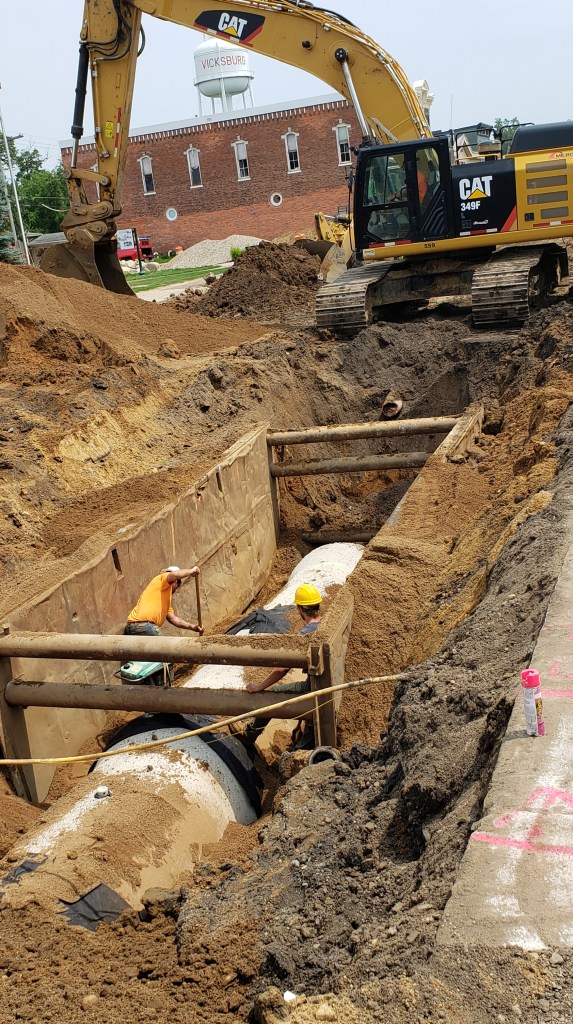
Left: Storm drain installation on the corner of Prairie Street and South Michigan Avenue. The steel trench box protects workers from cave-ins.
By Bob Ball
Pipes, heavy earthmoving equipment, dirt streets and hard-hat workers have replaced pavement, sidewalks, cars, pickups and pedestrians in downtown Vicksburg.
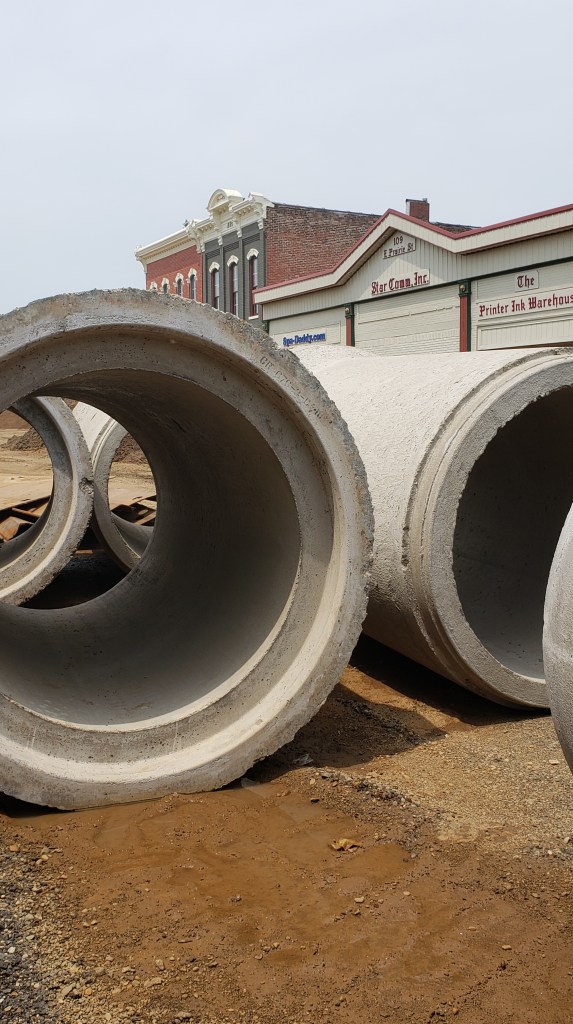
Large concrete pipes have been parked on Prairie. Smaller green plastic pipes, bundled in fours, have waited on Washington. Still smaller black iron pipe is stacked at Prairie and North Richardson.
Interlocking sheet piling is stored on Prairie. So are large steel trench boxes. Both are needed temporarily to shore up excavations for protection of workers and equipment.
Village Manager Jim Mallery, DPW Director Randy Schippers and Jason Washler with the engineering firm of Prein&Newhof described what’s to be seen and what’s happening with it.
The concrete pipes: They’re storm drains, increasing capacity for storm water toward three outfalls, one into the creek in Clark Park at a depth and in a location that required eliminating the waterfall, the other two into Portage Creek at Washington. Installation, to a depth of approximately 10 feet began on the village’s east side. A map provided by the engineering firm shows new drains are being buried on Prairie from Pearl to Michigan with short spurs on North Richardson and North Pearl. The new drain also continues south on Main from Prairie to Washington, west on Washington to South Mill and for a short distance north on Mill. Washler said diameters range from 48 inches between Clark Park and Main and decrease in size upstream, to 15 inches at Elm.
There are three sets of circular chambers, “hydrodynamic separators”, designed to collect debris washed into the drains, preventing it from reaching the lake and streams. Storm water flows into the first chamber of a set, said DPW Director Randy Schippers. There, the debris is deflected by a fiberglass insert and is pushed into adjacent chambers while the storm water flows on toward the receiving stream.
The sewers: The village sanitary sewer system routes sewage north toward a connection to Kalamazoo’s sewage treatment plant. Differing elevations in the village require a combination of gravity sewers, lift stations and pumped “force mains.” Work underway includes replacement of a sewer line from the final pumping station at Spruce near Richardson south to Prairie via Spruce and Pearl. There, it connects with a sewer on Prairie from Wilson to Michigan. A connection from the Prairie sewer connects to another on Main from Prairie to Washington and from there on Washington to Mill and a lift station on the south side of Washington. Another new segment serves the Centennial and Trillium subdivisions via a force main to the lift station on Washington. Sewers in diameters of 21 and 24 inches are buried to approximately 15 feet. Stubs of vertical pipe projecting up at several places, Washler said, “mark locations for sanitary sewer connections yet to be finished.”
Water: Existing water mains are being replaced with 8-inch and 12-inch ductile iron pipe on portions of Spruce and Division, on Prairie from Wilson to Main, on Main from Prairie to Washington and Washington to Mill. An older four-inch main downtown is being taken out of service. Water mains are buried at depths of five feet. Washler said that work will begin early this month on Prairie between Kalamazoo and Main.
The contractor is Allegan-based Milbocker & Sons. The project, costing approximately $11 million, most of it for sewer work, is being financed by a 40-year low-interest loan through the U.S. Department of Agriculture. Repayment will come from increases on water and sewer charges.
“The contractor is currently planning on completing 95% of the work on these streets before the end of the traditional construction season November 15,” Mallery said. “There will likely be work that needs to be finished in the spring.”
Pipes for all three systems – storm drains, water and sewer – will be placed at varying depths on Main from Prairie to Washington. The village is using construction as an opportunity to redo that portion of Main: The block-long segment will become one-way southbound. Sidewalks will be widened to a minimum of 13 feet, Mallery said.
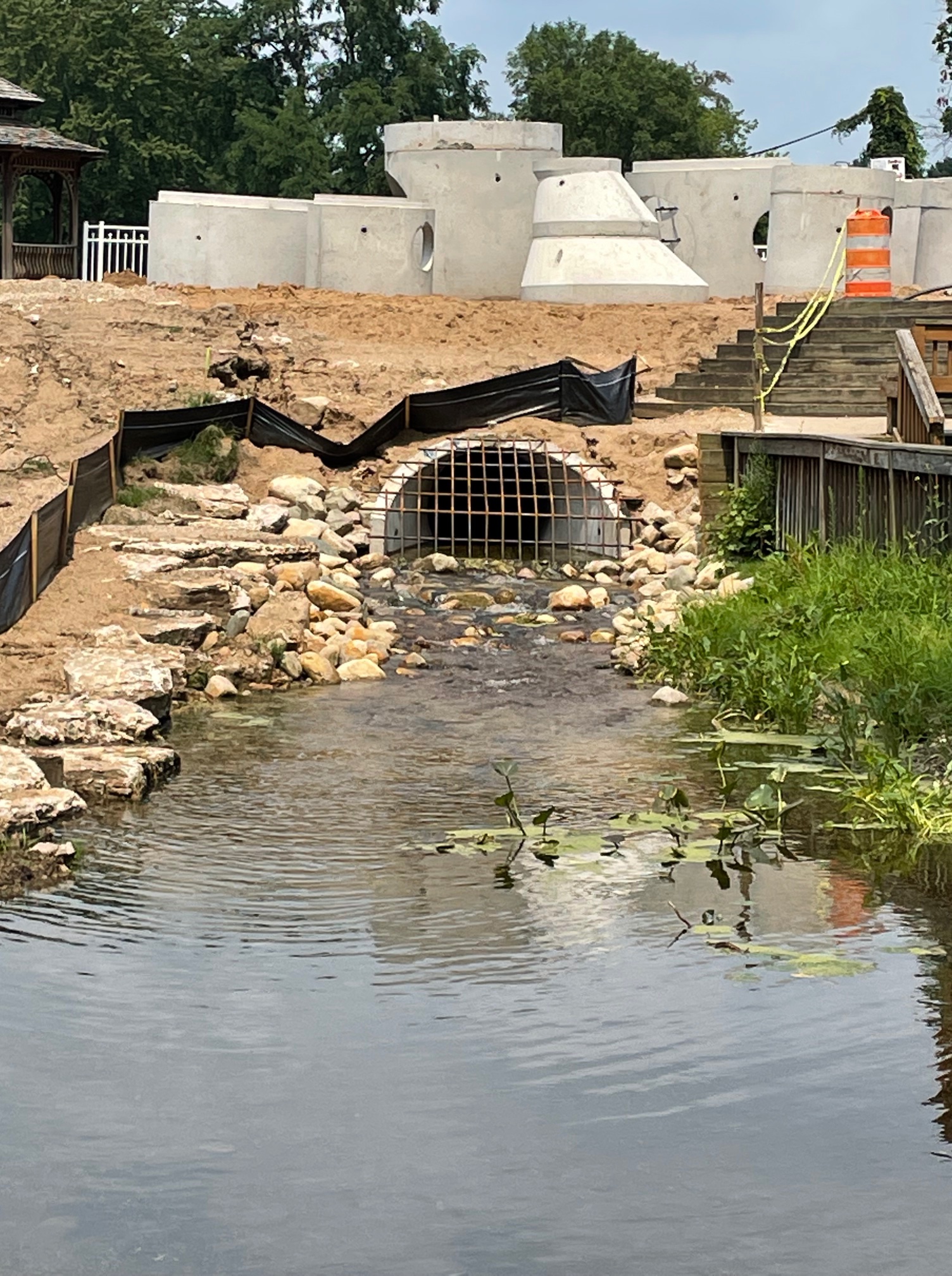
The outlet from a 4-foot-diameter storm drain replaces the waterfall that graced the north end of Clark Park at Prairie St. The pond was filled in and lined with concrete rip-rap. Photo by Rob Ball.
By Jef Rietsma
The demise of the waterfall at the north end of Clark Park was disclosed to Vicksburg village officials more than 18 months ago when plans for the current infrastructure project were being put together.
The flow ended in recent weeks when a pipe from a pond fed from nearby Sunset Lake was closed. Reopened, it continues to carry water from the pond, but it comes from the mouth of a 48-inch storm drain opening into the park.
Village Manager Jim Mallery said he understands sentimental attachment to the waterfall. “The pipe that came out of there was 18 inches. Now it’s 48 inches and rests 3 1/2 feet lower than the pipe that was there. So there goes the waterfall without that 3 1/2-foot elevation drop,” Mallery said. “The creek bed, up to the bridge, will be lined with large rocks they call rip-rap. They extend maybe 15 or 20 yards, but all the (rocks) that are down on North Main Street will be brought down to line the stream.”
Mallery said as crews continue with the downtown infrastructure project, they will eventually construct a wall above what will be a south-flowing stream in place of the waterfall.
Under normal circumstances, he said, the flow of the water will remain the same as it was previously. Mallery did note periods of exception.
“The flow of water from the pond between Vickers and Apple Knockers will be the same. But historically, the downtown has not had a storm-drainage system. So now, in the collection of the stormwater in the downtown area, that will flow out into that creek,” Mallery said. “During times of rain, the flow will increase.”
Mallery said he was surprised when he found out the waterfall would be removed but repeated that there wasn’t a lot the village could do to save it. Furthermore, there are some benefits to the reconfigured drainage system.
“To the people who felt a connection to the waterfall, I am sorry.” But, he added, the state Department of Environment, Great Lakes and Energy and the project engineers “aren’t going to put a waterfall back. On the upside, it will be lined appropriately, it’ll flow appropriately. We’re putting drainage in the park so hopefully that keeps the park dryer than it historically has been underneath the overhang, and there’ll be a wall constructed that will look a lot better than it did before.”
Stormwater will flow through a device which removes debris before reaching the creek.
As the director at South County Community Services (SCCS), I have seen firsthand how United Way helps people in our community. We benefit from both the local Vicksburg campaign and from the United Way of Battle Creek and Kalamazoo Region.
Although the organizations are linked, all money raised in Vicksburg stays in the area (minus a small administrative fee). We enjoy working with both groups – each works to build awareness of community-wide issues and work with nonprofit recipients of funding to build competency in things as diverse as strategic planning, building a more engaged board of directors, and helping to meet increased need due to the effects of COVID-19.
Today, however, I want to talk about some of the things that SCCS has been able to do with funding from Vicksburg United Way (VUW). For years, VUW has supported our Senior Outreach efforts – first, as we surveyed the area for local senior need (and found lots!) and later, when we began amping up our outreach efforts to the seniors we found who were isolated and had no other supports.
Because of VUW, we were able to create a position and apply for funding through the senior millage to support it; now, we have a senior outreach coordinator who works four days a week running programs that support seniors, meeting with seniors who need assistance, and connecting seniors to services that are readily available to those living in Kalamazoo or Portage, but that are difficult to access for many people who are isolated and living in rural areas.
This past year, VUW awarded us funding to restart Safe At Home, a program that was piloted in partnership with Rotary in 2019. This program is coordinated by our senior outreach coordinator and aims to help seniors remain in their homes by providing low-cost, safety-oriented home repairs. During the original pilot program, we were able to install assistive devices, reflective address signs, and a ramp. We had a little trouble getting the program off the ground during COVID-19, but now that it is once again safe to go back into seniors’ homes, we are beginning to work with people and do in-home assessments once again. This is a much-needed program and we are excited to be able to offer it – and very thankful for Vicksburg United Way’s support in providing it!
Now, I may be a little biased, but I for one am all in for United Way. They have supported us in providing essential programming that almost certainly would not be available without that support. They have supported other organizations as well – like Generous Hands, Miracle Field, and the Vicksburg Schools – to make this community a great place to live and work.
If you don’t know all about the different nonprofits in the area, but you know that you want to make a difference, Vicksburg United Way is a great place to start. Everyone who receives funding from them has been thoroughly vetted by people living in your community, who know the needs of the area and the people running the organizations. And, just like I am all in for United Way, they are all in for US.
If you are interested in supporting Vicksburg United Way, please follow the link below or scan the QR code. If you want to know more about South County Community Services and what we do for the community, please call 649-2901 extension 4 to talk to me!