


By Jeanne Church
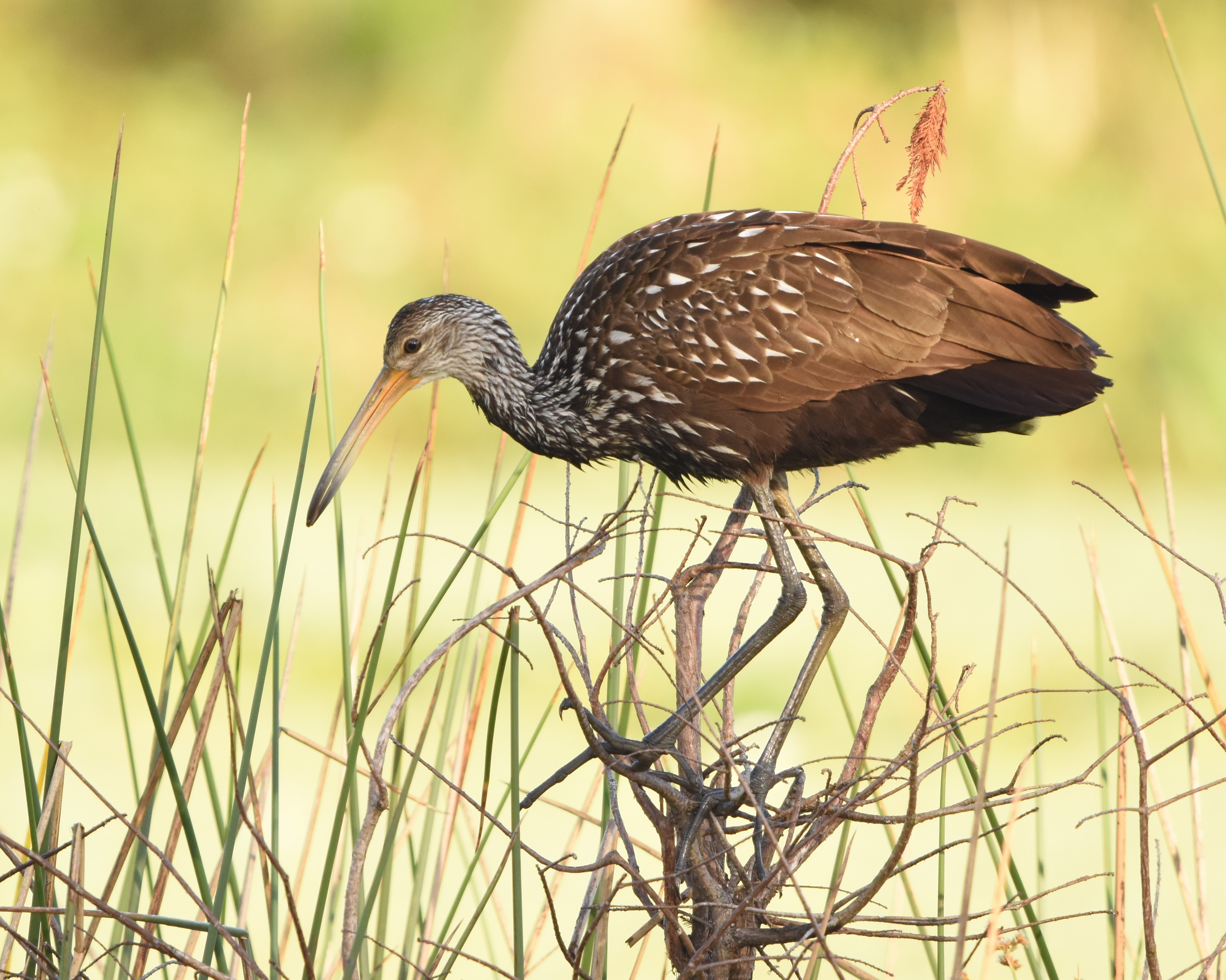
In February of 2019, while we were spending a few months in sunny St. Petersburg, Florida, I had the opportunity to photograph a wide variety of interesting and unusual birds that are not typically found in Michigan, like this beautiful limpkin. In the United States, limpkins are found primarily in Florida. They are also widespread throughout Central America. Within the last few years, though, limpkins have been showing up in Missouri, Iowa, Wisconsin, Minnesota, Ohio, Indiana, and Michigan! What makes this so unusual is that limpkins are not migratory birds! They are a long way from home and no one knows exactly why.
The first limpkin sighting in Michigan occurred in early August of 2022. A 10-year-old boy and his father spotted what they suspected was an extremely rare bird wading along the edge of an island in the Grand River near Grand Haven, Michigan. They were paddling along in their canoe when they both noticed the brown and white bird driving its bill into the mud. Both father and son were avid birders and knew immediately that the bird they were looking at was a limpkin, and that no one else had ever reported seeing one in Michigan prior to their discovery!
One year later, in September of 2023, another limpkin was spotted wading along the Thornapple River in Barry County, Michigan and another one in Albion near the Whitehouse Nature Center. Then, on January 8 of this year, one showed up in Greenville, and another one appeared in Montcalm County the following day. What was going on?
Chad Machinski, a conservation manager with the Michigan Audubon Society, said that it’s difficult to pinpoint the exact reason why limpkins are showing up this far north. He noted that Florida, which is the limpkins’ home territory, has lost many of its freshwater wetlands over the years and that “This may be putting a strain on the available habitat for limpkins, causing the birds to be more exploratory. Limpkins can be spurred to wander if their wetland habitats dry up.” Machinski also went on to say that Michigan might be an attractive place for limpkins to visit because it has a large, invasive species of snail called the Chinese mystery snail.
In their home territory, limpkins feed almost exclusively on apple snails. The tip of their long bill is curved slightly to the right and it has a gap just before the tip that acts like a tweezers, making their bill uniquely well adapted to foraging for these snails. We don’t have apple snails here in Michigan, but the invasive Chinese snail has proven to be a very good substitute for them. Unfortunately, these snails are reproducing faster than they can be eaten by predators such as the limpkin.
Limpkins are beautiful but somewhat non-descript birds with brown and white feathers. They blend in quite well with the surrounding landscape and can be easily overlooked as they stalk the marshy vegetation looking for snails. Limpkins are not easy to see, but you’ll know they’re nearby when you hear their loud, piercing banshee screams! Because of this distinctive wailing sound, limpkins are sometimes called the “crying bird”. Their given name, limpkin, however, comes from the way they hobble along through mucky terrain giving the distinct impression that they are limping.
I expect we will continue to find more and more birds like the limpkin who show up at our doorstep far beyond their expected range. It’s always exciting to find these rare birds, but never a good thing if they’ve arrived here because of habitat loss, climate change, or catastrophic weather events that have thrown them off course. We are currently experiencing far too many of these environmental disruptions and the impact on all of us is cause for concern. To me, it’s like the canary in the coal mine.