

This is a story about woodchucks. But they’re also called whistle pigs, and I love the name whistle pigs! It always makes me smile.
The “whistle” part of their name refers to the high-pitched sound they emit as a warning to each other about nearby predators. The “pig” part may just be a nod to their rodent cousins, the guinea pigs.
Woodchucks are also called groundhogs, land beavers, and thick woods badgers. In truth, they are neither pigs, nor hogs; beavers or badgers. They’re squirrels—the largest, in fact, of five squirrel species that include the Eastern gray squirrel, American red squirrel, Southern flying squirrel, and the Eastern chipmunk.
As children, many of us learned the tongue-twisting rhyme, “How much wood could a woodchuck chuck if a woodchuck could chuck wood?” It was a fun little riddle, but we had no idea what we were talking about! Woodchucks rarely chew wood and they certainly don’t chuck it! But one Cornell wildlife biologist wanted to know the answer to that riddle and measured the volume of a typical woodchuck burrow. He then estimated that if the hole were filled with wood rather than dirt, the woodchuck would have chucked about 700 pounds of wood!
In all likelihood, the woodchuck name originated from the Native American word, wuchak, which roughly translates as “digger.” Woodchucks are, if nothing else, prolific diggers. Their extensive burrows can be 6 feet deep, 20 feet wide and up to 100 feet in length, with multiple entrances!
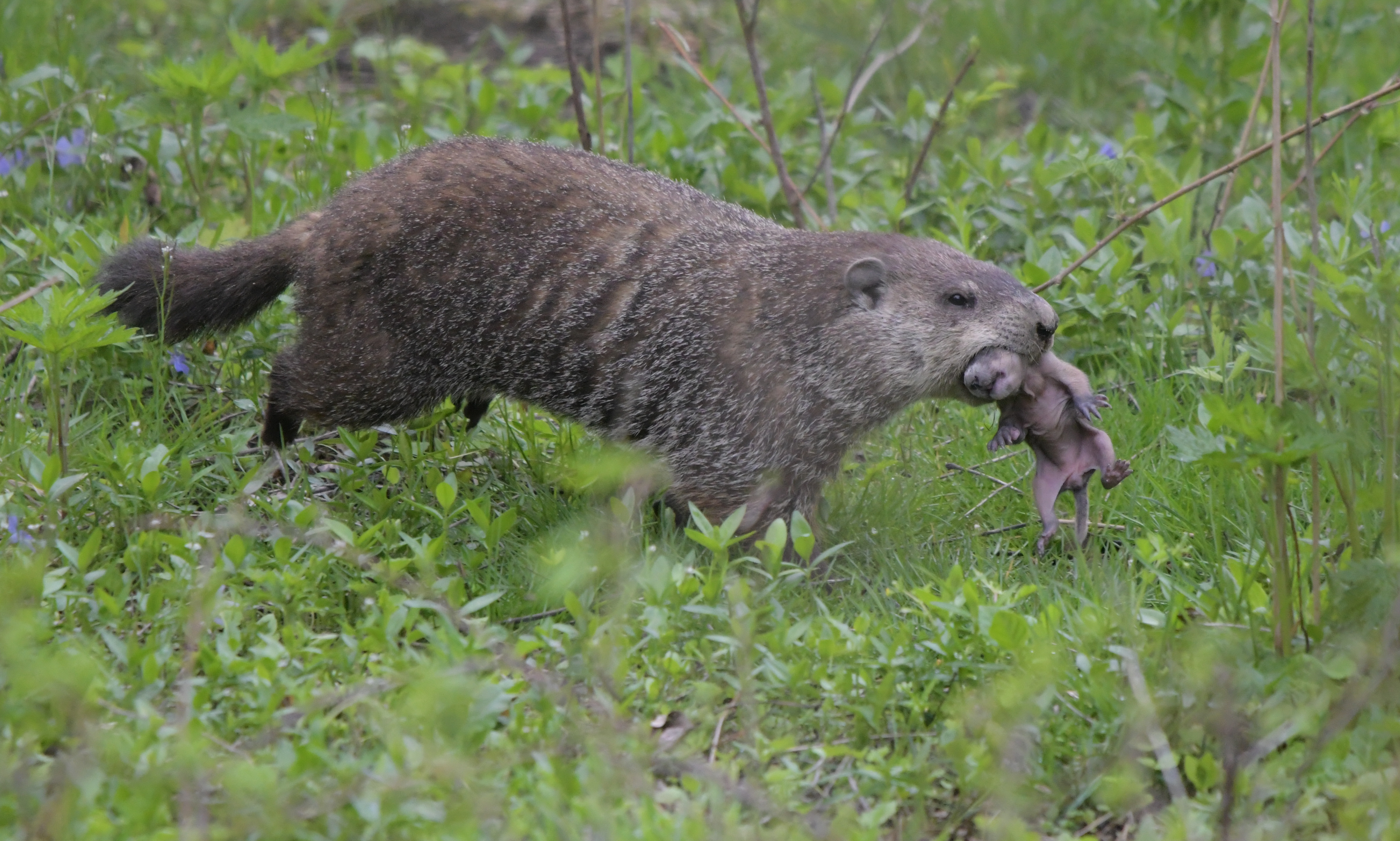
I started down this whistle-pig rabbit hole quite by accident while standing in our backyard taking pictures of birds. There was something going on in the brush about 50 feet from where I was standing and I turned my camera in that direction to get a closer look. It was this very industrious mama woodchuck transporting her babies in her mouth one by one from point A to point B. I’m not sure why she was moving them, but my first thought was perhaps a predator was nearby, or maybe the den was getting just a little too messy with all those babies! Later, when I was doing research on woodchuck behavior, I was delighted to learn that those baby woodchucks are called “chucklings.” What an endearing name!
I do realize that not everyone is as fond of whistle pigs as I am. If I were a gardener or a farmer, I might not be so easily amused by their cuteness either. Whistle pigs love vegetables, especially broccoli, peas, beans, carrot tops, lettuce, cucumbers, parsley, and squash! They eat about a pound and a half of vegetation every single day, meaning that a pair of them could plow through your entire garden in less than 24 hours! They’ll also gobble up your blackberries, raspberries, cherries, and other fruits, as well as the bark off your hickory and maple trees!
In defense of whistle-pigs, it’s important to know that they are considered a vital keystone species; a species on which many other creatures in our ecosystem depend. If whistle pigs were to be completely removed, the results would be disastrous. Their burrows provide shelter for rabbits, foxes, skunks, opossums, snakes, raccoons, amphibians, and burrowing owls. They’re also an important food source for a variety of predators such as eagles, red-tailed hawks, falcons, coyotes, foxes, and bobcats. Not only that, woodchucks are responsible for eating a wide variety of creatures in your garden that are considered pests, namely June bugs, grasshoppers, grubs, and snails.
Like so many animals in our environment, whistle pigs bring joy to some and irritation to others. I prefer joy. It’s not always easy to live in harmony with the creatures around us, especially when they damage or destroy the things we love, but it’s imperative that we do so. Their survival impacts the survival of countless other living things and, ultimately, our own.