

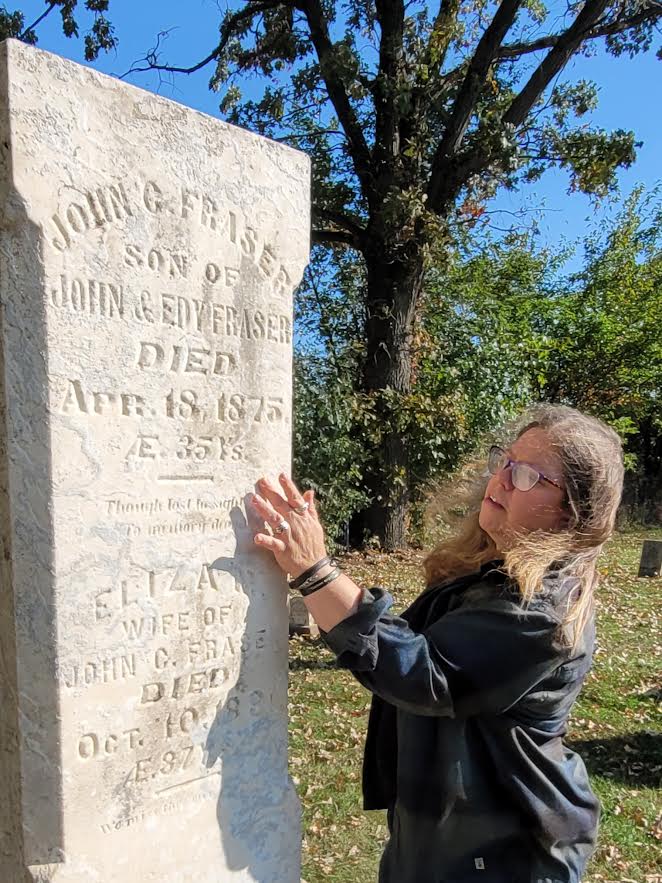

Dusti Morton is a person with a big engaging smile, a vast knowledge, and a deep and determined passion for what she does. She also likes words.
I made that assumption after noticing words on her clothing, her jacket, and the bumper stickers plastered on the back of her vehicle. During basic introductions, I learned that she is a member of the Association of Gravestone Studies, attends conventions associated with the organization, and is looking forward to the next gathering at the historical Gettysburg Civil War site.
A conversation with Dusti is a pure delight.
Information pours out in unanticipated volumes, leaving a listener wondering which of the next questions to ask first. Today’s conversation? The deDie-Richardson Cemetery, also known as the Clement Cemetery, in Brady Township. Dusti approached the township about doing research and restoration work. “I signed a waiver and was granted permission,” Dusti said, “I do not work in the newer sections or on graves that are being cared for and maintained.” Dusti ads, “It takes on average, three generations for a grave to become unvisited and unattended.”
There is a developing science dealing with restoration of markers and monuments and the solving of mysteries that each cemetery or graveyard contains. “The greatest threat to markers are people, trees and lawnmowers,” Dusti says. “Improper cleaning and repair methods can do more harm than good.” Trying to solve the mysteries of the who and when associated with the residents can be a complicated task of reviewing cemetery records, obituaries and death certificates, but the advent of the Internet, the development of associations and groups working together, and the careful chronicling of local volunteers is making searching options easier.
Some of the more well-known people in the deDie-Richardson Cemetery include the Fraser family. Jeanette Fraser was a spiritualist who owned a 40-acre plot south of Vicksburg known as Fraser’s Grove. In the late 1800s and early 1900s it drew large groups of spiritualists and metaphysics students to the area during their August Spiritualist Camps. Jeanette Fraser’s dream was to have a permanent metaphysical school in Vicksburg. According to Dr. Arle Schneider in his book “A Tale of One Village”, “By 1927, this longstanding Spiritualist Camp Meeting had evolved into the School of Divine Metaphysics and Psychology, and was now a leading center in the middle west for instruction in metaphysics and applied psychology.”
“Meta” means beyond or across and “physics” means the physical, in this case the physical world. It is about the unseen world of spirit, energy and consciousness, and a spiritualist is a person who believes that people can communicate with the spirits of the dead and that the deceased continue to exist after death. Dusti says, “I may talk to the deceased about what I’m doing to improve their gravesite, but I have not heard back, at least not yet.”
Dusti wears a large ring in the shape of a coffin with an interesting stone. When I ask about the ring, I’m told the stone is a polished gravestone. This seems odd for a person with a commitment to preservation, which leads to an interesting discussion on how some stones are found.
It turns out that stones that tip over, or are knocked over, often by mowing, are often just piled up in corner of some cemeteries. Some cemeteries remove footstones from graves to accommodate bigger mowers, and some stones just deteriorate beyond repair. The ring is made from Norwegian Moonstone (Larvikite} that was ethically obtained. It was ordered and not made from the restoration work done by Dusti. If you’d like to follow Dusti’s work in the deDie-Richardson Cemetery, she has a wonderful Facebook page titled Clement Cemetery.