


By Danna Downing
There has been lots of cultural wisdom shared about the value of sleep over the years. But, until the last two decades, we have been short on scientific research about sleep. And, health advocates have yet to adequately educate the public about this most recent research. Hence, we are still a society where one in three of Americans report sleep problems and life-diminishing difficulty in getting enough rest and sleep every day.
In his book, “Why We Sleep”, Matthew Walker PhD, director of UC Berkley’s Sleep and Neuroimaging Lab, frames a groundbreaking exploration of sleep from a uniquely scientific point of view. He bases his work on the most recent explosion of scientific discoveries about sleep. His work sheds new light on the critical need we have for sleep, and should inspire public health advocates to focus on helping us to better understand how sleep works and how we can unlock the power of sleep for ourselves. Such an investment would allow those who suffer from sleep deprivation to find the way to a longer, more productive, and satisfying life.
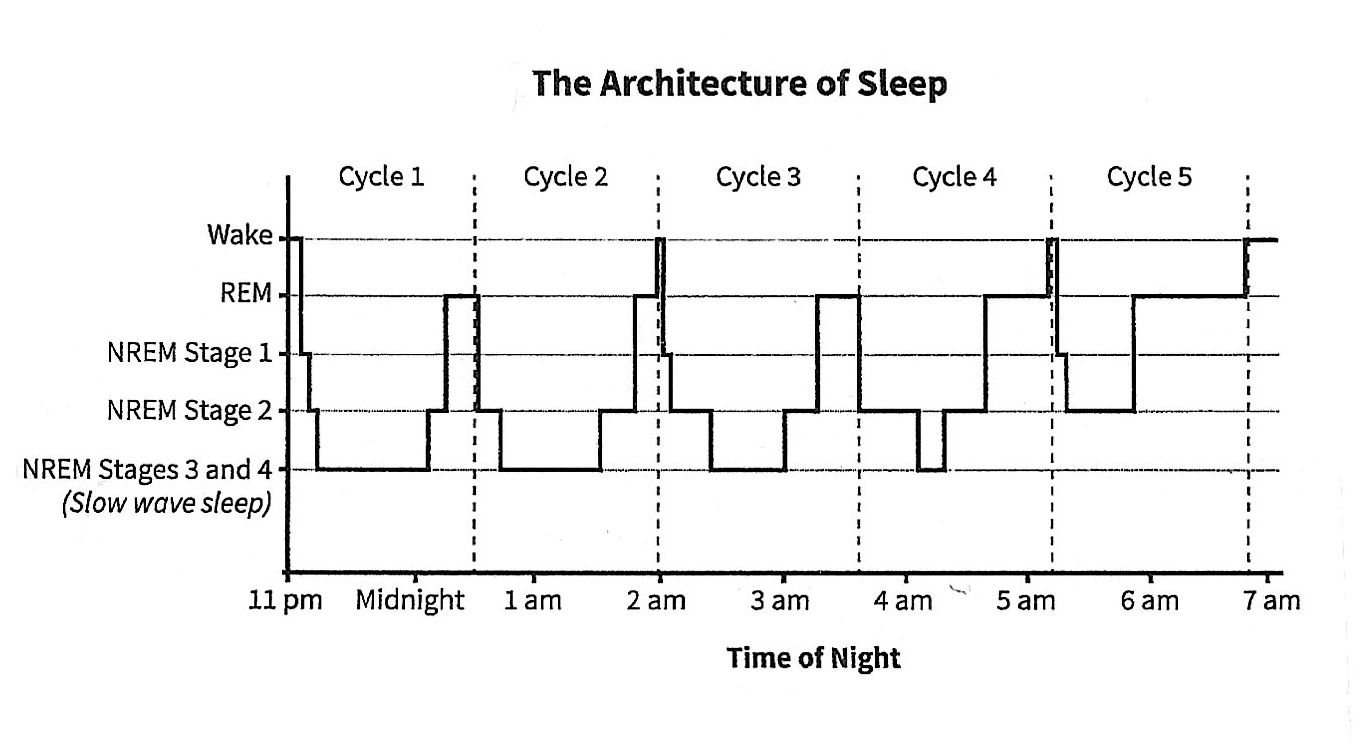
Our nighttime sleep is an exquisitely complex, metabolically active, and deliberately ordered series of unique sleep stages which are well documented in over 17,000 well-scrutinized scientific reports, according to Walker. Using the sleep graph provided here, we can begin to understand the architecture of human sleep and how it is designed to support and restore our bodies in a unique and miraculous manner.
For humans, “the cerebral war between two kinds of sleep stage (REM (rapid-eye-movement) and NREM (non rapid-eye-movement) is won and lost in each of multiple 90-minute cycles.” Each kind of sleep has specific roles and benefits for the sleeper. Per the illustration, early in the night, NREM sleep in descending steps, followed by a recurring push/pull battle for brain domination by REM sleep, is repeated throughout a night of sleep. In theory this provides the sleeper with an adequate number of hours of sleep. Our brain is most active during deep NREM sleep and most restful during REM sleep. REM sleep has two vital functions designed to improve the quality of our waking hours. REM sleep helps us navigate life’s complex socioemotional signals. These signals are very abundant in human culture and critical to surviving and thriving in a human community. Another critical function of REM sleep is to help us accurately recognize and understand signals to the brain. This in turn helps us to make more intelligent decisions about the actions we take each day. That is also why REM sleep is so important for mood management, sharper memory skills, making healthy decisions, and increased immunity to diseases.
Quality and length of time at rest play critical roles in our health and quality of life. Fortunately, it is never too late to apply what we learn to create the future we desire. Most of us can do better at designing and assuring a good night’s sleep on our own. However, we should not be afraid to employ experts to assist us in achieving our sleep goals. Most importantly, we need to make a commitment to taking some first steps and to not getting too discouraged if what we try does not work instantly. For those of us at a certain age, we may need to reconcile with our aging bladder habits and need for medicines to make improvements in a creative manner. On the other hand, we have lived long enough to realize how energy expended relates to improved outcomes. Walker offers many tips for good sleep. Resources such as the National Sleep Foundation, the American Sleep Apnea Association, the Restless Leg Foundation, and the National Heart Lung and Blood Institute can be helpful. Whether you are a caregiver or are receiving care yourself, you can establish a good sleep routine for bedtime and improve your sleep environment. This “priceless cure” is good for everyone!