

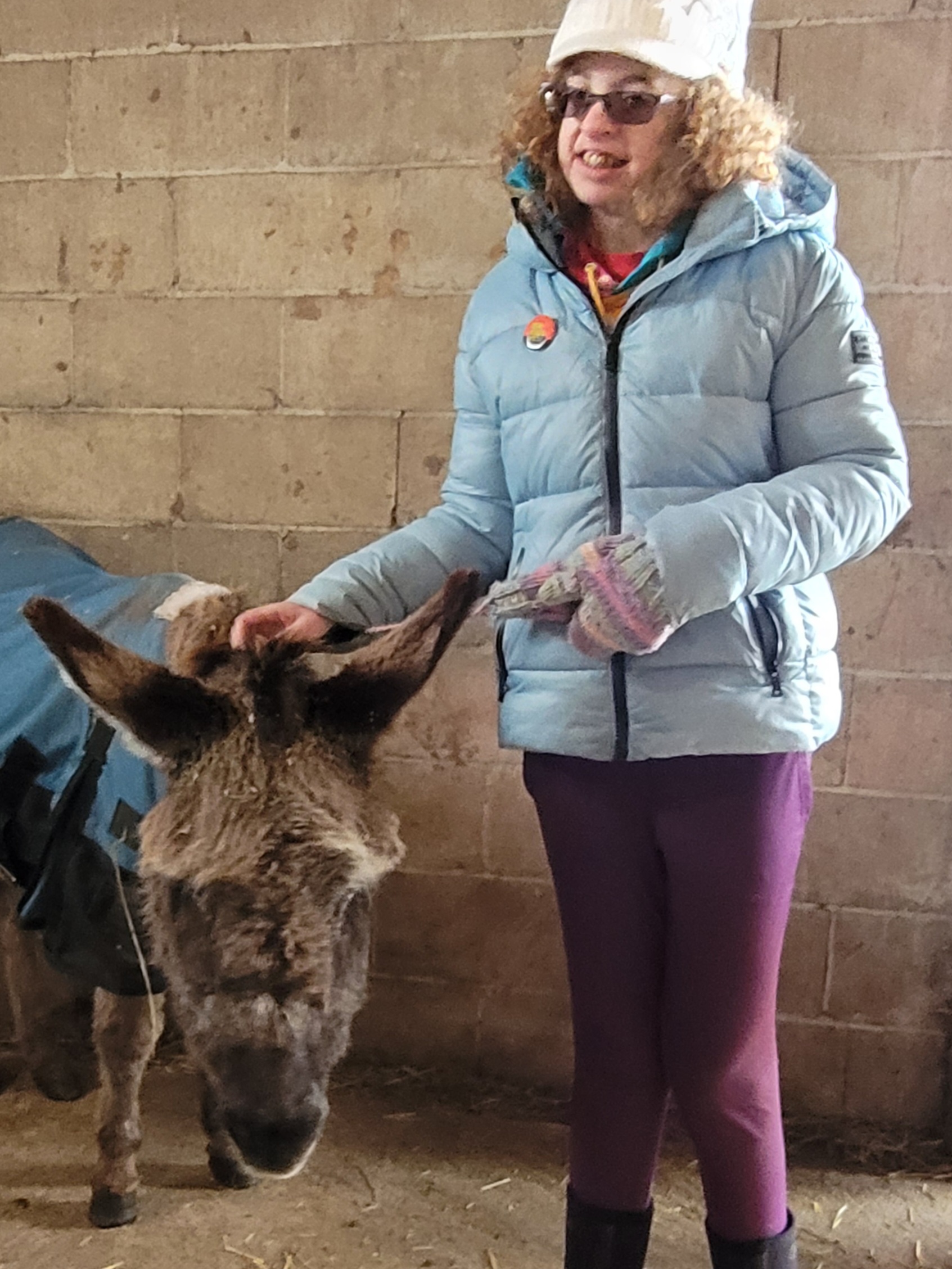
AACORN participant Mary Lee McNelis tends to the farm’s mini donkey named Harper.
“Neurodivergent” is the latest term to describe people whose brain differences affect how their brain works. In that discussion “neurotypical” would refer to most of us. While the words have changed, people have not. Other expressions used include developmental differences, special needs and autism. For the first 200 years of our country’s existence, children with additional needs were denied adequate schooling. Special education didn’t begin until the early 1970s and since that time, post-school programming and housing options for adults with intellectual and developmental differences are extremely limited.
Children with additional needs in Michigan are eligible for education through the age of 26. Those services are provided through an individualized education program, an IEP. These services are invaluable, but there are some difficult realities for the parents of these children. Many of these children will not celebrate the milestones of their peers. They won’t meet state testing standards, they won’t graduate with a diploma, learn to drive, attend college, find full-time employment or move away to start families of their own. It’s also possible that they could lose the love and protection of family by outliving their parents. What happens when these young people age out of educational services?
I took that question to Mary Pickett, executive director of AACORN (Adult Agricultural Community Options for Residential Needs) located northeast of Vicksburg at 6409 South 34th Street. The program was started in 2011, but the current 40-acre farm was purchased from Tillers International in 2018. The farm has several buildings including a caretaker’s home, a barn and the newly built Dr. Liz Farner Activities Building. Permanent residents on the farm include chickens, goats, pigs, a mini donkey and a mini horse. Pickett says, “We hope to add a residential component in the next three to five years with housing consisting of private bedrooms and bath and shared kitchens and living areas.” Participants, including KRESA Young Adult Program students, take part in a wide variety of activities ranging from chores and walks around the farm to craft making. There is a small store on site that sells soaps made with goat milk, and fresh eggs from the farm’s chickens. Participant’s craft projects, and farm-grown herbs are also for sale. Pickett says, “In October of 2024 the program became tuition free. We rely on grant funding and individual and corporate donations.”
I had the opportunity to observe the participants at lunch. The group was involved in eating, relaxing, and reading the paper. The sense of community was obvious with friendships, conversations, and most importantly, belonging. I asked for an introduction to the animals and was quickly and enthusiastically escorted to the barn by Mary Lee McNelis who described her favorite responsibility – sweeping the barn.
You can learn more about the AACORN at https://aacorncommunity.org where you’ll find information about the program, donating, and signing up for a tour of the program. Pickett says, “Age is not a barrier to participation as the oldest participant at this time is 58”. She adds, “We have program openings to add participants to our community.”