

By Maggie Snyder, Vicksburg Historical Society
There’s been a lot of discussion on social media lately about which Michigan blizzard was the worst – 1967 or 1978. I guess 1978 won because strong winds of up to 70 miles per hour piled up massive drifts, even though the 1967 accumulation of snow was greater. But maybe the real winner is any blizzard our ancestors had to endure. Maybe we should remember that while today we enjoy heat, light and comfort during the winter, many of our ancestors endured cold, darkness and discomfort up until the 1920s.
Take this January 29, 1920, entry from Eva Robinson’s diary for example: “Frank worked all day on Kazoo-Vicks road shoveling snow.” That’s today’s Portage Road, and that’s how roads in rural areas back then were cleared out – by lots of men with shovels. My father told a story about a funeral held in Vicksburg in the 1930s, with burial scheduled for Boughton Cemetery in Pavilion Township, 8 miles away. The night before the service a terrible storm blew up, leaving the roads badly drifted in places, making it necessary for folks from the country to do some shoveling just to get to the funeral home. But that wasn’t the end of it. After the funeral, a line of cars slowly headed toward the cemetery along the snow-clogged rural roads until they hit a big drift and came to a halt. Men jumped out of their cars, grabbed their shovels, cleared the way, then hopped back in and drove to the next drift. After much starting, stopping and shoveling, the procession finally reached the cemetery.
Snow and cold weather caused plenty of problems for people in town, too. Fire cisterns froze and horse-drawn fire wagons struggled through snow-clogged streets. Streets, paths and sidewalks in town had to be kept open so people could get around, so home and business owners, as well as village employees, were faced with endless hours at the end of a shovel, just like their country cousins.
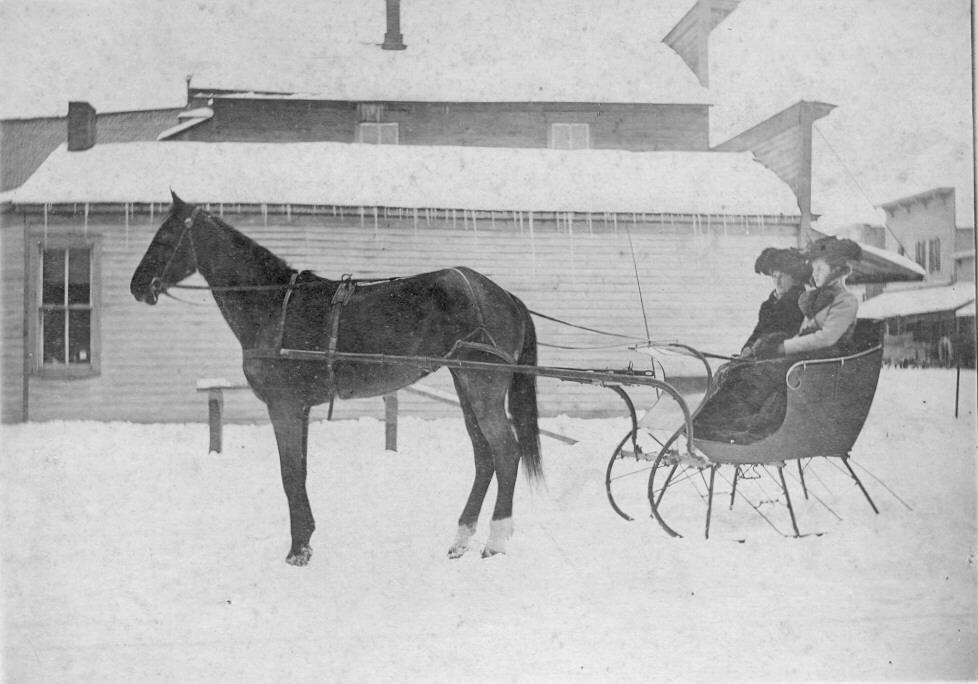
There was another way our ancestors coped with clogged roads besides just waiting for the snow to melt. In his diary entry for December 25, 1878, Elijah Grover of Scotts wrote: “…lots of snow but poor sleighing as the roads are not broke good yet…” The term “breaking roads” meant getting the roads in shape for sleighing. This was often accomplished in those days – and much later – by packing the snow with a roller. The packing was done with a crude vehicle called a snow roller, essentially a giant, wide wheel weighed down with rocks and pulled by oxen or horses. This contraption flattened the snow making a surface over which a horse could pull a sleigh, or a buggy equipped with runners. Grover’s diary mentions such a roller, but we don’t know who it belonged to or who operated it.
Rural mail delivery was often halted for days by snow-drifted roads, but we know Vicksburg rural delivery man James Fulton tried his best to reach the people along his route. He took the wheels off his mail cart and attached runners to the box, turning it into a covered sleigh. We know from Eva Robinson Braden’s diary and other sources that the mailman was often invited to come into farmhouse kitchens for a hot cup of coffee and a chance to thaw out. When the Historic Village opens again in the spring take a look at Mr. Fulton’s mail wagon and the Grenya sleigh in the Village Garage and remember how tough winter was for our ancestors, and how easy it is for us today.