


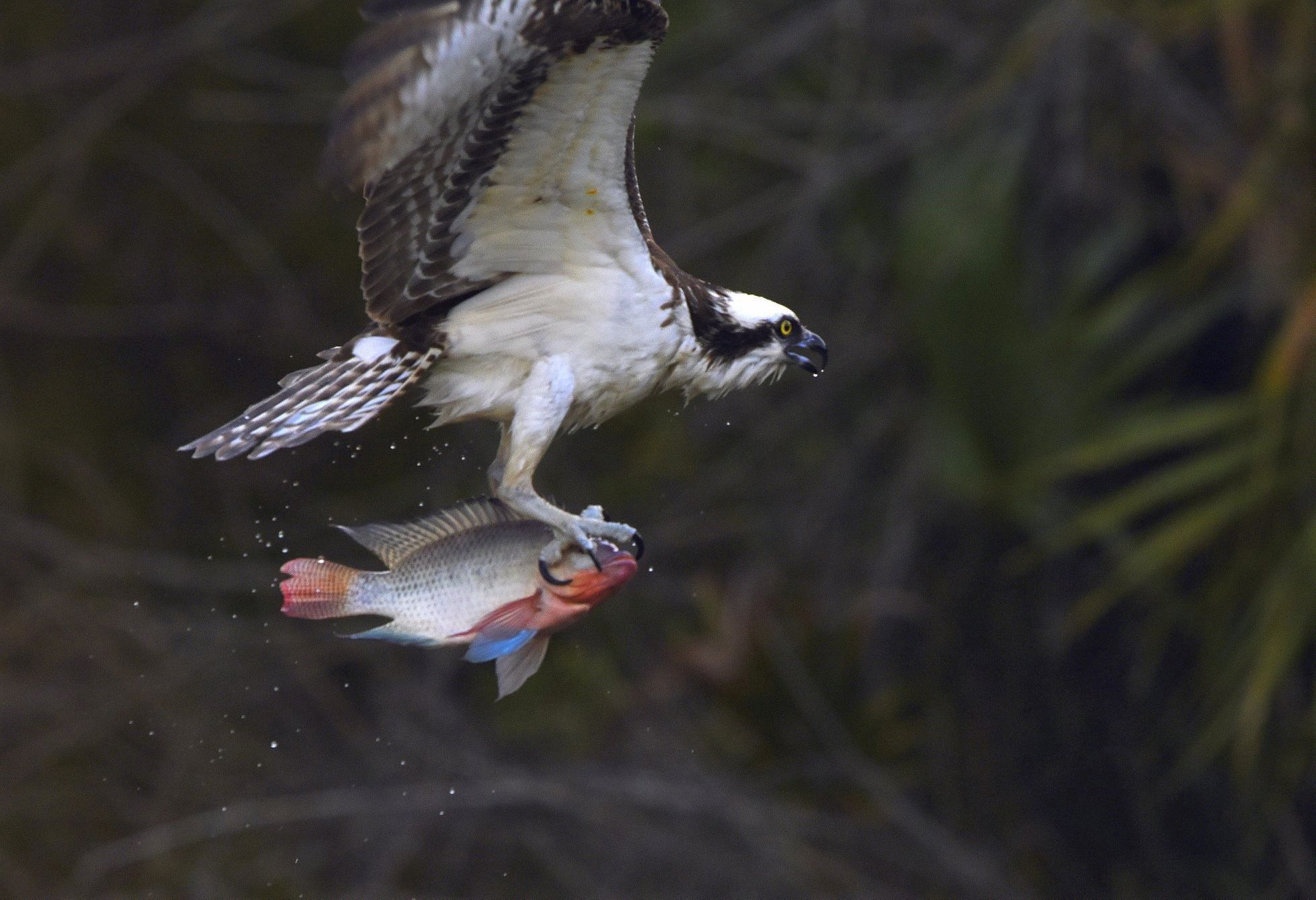
I don’t see osprey in Michigan very often, but when I do, it’s almost as exciting as seeing a bald eagle! They are incredible raptors that sometimes get mistaken for eagles, particularly when they are flying overhead. Ospreys and eagles are both large birds of prey, but there are some very distinct differences.
The most obvious characteristic that sets an osprey apart from a bald eagle is its predominantly white underbelly. Adult eagles, by contrast, are solid brown. Juvenile bald eagles have a sprinkling of white on their undersides but overall, their coloring is brown, making it fairly easy to tell them apart from ospreys when you know what to look for.
Most people rely on a bald eagle’s white head and tail for identification, but those characteristics only develop after an eagle is 4 or 5 years old. Prior to that age, a juvenile bald eagle lacks the white head and tail and may be mistaken for an osprey or a vulture, which are commonly seen in the same areas.
You can even tell these birds apart by their silhouettes in flight. Ospreys fly with their wings bent at the wrist and elbows, giving them a distinctive M-shape outline, while bald eagles fly with their wings out straight.
These two birds also have different fishing techniques. An osprey will plunge feet first into the water, sometimes becoming completely submerged, grab its fish, and then burst from the water with strong, deliberate wingbeats as it prepares to take flight. A bald eagle, on the other hand, will snatch a fish from the surface of the water and barely get its feet wet! Compared to an osprey, eagles are not particularly good anglers. Their success rate hovers around 30% while an osprey’s rate can be as high as 70!
Because ospreys enjoy a much higher success rate when it comes to fishing, bald eagles in the same area will often just sit and wait for the osprey to catch a fish and then harass it unmercifully in midair trying to make it drop the fish! If the eagle is successful, it will grab the osprey’s fish as it plummets to the water below.
Ospreys are also much more efficient than eagles in transporting their catch. They are unusual among hawks in possessing a reversible outer toe that allows them to grasp a fish with two toes in front and two behind. Barbed pads on the soles of the osprey’s feet also help it hang on to a slippery fish. When flying with their prey, ospreys will always orient their catch headfirst for less wind resistance. Eagles do not.
Given its exceptional fishing abilities and the fact that fish make up 99% of its diet, the osprey is often called a “fish hawk.”
Like many bird species, osprey numbers dropped precipitously in the early 1950s to 1970s when the pesticide DDT was widely used. DDT poisoned the adult osprey and thinned the eggshells of their offspring, causing the eggs to crack when the female tried to incubate them. Very few young were born. In 1969, Michigan was the first state to ban the sale of DDT. The federal government, on the other hand, didn’t institute a ban until 1972! By that time, about 90% of the breeding pairs of ospreys disappeared in some areas of the United States! Not surprisingly, after DDT was banned, osprey populations rebounded, but not without the hard work and dedication of countless conservation activists across our country.
Unfortunately, ospreys are still listed as endangered or threatened in some states where pesticides had previously decimated or totally eliminated some populations. Also, a growing cause of death among ospreys is due entirely to human carelessness. These raptors often incorporate baling twine and other discarded plastic lines into their nests. The offending lines can wrap around a chick’s feet and severely injure it or keep it from leaving the nest. Be mindful of what you leave behind!
The ospreys will be returning to Michigan by late March, so keep an eye out for these beautiful birds of prey as they soar overhead or build giant nests near our lakes and streams.