


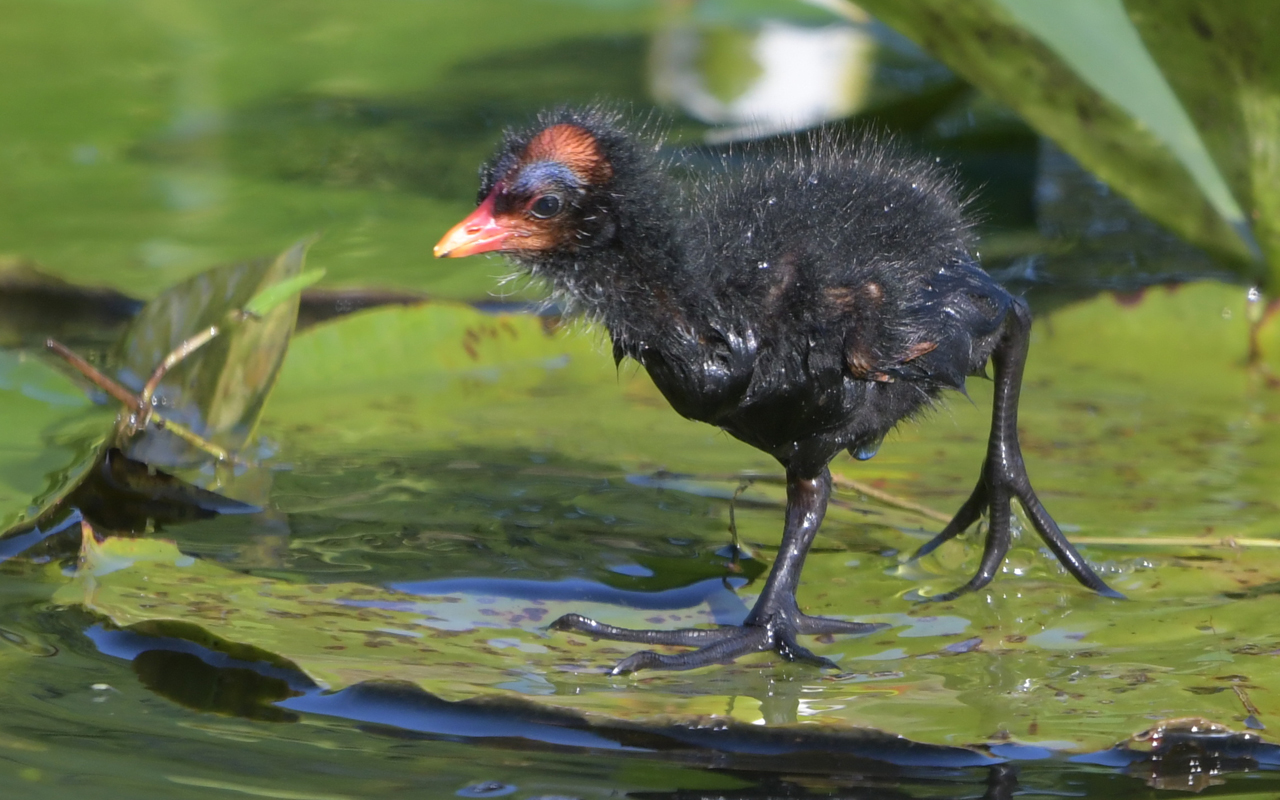
A very young common gallinule.
I have taken hundreds of pictures of common gallinules over the years while visiting Florida during the winter. It came as a great surprise recently to learn that these birds are also found in Michigan!
Common gallinules arrive in Michigan during March and April to breed, choosing well-vegetated freshwater marshes, reedy ponds, and coastal wetlands across the state. If you’re interested in tracking down these elusive birds, they have been spotted in the Shiawassee National Wildlife Refuge in Saginaw, the St. Clair River Delta in southeastern Michigan, the lower Detroit River, the Muskegon Wastewater System, the Ionia State Recreation Area, and Nayanquing Point in Pinconning.
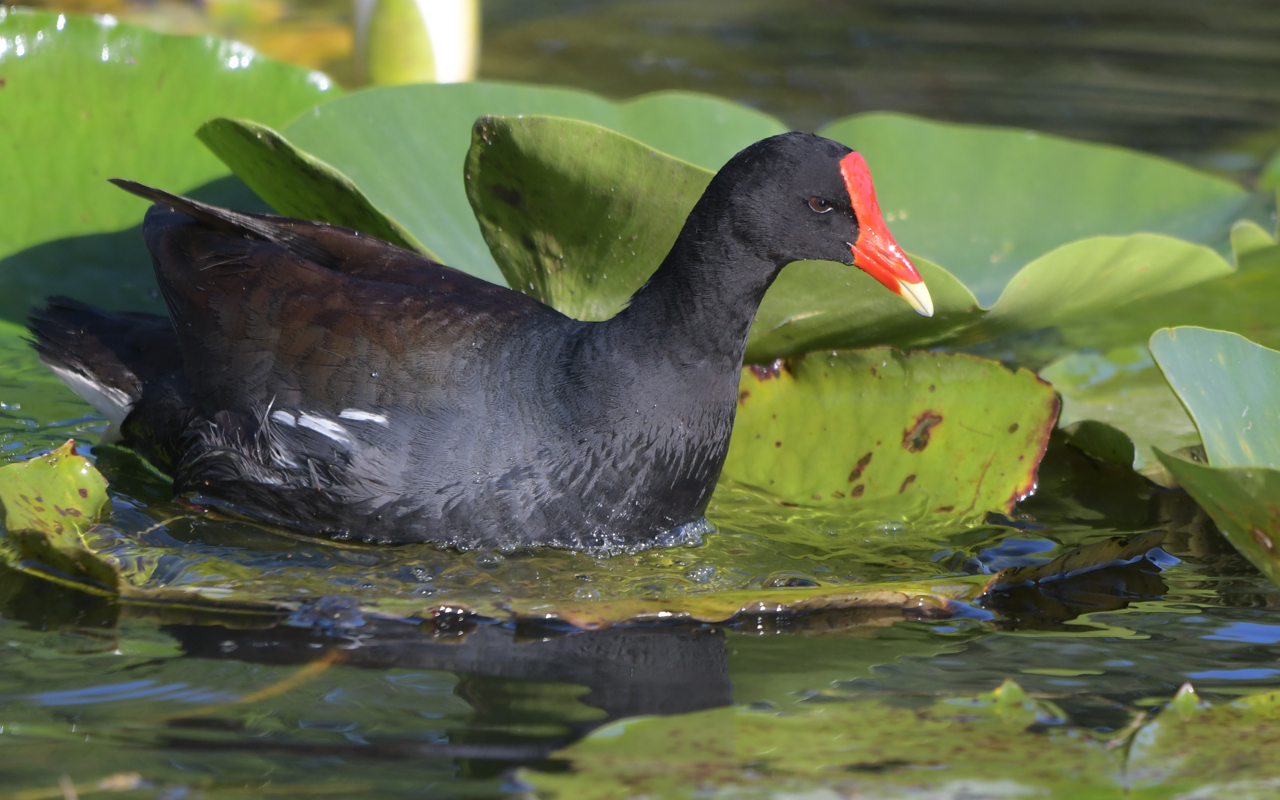
Look for a chicken-sized bird with a charcoal-gray body, a bold white stripe along its flanks, a bright red facial shield, and a yellow-tipped red bill that looks a bit like candy corn. If you’re lucky enough to find one walking rather than swimming, take a look at the freakishly long toes that make it possible for them to traverse floating vegetation and soft muddy areas with ease.
While I was taking pictures of common gallinule adults in Florida this winter, I was fortunate enough to also see some of their newly hatched babies as they rooted around in the vegetation with their parents along the edges of a small pond.
Common gallinule chicks are ugly-cute little creatures that start walking and swimming within a day or two of hatching, but are dependent on their parents, and sometimes their older siblings, for food during the first few weeks of life. They start foraging for themselves around three weeks of age, but aren’t fully independent until they are six or seven weeks old.
Common gallinules are considered opportunistic feeders. They’ll eat whatever is most abundant at any given time including seeds, fruits, berries, aquatic plants, insects, spiders, earthworms, snails, tadpoles, small fish, eggs of other birds, and even carrion.
Interestingly, common gallinules have gone through a variety of name changes over the years, some of which are still in use today. You might find them referred to as Florida gallinules, common moorhens, American gallinules, black gallinules, red-billed mud hens, marsh hens, water hens, or even swamp chickens. Take your pick!
The name that most interested me was “mud hens.” The only mud hens I knew were the Toledo Mud Hens, a minor league baseball team in Ohio whose games I had attended several years ago.
A mud hen, I have come to learn, is a common nickname for the American coot, a plump, dark-gray marsh bird with a white beak that’s closely related to the common gallinule and is often found along with it. Both birds share similar habitats, dark plumage, and triangular bills (albeit different colors). They earned the name “mud hens” for their chicken-like appearance, head-bobbing behavior, and a distinct preference for living in mud-rich marshes.
In 1896, sportswriters began calling the Toledo baseball team Mud Hens for their close proximity to the American coots living in the swampy wetlands surrounding Bay View Park where the team’s home games were being played. Prior to 1896, the team had been called the Toledo Swamp Angels!
I find it ironic that the current mascots for the Toledo Mud Hens, Muddy and Muddonna, with their colorful orange beaks, yellow feathers, and bright orange legs, look nothing at all like an American coot or a common gallinule!
The common gallinule is found on every continent except Australia and Antarctica, and is thriving everywhere except Michigan and Hawaii. In Michigan, it has been listed as a threatened species by the International Union for Conservation of Nature (IUCN). Under the Endangered Species Act, a species listed as threatened is in danger of becoming extinct in the foreseeable future! Common gallinule numbers have declined precipitously in our state over the years due to pollution and wetland destruction, two very serious man-made problems that are adversely affecting many other creatures as well – including us.
Currently, there are 407 native plants and animals on Michigan’s threatened and endangered list.
The loss of even one of those species is cause for concern.
Our lives are all connected.