

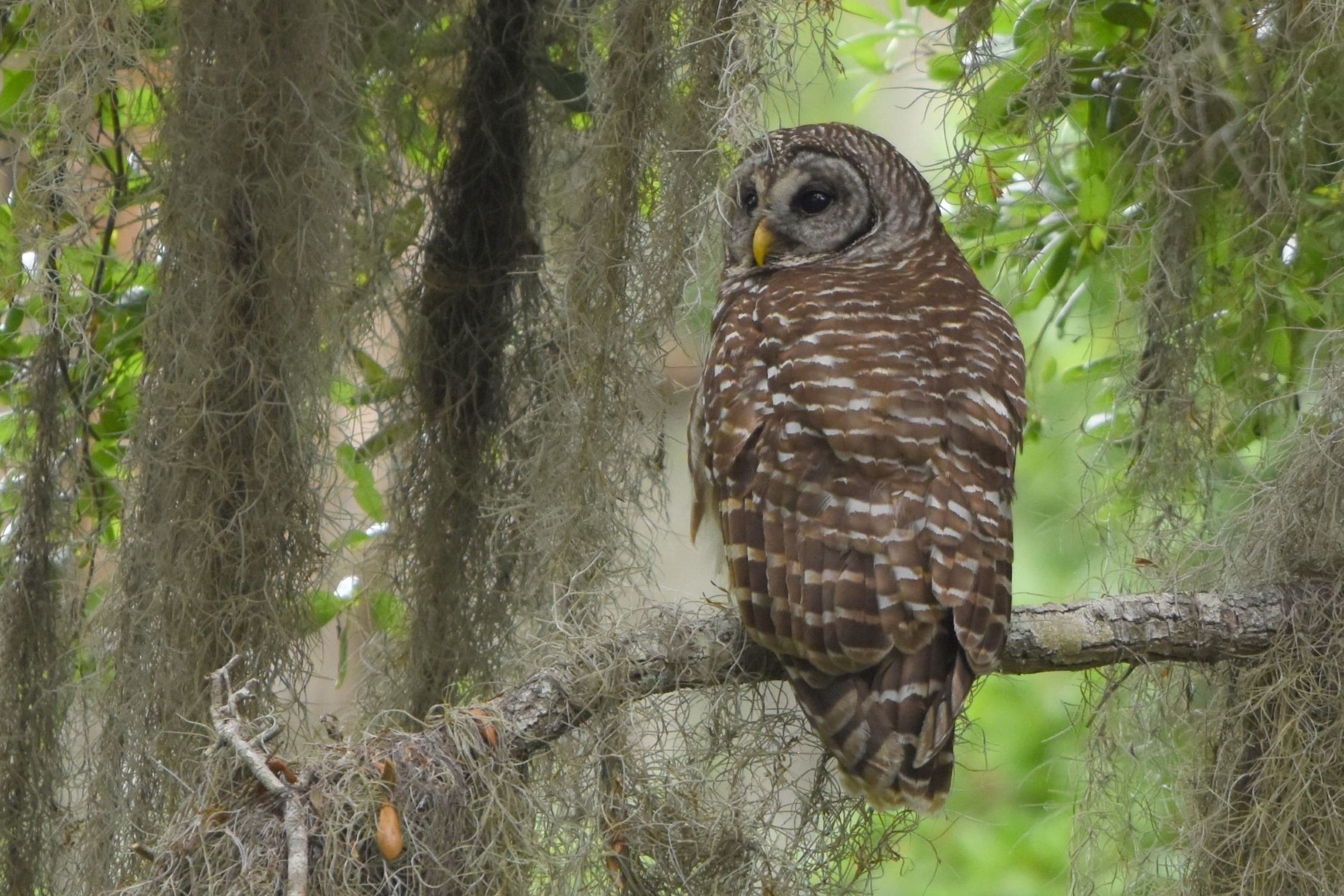
I love finding barred owls, but I’m rarely successful! Over the last ten years of picture walks, I’ve only found two; one in Michigan and one in Florida. It might be that I’m not looking in the right places at the right time, or I’m looking up the wrong trees! Barred owls prefer large, mature forests especially in low-lying swampy areas, and I’m usually out birding in dry, open areas where it’s easier to get a clear, uncluttered picture. Barred owls are also more active at night. I am not!
The barred owl gets its name from the distinctive vertical brown bars on its white belly, and horizontal brown bars on its upper breast. If you’re looking at the barred owl from the back, the wings and tail are also barred brown and white. You might also know this owl by one of its many nicknames, including eight-hooter, rain owl, striped owl, wood owl, and swamp owl!
The “eight-hooter” name refers to the barred owl’s familiar eight-note call that sounds something like, “Who cooks for you? Who cooks for you?” as it echoes through the forest. “Rain owl” is a reference to the barred owl’s marked increase in activity on overcast, rainy days, and its habit of calling out loudly after a rainstorm. The striped owl, wood owl, and swamp owl nicknames are pretty much self-explanatory and refer to the barred owl’s appearance or its preferred habitats.
What I didn’t know about the barred owl was its propensity for attacking humans. In the owl’s defense, these beautiful creatures are only trying to protect their eggs, their chicks, or their mates from real or perceived dangers. Numerous cases have been reported across the United States of barred owls attacking hikers or runners who unknowingly wandered into their home territories. For example, in 2015, there were repeated attacks on runners in a Salem, Oregon park. The victims suffered from multiple half-inch talon cuts and the attacking bird ultimately earned the nickname “Owl Capone”!
These types of attacks can happen with no warning. A protective owl will silently swoop down from behind the intruding human and proceed to dive bomb their head, talons first. If this ever happens to you, flail your arms and legs and make as much noise as possible in an attempt to disrupt the attack and, hopefully, convince the owl to retreat.
I also didn’t know that barred owls will sometimes eat crayfish and crabs in addition to their regular diet of small mammals, birds, frogs, salamanders, snakes, lizards, and the occasional insect. Surprisingly, if the owl eats enough crayfish, the feathers under its wings can turn pink, just like a flamingo’s!
Over the last several years, barred owls have been the subject of a great deal of controversy, particularly between animal welfare advocates and the United States Fish and Wildlife Service (USFWS). In November of 2023, the USFWS published a proposal to kill nearly half a million barred owls across the old-growth forests of the Pacific Northwest and California as a way of protecting the northern spotted owl which is under threat of extinction by its more aggressive cousin, the barred owl. The culling would begin this spring and continue over the next 30 years.
The U.S. Fish and Wildlife proposal presents a very real moral dilemma: Do we have the right to kill one species in order to protect another? If we don’t cull the barred owl populations, the Fish and Wildlife experts argue, then the northern spotted owl will ultimately become extinct. Animal rights advocates argue that lethal control strategies like this have been attempted many times over the years with other species and have never yielded the kind of results that would justify such a massive killing. It’s a very complicated issue that requires much more space than I have here but you can find dozens of articles, blogs, and opinions online that delve into this topic further and offer more humane solutions.
While the barred owl is considered a threat to the northern spotted owl, it faces many challenges of its own, but not to the point of extinction. The biggest threat to its existence is us! Barred owls, as well as countless other birds, are frequently injured or killed as a result of collisions—either with our cars or our windows. We’ve also destroyed many of the forests that barred owls call home and, sadly, some owls have met their fate by ingesting rats and mice that we have poisoned.
The task seems overwhelming sometimes – trying to protect all of our vulnerable birds from harm, but each of us in our own small way can help by simply living a bird-friendly life—by adding more native plants to our gardens, adding bird-strike decals to our windows, avoiding the use of pesticides and rodenticides, and keeping our cats indoors. Simple changes like these can make a big difference to the creatures who share our planet and enrich our lives.
Saving them saves us.