

The first white settlers arrived in New Buffalo in 1834 when Wessel Whittaker and his crew were bound for Chicago from Buffalo, New York. A rough November storm forced their damaged ship onto the Lake Michigan shore near the current village of Grand Beach just south of New Buffalo. While heading to St. Joseph to report the loss of their ship, they came upon a harbor which Whittaker was certain could rival the port of Chicago. Whittaker returned to the area and found his “New” Buffalo.
Captain Whittaker wasn’t the first visitor to New Buffalo. The Miami, Iroquois, and Pottawatomi Indians all fought for control of the area. The Indians and the game and fish they cherished also attracted French traders and missionaries. But it was Captain Whittaker who first made New Buffalo a permanent community.
Whittaker, along with friends and relatives, returned in 1835 and began to develop the area. Sawmills were constructed and log buildings sprung up. More settlers arrived from New York and the south.
These settlers soon learned the value of tourists as land travelers between Detroit and Chicago came through New Buffalo and spent money. In the late 1840s, the Michigan Central Railroad Company completed the stretch of track between Niles and New Buffalo, making New Buffalo the end of the railroad line for travelers between Detroit and Chicago. The final tracks were laid in the spring of 1849; 200 people celebrated the arrival of the first train. That year, over 100,000 people rode Michigan Central. Many stopped at New Buffalo and new hotels, restaurants and stores thrived. The railroad built piers and improved the harbor. Three new Ward Line steamers, Pacific, Traveler and Cleveland, ran to Chicago and Milwaukee and brought more tourists and prosperity to the area.
Sidetracks appeared every mile or so along the railroad, opening up the lumber industry. Logs were picked up on the sidings and transferred to ships headed across the lake. In 1850, one steamship company alone purchased 7,000 cords of wood. Then in 1853, Michigan Central extended its line through Indiana to Chicago. The passengers didn’t stop. The boom was over. The town lost half its size. Some buildings went by flat car to Three Oaks, where the lumber industry would thrive for another 20 years.
Tourism picked up again in the early 1900s when the automobile revitalized New Buffalo and re-established its link to tourism. In 1934, the State recognized New Buffalo as “The Gateway to Michigan” and built a tourist information center here. This continued throughout the century and gained another burst of tourists when 1-94 was completed in the early 1960’s, running parallel to the old Red Arrow route.
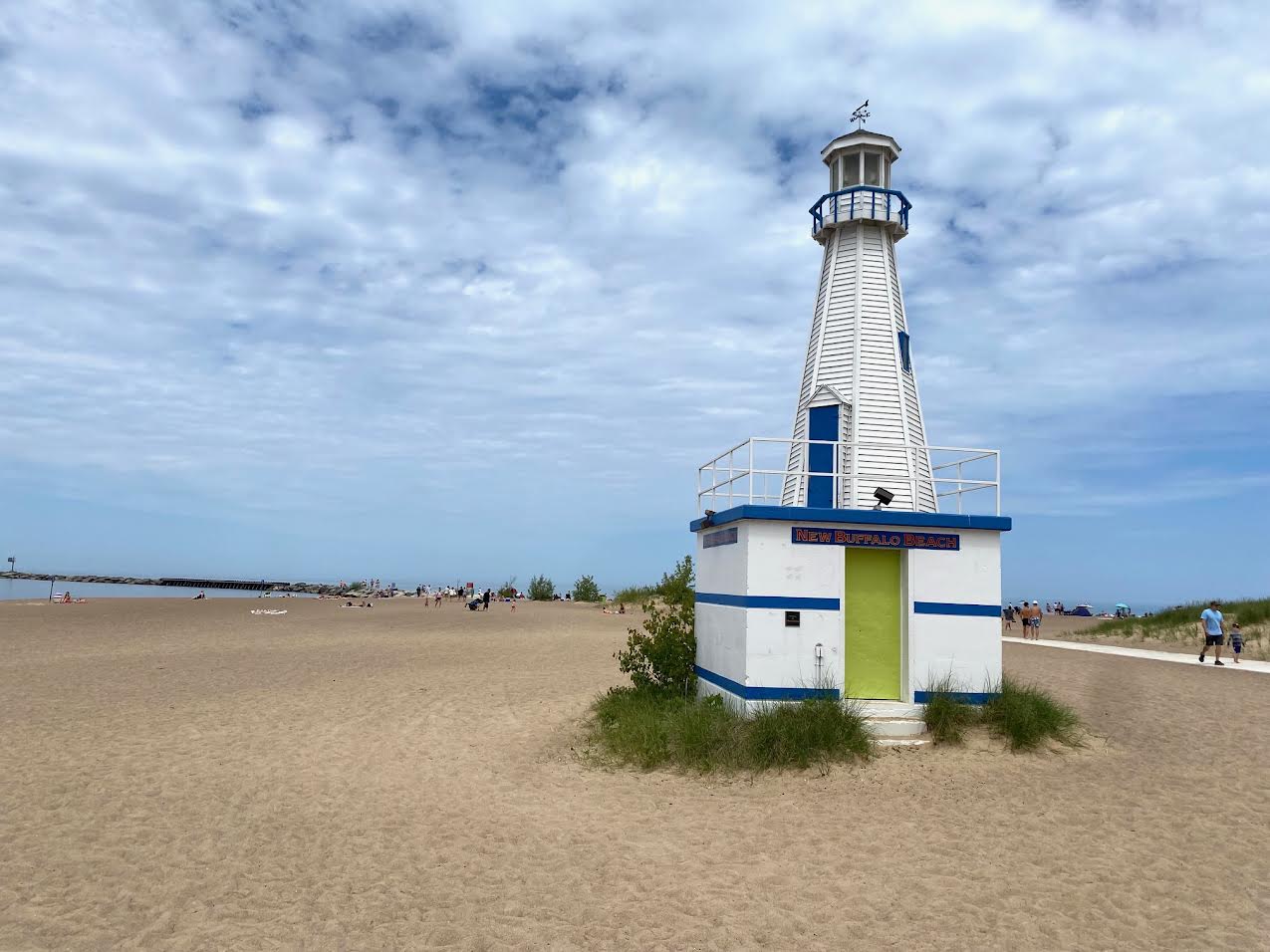
Jackie and I started heading over to this part of the state about 19 years ago. We loved Union Pier, Sawyer and Three Oaks but did not spend much time in New Buffalo. It has a nice beach, but the downtown and harbor were somewhat taken over by condo developers and it did not have the laid back, sleepy feel of the other towns in the area. We did, however, continue to ride our bikes along the lake from Union Pier to New Buffalo in front of the gorgeous houses on the water a couple times per year for dinner and ice cream.
On our first trip, we stayed at one of the cabins at Warren Dunes State Park, and while heading into New Buffalo for dinner along the old Red Arrow Highway could not help but notice the giant smiling Redamak’s sign, proclaiming, “The Hamburger that made New Buffalo Famous.”
George and Gladys Redamak, the original owners, ran an operation that was truly the American dream. Dating back to the late 1940’s, they sold hamburgers for many years in a building not much bigger than a 1,500 square foot home. For many years, as you entered the building, either Gladys or George was there to greet you, most of the time by name and a warm hello. It is much larger now but still holds the rustic charm of yesteryear.
This past May, we were delighted with our tasty wood-fired pizza and salad at Brewster’s, a mainstay in New Buffalo since 1992. What began as the small, one-room Brewster’s Coffee Shop on Merchant Street in the heart of downtown New Buffalo has expanded over the years into an airy, family-oriented Italian café that serves wood-fired thin-crust pizzas off a menu of authentic Italian cuisine. The menu changes every day but always features a wide variety of antipasto, salads, wood-fired pizza, amazing pasta and a fresh assortment of meats, fish and seafood. Sandwiches, frittatas and panini are available during lunch. Brewster’s bakery is open Friday through Sunday, and offers homemade desserts, muffins, cookies and pastries with espresso and coffee.
After dinner, we headed to the legendary Oinks Dutch Treat for ice cream.
Founder Roger Rink was a long-time teacher in New Buffalo and during his summer break in the early 1980s, he and his wife, Sharon, would go canoeing in Baldwin and visit Jones Ice Cream Shop. He got inspired and opened his ice cream parlor in 1987. The name comes from his nickname, Oink, given to him by a long-time friend. With an average of 25 employees, the shop has been open for more than 38 years and is still growing in popularity. Besides the great ice cream, the building is full, from floor to ceiling, with thousands of unique pig and ice cream memorabilia to enjoy while waiting.
The Stray Dog is another popular downtown eatery that offers rooftop seating and a nice selection of tacos, salads, sandwiches, half-pound burgers and more.
After our past couple trips, we were pleasantly surprised as to how much fun New Buffalo is, with people everywhere and lots to do.
We will be back soon!