


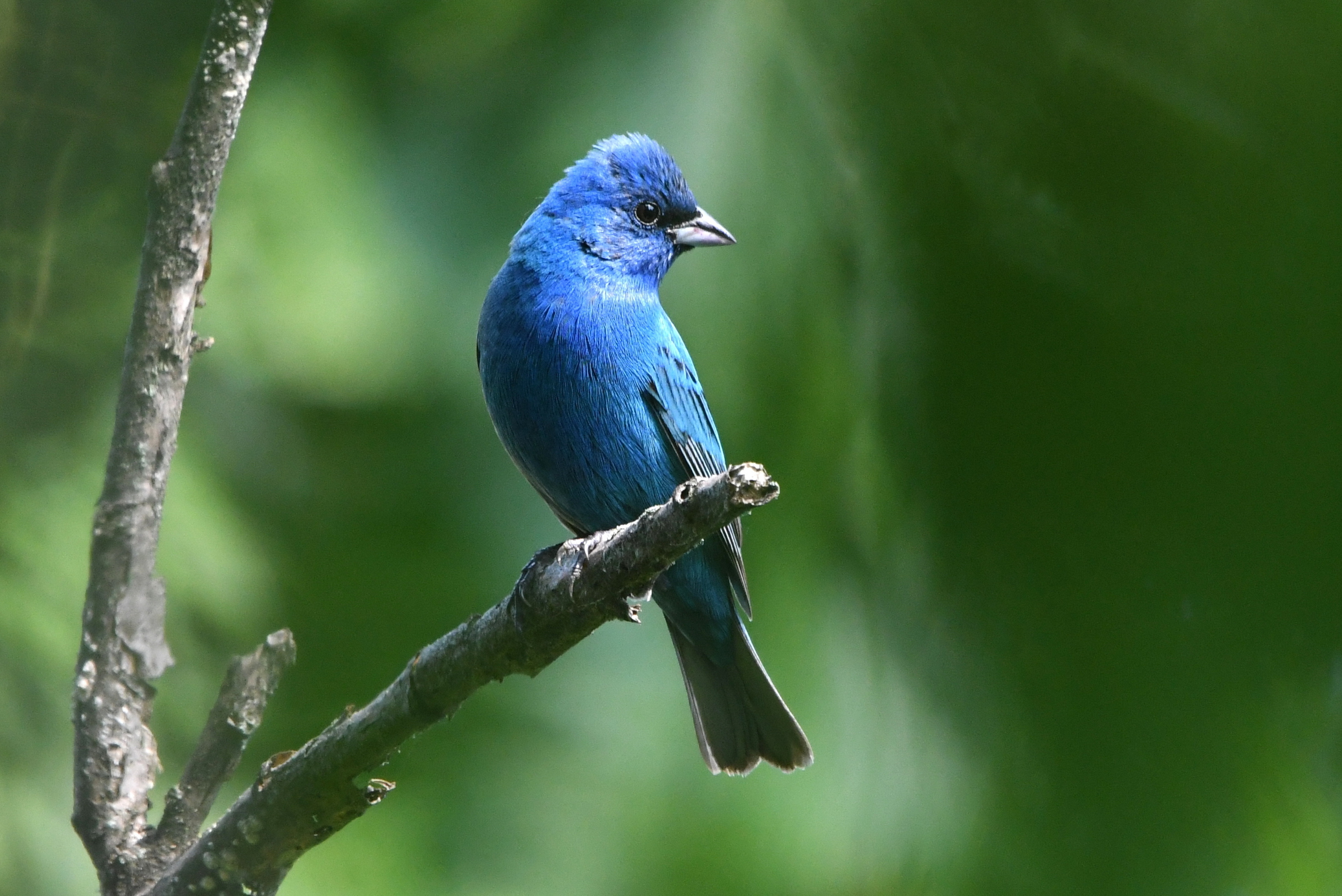
Indigo buntings are sometimes called “blue canaries” and are the most common songbirds in the eastern United States including all of Michigan – but I rarely ever find them! When I do happen upon an indigo bunting, it’s hard to contain my excitement and take a decent picture before it flies away!
The male indigo bunting in breeding plumage is one of the easiest birds to identify with his brilliant blue feathers. The female, on the other hand, is basically brown. From a distance, she is easy to mistake for any other dark-colored bird flitting around in the trees. And, like most other female birds, she is not a flashy dresser for a reason; there are predators out there who would like to eat her babies. She cannot afford to be seen as she protects them.
Interestingly, the brilliant blue feathers of the male indigo bunting are an illusion. The blue color comes from microscopic structures in the feathers that refract and reflect blue light. In low lighting conditions, the male bunting’s glorious colors disappear like magic and he becomes just another plain, dark-colored finch!
Indigo buntings, like many other North American songbirds, migrate at night using the stars for guidance. These birds have an internal clock that enables them to adjust their angle of orientation to a star, even as that star moves through the night sky. Our indigo buntings here in Michigan will start heading south in September or October to their wintering grounds in Florida, Mexico, Central America, South America, and the Caribbean; flying more than a thousand miles to reach their destinations! In April and May of next year, these birds will make the same long, perilous journey back to us as they return to their breeding grounds.
You can look for these stunning little songbirds along rural roads perched on telephone wires or sitting high in the nearby trees. They love weedy, brushy edges along roadsides, especially where fields meet forest. Sometimes, if you’re lucky, you’ll find them foraging for seeds and insects low to the ground where they might be easier to see.
One of the best ways to locate them, I’m told, is to listen for the male indigo bunting’s song, described as repeated pairs of high-pitched notes that last about two seconds. The notes of the indigo bunting sound something like ‘sweet-sweet’ or ‘see it-see it’ and those notes might be repeated as often as 200 times an hour while the males defend their territory from other males or attempt to impress the local females.
You can entice indigo buntings to your yard if you put out thistle, nyjer, white proso millet, black oil sunflower seeds, or hulled sunflower seeds. They also love mealworms, especially live ones! Some birders have also reported finding indigo buntings dining on the fresh fruit they have left for orioles or perched on their hummingbird feeders!
Although the indigo bunting still appears to be abundant throughout its range, Partners in Flight surveys show that their numbers are declining. These birds, like so many other creatures in our world, are experiencing the impact of both habitat loss and global warming.
We can’t afford to lose any of them.
Saving them, saves us.