


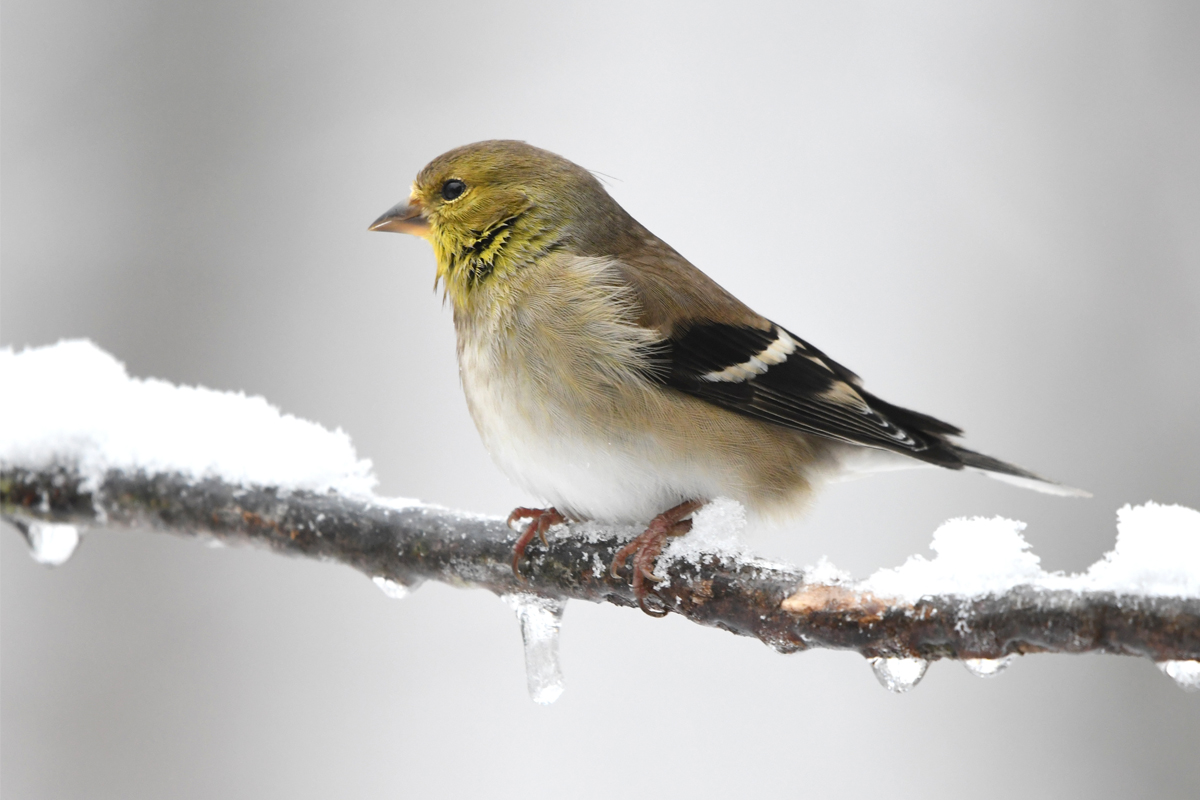
Before I knew anything about birds, I thought goldfinches were wild canaries. Before I knew anything about photography, I thought goldfinches were only here in the summertime. Imagine my surprise the first time I photographed a little goldfinch perched on a snowy branch in the middle of winter! I have since learned that goldfinches are here in Michigan all year, but they don’t always look the same!
Both the male and female American goldfinch molt completely twice a year; once in late winter and again in late summer. Of the two sexes, males have the most dramatic transformation. They’re a dull yellow-brown color in the winter and turn bright yellow in the spring. With their contrasting black and white wings and distinctive black patch on the forehead, male goldfinches are easy to tell apart from any other yellow songbirds flitting about. The female goldfinch, on the other hand, is never as brightly colored or as flashy as her male counterpart so her seasonal transformation is much more subtle. During the winter months, both the male and the female goldfinch look more alike, with feathers of brown, olive, and dull yellow-green, accented with buff or white markings. Once spring arrives, though, the sight of a bright yellow male is a sweet reminder of warmer days ahead!
Those beautiful yellow feathers help the male goldfinch attract a mate. The intensity of the yellow color is a signal to the female that her suitor is in good health and ready to start a family! She might also be impressed with his elaborate flight displays, heartfelt songs, and the gentle pecking of her bill. He’ll even bring her food. But wait! There’s more! Once she lays her eggs, he’ll keep on feeding her through the 12 days of incubation and will help feed the hatchlings. What a guy!
Goldfinches don’t begin their nest building activities any sooner than July or August, a time when most other songbirds have already slowed down their breeding activities. The female goldfinch, who is solely responsible for nest building, is biding her time until the thistledown is available to create her nest. Thistledown, the soft, fluffy part of a thistle plant, is used for lining her nest and isn’t available in sufficient quantities until July. The availability of thistle seeds is also an important factor in the goldfinch’s breeding schedule. Goldfinch babies are dependent on a steady supply of regurgitated seeds from their parents for survival, particularly thistle seed. Even after the babies fledge, the male goldfinch will continue feeding his offspring regurgitated seeds for another couple of weeks.
American goldfinches are one of the strictest vegetarians in the bird world, selecting an entirely vegetable diet and only swallowing an occasional insect by mistake. Most other seed-eating birds supplement their diets with insects, especially when feeding their babies. A strict vegetarian diet works quite well for the goldfinch, but not so well for a much larger bird living in the same area: the brown-headed cowbird. The lives of these two birds sometimes intersect.
Brown-headed cowbirds are nest parasites. They never build their own nests and they never raise their own young. All their energy goes into producing eggs and plopping them into the nests of other birds, like goldfinches. Once the cowbird hatches, Mama and Papa Goldfinch will feed their new arrival the very same vegetarian diet as the rest of their babies, but a brown-headed cowbird cannot possibly survive without a protein-rich diet of caterpillars, grasshoppers, and beetles.
Because American goldfinches are strictly seed-eaters, they’re easy to attract to your feeders. Any size, shape, or style of feeder with sunflower seeds, thistle seeds, or millet will work. They’ll even clean up the seeds that have fallen on the ground below your feeders! For a more permanent attraction, though, plant native thistles, purple coneflowers, sunflowers, zinnias, and milkweed. The goldfinches will love you forever – and the butterflies will follow suit!
Enjoy!