

In late November of last year, with our first significant snowfall of the season, I was eager to be outdoors taking pictures of all the little birds landing on the snowy branches of the nearby trees: cardinals, juncos, white-throated sparrows, and a host of other winter-hardy birds. My favorite place to capture these feathered friends is right outside our back door, and that’s just where I planted myself for the better part of three hours on that snowy November day.
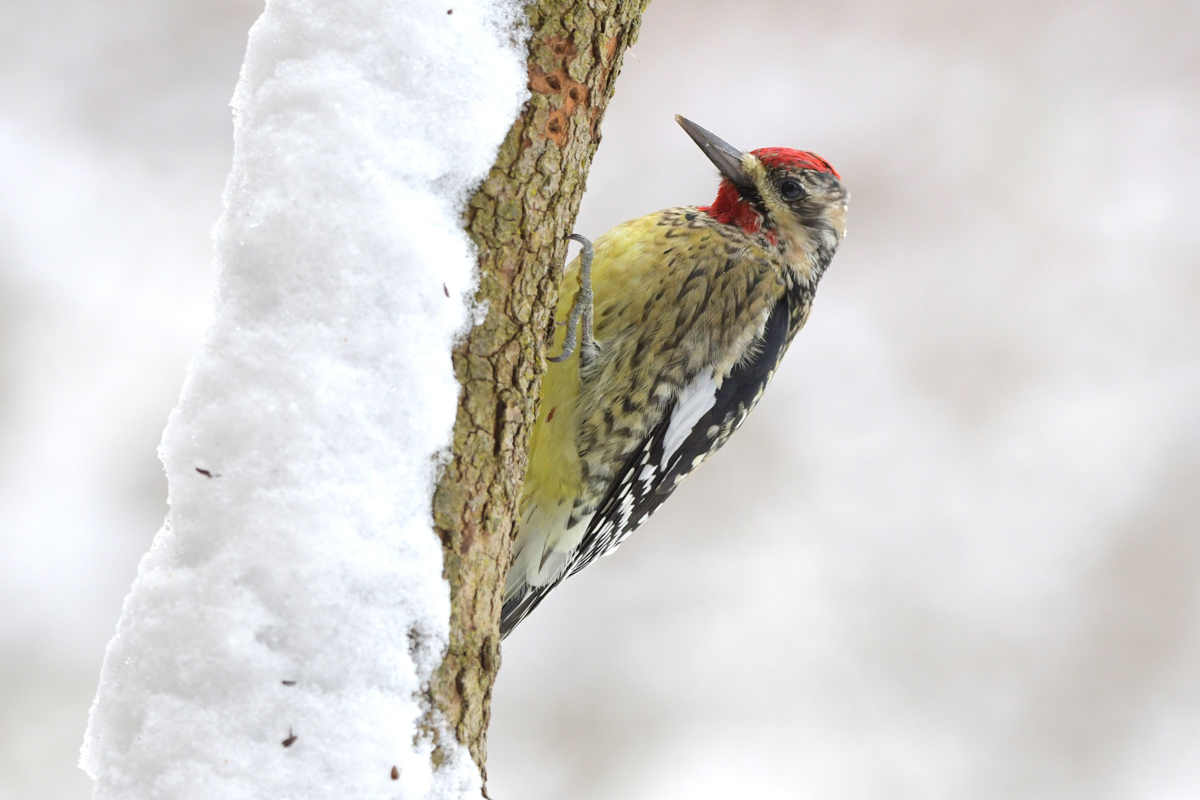
Somewhere in the middle of that songbird marathon, a slightly larger bird landed on a nearby dogwood tree less than ten feet from where I was standing! It wasn’t a bird I usually see, but I knew immediately that it was a yellow-bellied sapsucker.
It’s an easy woodpecker for me to identify because it looks rather “muddy”. All of the other woodpeckers I’m familiar with have darker, more distinctive red, white, and black markings. Even the sapsucker’s characteristic “yellow belly” isn’t particularly distinctive. Sometimes, it’s a dull shade of white, sometimes it’s a muted shade of yellow. Whether it’s a white or yellow, there’s a heavy spattering of black and gray feathers mixed in to muddy things up.
For non-birders, the name “yellow-bellied sapsucker” might sound like a joke or an insult. The term “yellow belly” has been used over the years as a synonym for coward. The phrase “yellow belly” gained traction in the mid-1800s and became firmly established by the early 1920s with the advent of movies and TV shows featuring cowboys who used the term “yellow belly” or just “yellow” to describe someone they thought was a coward.
In 1953, the moniker “yellow-bellied sapsucker” came into use as an insult with the introduction of a Loony Tunes cartoon character named Yosemite Sam who frequently spat this insult at his carrot-loving nemesis, Bugs Bunny. Yellow-bellied sapsucker was also used as a jibe by Ralph Kramden and Ed Norton in the mid-1950’s TV series, “The Honeymooners”. In the aftermath of all those shows, a whole generation of kids grew up thinking that a yellow-bellied sapsucker was just an imaginary, cowardly beast!
Yellow-bellied sapsuckers are, indeed, real birds, but they aren’t really sap suckers. They have very long tongues with short, brushy hairs that they use to drink the sap, or lap it up. Interestingly, the collective noun for a group of sapsuckers is called a “slurp,” which directly relates to the way they lick up that sticky tree nectar with their tongues!
Sap is a huge part of the yellow-bellied sapsucker’s diet. In fact, half of its food intake can consist of this nutritious confection! Sapsuckers round off their diet with fruits, nuts, berries, and insects, depending on the season and what’s readily available.
Yellow-bellied sapsuckers find their sap by drilling multiple small, shallow holes, or sapwells, around the circumference of a tree. The holes are only drilled deep enough to get the sap flowing and are generally not harmful to a healthy tree which will form a protective callus over each hole and grow new wood. I was very surprised to learn that sapsuckers find sap in more than a thousand different species of trees including maples, birches, poplars, hemlocks, pines, and serviceberries! Their favorite trees, however, are maples and birches.
Some of the creatures we share this planet with are known as “keystone species”, meaning their existence is critical to the lives of other species. The yellow-bellied sapsucker, however, is known as a “double keystone species”, meaning two of its activities, drilling for sap and excavating nest cavities, are crucial to the survival of other creatures. In some parts of Canada, for example, the ruby-throated hummingbird relies on sapwells so heavily that it coordinates its spring migration with the arrival of the sapsuckers! Hummingbirds are just one of many species that depend on those sapwells for survival. Other birds and mammals depend on the sapsucker’s abandoned nesting cavities for shelter or for nesting sites of their own.
If you’d like to attract yellow-bellied sapsuckers to your yard, suet feeders are your best bet. In addition to sapsuckers, you might also get a variety of other woodpeckers like we have at our feeders. We’ve had the joy of seeing downy woodpeckers, hairy woodpeckers, northern flickers, red-bellied woodpeckers, yellow-bellied sapsuckers and sometimes a magnificent pileated woodpecker will stop for a visit!
I love seeing them all!