


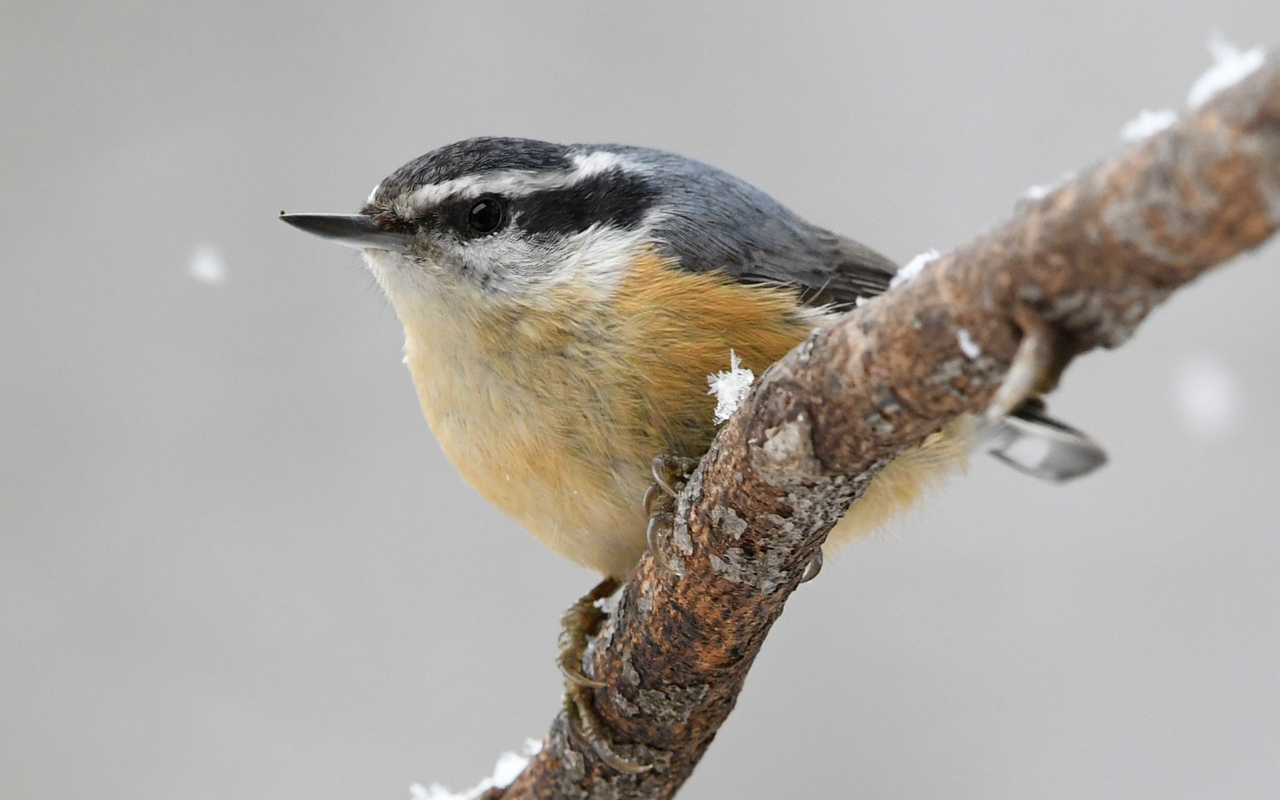
There are four species of nuthatches in the United States — white-breasted, red-breasted, pygmy, and brown-headed. The two most widespread of these are the white-breasted nuthatch and the red-breasted nuthatch, both of which can be found in Michigan. The white-breasted nuthatch is much more common than the red and is a year-round resident throughout the state. Red-breasted nuthatches, on the other hand, are only intermittent, seasonal visitors to the southern half of our lower peninsula.
What all nuthatches have in common is their unique ability to walk head-first down a tree, and their “nut-hatching” skills. They are equipped with a disproportionately long, rear-facing toe that has a very strong, curved claw. When a nuthatch moves one foot forward down a tree, the claw on the opposite foot holds the bird firmly to the bark. This is the nuthatch’s super power! Other “tree climbing” birds, like woodpeckers and brown creepers, can readily scurry up a tree, but nuthatches go up, down, and sideways! Their unique ability to walk down a tree headfirst has earned them the nickname “upside down bird.”
The common name “nuthatch,” stems from this bird’s habit of jamming nuts or seeds into tree bark crevices and using its sharp beak to “hack” open the nut or “hatch” the seed from inside its shell.
White-breasted nuthatches and red-breasted nuthatches are both small, acrobatic, tree-climbing birds, but differ in size, coloration, and habitat. The white-breasted nuthatch, at about one ounce, is twice as big as its red-breasted counterpart who, even on a “fat” day, weighs only half as much!
Both birds wear blue-gray feathers on their backs, and have caps on their heads; gray for the females, black for the males. The red-breasted nuthatch, though, with its rust-colored belly, thick, black eye-stripe, and long, white eyebrow is easy to distinguish from its white-bellied cousin.
When choosing a place to live and raise a family, both birds prefer mature woodlands, but differ in their choice of trees. White-breasted nuthatches like deciduous trees and are common, year-round residents in yards and parks where there is a preponderance of maple, hickory, basswood, or oak. Red-breasted nuthatches look for large stands of conifers like spruce, hemlock, and fir.
In Michigan, red-breasted nuthatches can be found mostly in the upper peninsula or in the northern part of our lower peninsula. They intermittently come to the southern half of our state in late fall or early winter and stay until spring. Their arrival depends almost entirely on the supply of conifer cones in Michigan’s northern forests. Red-breasted nuthatches are dependent on the seeds they can extract from pine, spruce, and fir cones and, if those seeds are in short supply, they head south.
Both white-breasted and red-breasted nuthatches need dead or partially dead trees for nest building. White-breasted nuthatches use the natural cavities of decaying trees for their nests or the abandoned holes left by woodpeckers, while red-breasted nuthatches look for the soft, dead wood of conifer trees to excavate their own nest holes rather than using an existing one. When we do too much pruning or felling of dead and dying trees in our parks and yards, we reduce the nesting opportunities for these delightful little birds.
You can easily entice nuthatches to your backyard feeders, particularly during the winter months, when their favorite insects are in short supply, by offering them sunflower seeds, safflower seeds, peanuts, mealworms, or suet cakes.
If you currently have red-breasted nuthatches coming to your feeders, they’ll soon be heading north, but the white-breasted nuthatches will continue to visit all year long if you put out their favorite foods and have some of their favorite trees nearby.
Happy birding!