

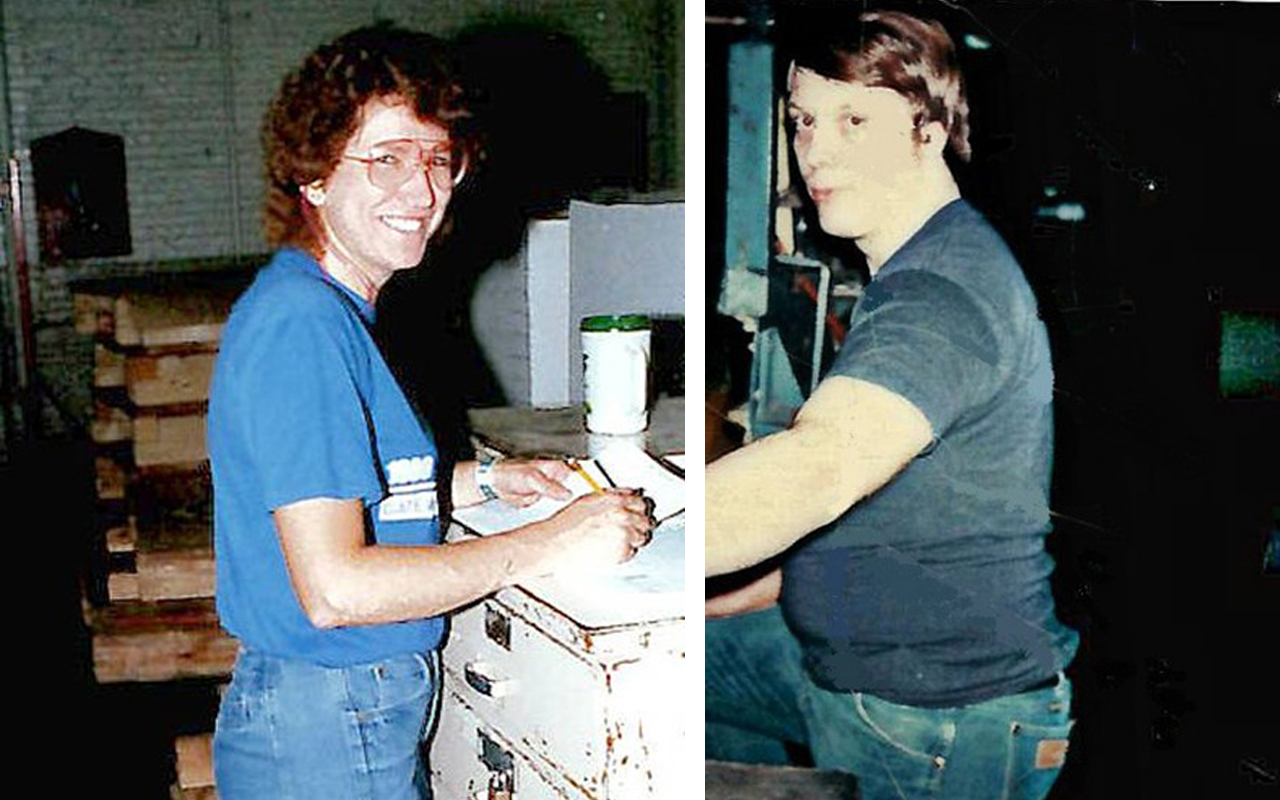
Paul Pietrzykowski was down by the old Mill Stream when he first met Brenda Richmond. Actually, Paul was inside the Simpson Lee Mill itself, “right in the first room you walk in when you take the tour on the south side,” he pointed out. That was where they’d check the rolls of paper for defects in the Finishing Department. “I was a rewinder,” Paul said; and “I was fanning paper,” added Brenda, his wife of 36-years as of this May 26th.
Both Paul and Brenda went to elementary school in Fulton. Both had Mrs. Marian Oswalt for fourth grade, but Paul was a year or so ahead of Brenda and the two never met in those years. In fact, it would be decades later before their paths crossed at the mill.
After Paul graduated Vicksburg High in 1969, he went over to Simpson Lee Paper Company where Clinton “Whitey” Linton was the assistant personnel manager. “He had been a teacher at VHS, and was known for immediately offering a job to any alum,” Paul recounted. “I got the job and was told to start on Monday.” Paul told Linton he didn’t expect to stay forever, just long enough to make some money and get back to college to study machine tool technology.
But Paul did stay on. “I started as extra crew. There was still a rag room then. They’d put the rags into those boilers, and I’d have to go in those and push the rags to the side when more rags were being dumped in. Today, that would never be allowed, and I was one of the last ones to do that work. They’d boil those rags until they were pulp.
“We made 100% rag pulp, which was one of the first things the mill was known for: 100% rag paper. My first permanent job was as a sealer on second shift. We’d hand wrap all these packages of paper. Then I was on the cutters—loader and runner. Then I went to the rewinders where we’d check for defects. I went from there to instrument repair. “
Eventually, Pietrzykowski would eventually finish his college degree, paid for by the mill. Meanwhile, Brenda was out west living and working in Montana when she was widowed. With two young daughters in tow, she came back to Michigan to be closer to family. Her brother-in-law, Alan Harris, worked at Simpson Lee and urged her to look for employment there. “On October 1, 1986, I got a job in the finishing room and I loved it,” Brenda said.
“Mary Ellen Crouch taught us how to sort and fan. You had to count it, stopping at 500 sheets,” Brenda said. “After that, I went to the cutters. You’d stand on a two-step and as the paper came in, you’d stick the paper in at the 500-ream count. Then I went to the Maxson sheeter, which would cut the paper. I’d take them and wrap them. Next, I went to the Bielomatik machine that did everything—roll form to packaging.”
The new girl working on the #3 Cutter did not go unnoticed by Paul, the rewinder. But he was in his mid-30s and had never been married. It took some time to “get up the nerve and ask if she wanted to go out.” When she said yes, Paul admitted he was so relieved, “I almost passed out.” Brenda remembered the scene well. “He was shaking like a leaf . . . his hands were just shaking. I was afraid to say no! He could have ended up on the floor and I’d have felt bad,” she grinned.
Their first date was at a restaurant on Red Arrow Highway. The couple kept things quiet, but one of Brenda’s astute coworkers predicted, “You two are going to get married.” And they did, on May 26, 1990, in a small ceremony in the backyard of Paul’s house on Sprinkle Road.
The reception was a considerably bigger event—everybody was invited. “We just put a notice on the bulletin board at work inviting the whole mill to the reception,” Paul said. It was a joyful, boisterous gathering. “Even my Aunt Joy Hoag danced! She was hilarious,” Brenda reported. They held it at the Lion’s Pride Center which was located just behind Family Fare in those days. “It’s where the Beer & Brat Festival was held every summer,” Paul said. “It pretty much shut the Mill down because everybody went to it and then called in sick the next day!”
The Pietrzykowskis continued working at the Mill, which presented each of them with unique opportunities over the course of their careers. “Once I went to Italy for the mill,” Brenda said. “They’d bought a big machine made there and I’d be an operator so they sent me over there to learn how to operate it.” For Paul, managing the mill’s tutoring program was a satisfying endeavor. “There were lots of the best workers you could ever get, but they couldn’t read. So the mill provided tutoring, and I got asked to coordinate it. This was a free service to employees who needed it, which I did with Paula Cross for a couple years.”
Musing over their years as a couple, and as part of the mill family, Paul and Brenda have memories to last a lifetime. “There were lots of married couples at the mill,” Paul confirmed. More than just a workplace, the mill was a community that enriched family life. “The Mill picnics, they were fantastic. They’d set up a big tent out at a farm out on W Avenue. There was a Christmas dinner up at WMU with the dance hall all decorated. Almost everybody would go,” Paul said. “There was even a corporate Olympics thing. I was a runner. We had uniforms—it was a big thing.” Brenda remembered. “They had dinners for perfect attendance at the Beacon Club on Portage Road,” Paul added. “That was a fancy affair. We were always there because we had perfect attendance.”
For Paul and Brenda, working at the mill created a sense of belonging—and pride. “We knew we were making the best paper. No one would argue against that,” Paul insisted. “We made paper for Polaroid film—we were the only paper mill who could do that. Star White Vicksburg… our Coronado… everybody was proud of the fact that we made the best.”