


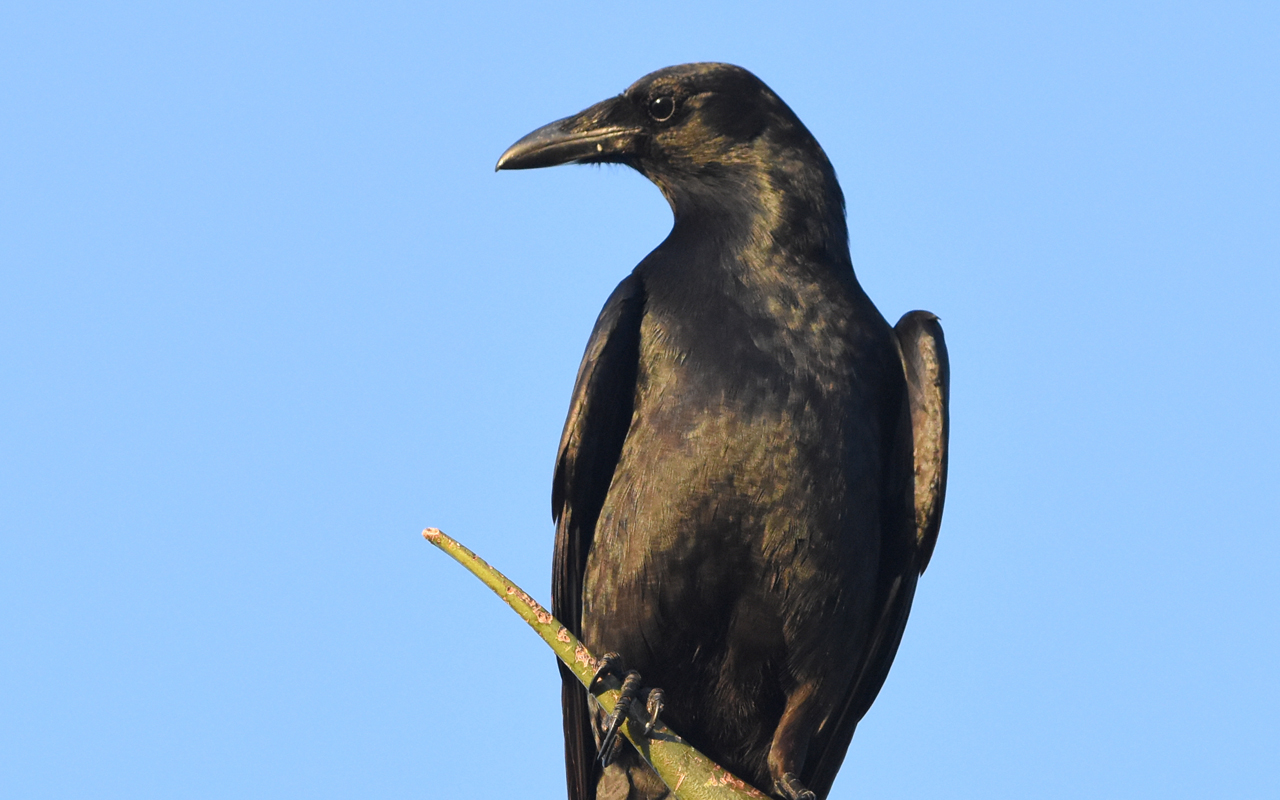
Have you ever heard of a fish crow? This was a totally new bird for me just a few years ago. We were vacationing in Florida when I heard a very distinctive bird sound that brought a smile to my face, and I wondered what it was. Thanks to my Merlin app, the bird was identified as a fish crow! Apparently, they’re quite common in the Southeast, especially along the gulf coast and the Atlantic coast.
This past fall, I was beyond surprised to learn that we also have fish crows in Michigan! They’re rare, but they’re here! The first verified report of a fish crow in Michigan occurred at the Forest Lawn Landfill in southern Berrien County in October of 2009. Since then, fish crows have continued to expand their range northward and have become regular visitors to Berrien County and other parts of southwest Michigan.
Fish crows are almost identical in appearance to our local American crows. You’d be hard pressed to tell them apart by just looking at them from a distance. Both birds are black and both are similar in size and shape. A fish crow is slightly smaller than the American crow, has shorter legs, more tapered wings, and a quicker wingbeat—but none of those characteristics are particularly helpful to the casual observer.
The key to identifying these birds is their call. The most notable and distinctive sound from the fish crow is a nasally, double-note sound that’s remarkably similar to the response you might give when something goes unexpectedly wrong, “Uh-oh,” or what you might say instead of “no” when responding to a question, “uh-uh”. Alternatively, the most common sound made by an American crow is a harsh, loud “caw”, which it repeats in various rhythms, pitches, or series depending on the situation. For instance, if the American crow says, “caw, caw, caw”, it’s considered a greeting, or a territorial advertisement, or a way to stay in touch with its flock while flying or foraging.
One researcher playfully suggested that we just ask the bird we’re looking at, “Are you an American crow?” If the bird answers “uh-uh”, you’ll know it’s a fish crow!!
Why is it even called a fish crow, I wondered. This is a bird that eats almost anything, including garbage, carrion, trash, nestlings, eggs of other birds, berries, fruit, seeds, grain, turtle eggs, and whatever it can steal from other birds. It also eats a variety of marine life including fish, crabs, and crayfish. Fish crows are opportunistic feeders: whatever is readily available and easy to grab, they’ll eat.
In 1812, Alexander Wilson, a Scottish ornithologist, gave the fish crow its name. He had garnered information about this bird from local fishermen who had described the bird’s habit of eating fish. Over the next 200 plus years, though, as the fish crow adapted to human encroachment, it expanded its coastal marine diet to include much of our edible detritus.
As highly adaptable birds, fish crows have been gradually moving northward and westward. They are now showing up on the shoreline of Lake Michigan almost every year and are particularly attracted to human modified habitats like harbors, fish docks, dumpsters, landfills, fast food parking lots, and urban waterfront zones where food is readily available. They share many of the same habitats as our American crows. It’s very likely that the fish crow’s expansion northward over the past couple centuries has been highly influenced by urbanization and abundant anthropogenic food sources, food made available by human activity.
Some ornithologists believe that continued global warming and human development will eventually support permanent populations of fish crows here in Michigan as well as farther north and west. For better or worse, fish crows may eventually become a more common sight in Michigan than they are today.
For a good comparison between the call of an American crow and the call of the fish crow, try this video on YouTube, The Nasally Fish Crow. https://www.youtube.com/watch?v=SCQqiFm6_vs.