


I started out writing this article about the elusive mink, but quickly went down a rabbit hole of muskrats, beavers, otters, and mink. These four critters often get confused with one another, especially when they’re swimming through the water and all we can see is a long, brown blob of fur.
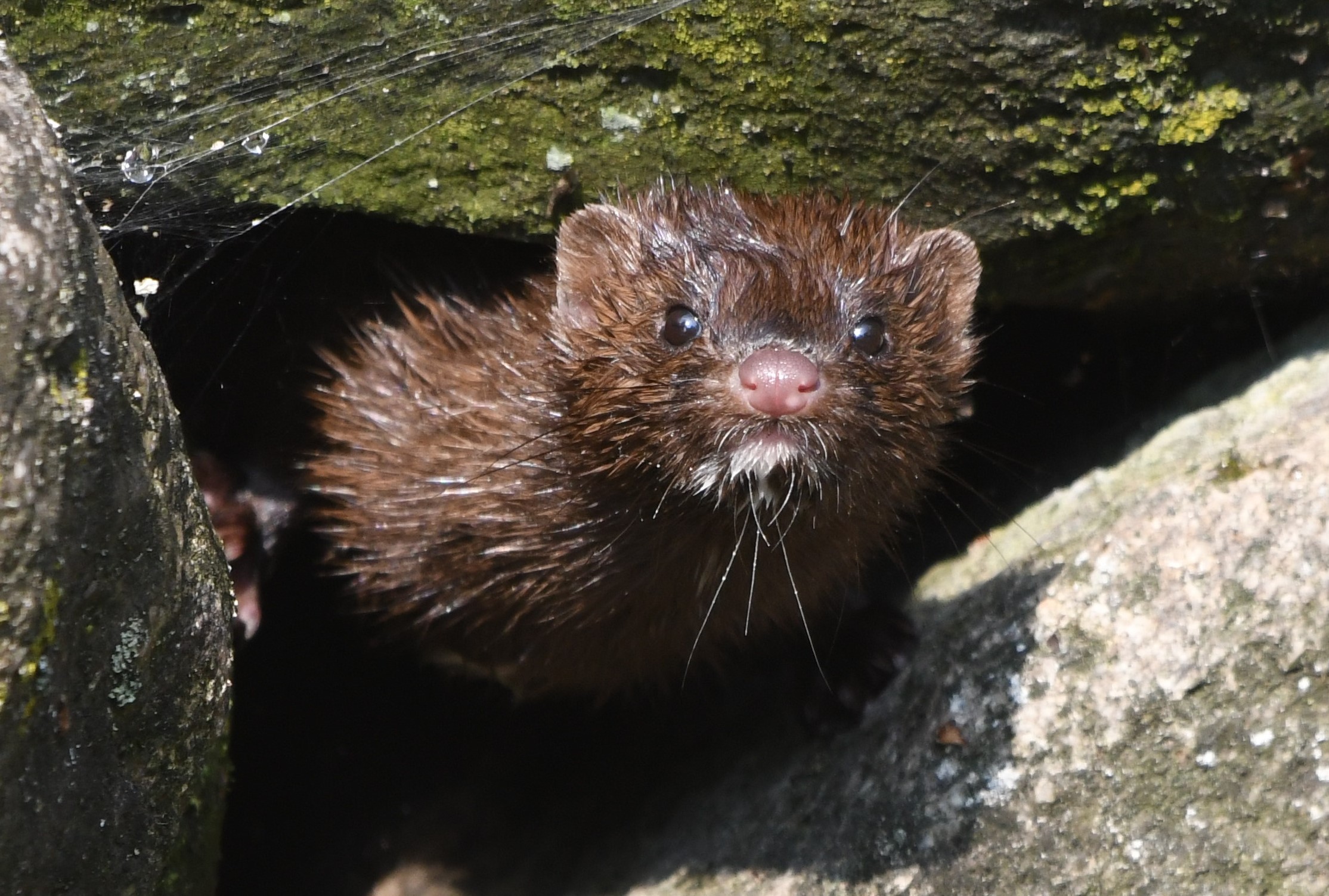
There is a small creek behind our condominium complex where I have often seen muskrats swimming. In the twenty years that we have lived here, this is the only mammal I have ever seen swimming in the creek – until the morning of July 14, 2021, when I spotted a very wet mink on the opposite shore staring back at me!
It got me thinking. Maybe some of the critters I had seen in the creek over the years had actually been mink, not muskrats. Then I thought about the muskrats in the preserve across the road and how people had often thought they were beavers. How do you tell a mink from a muskrat or a muskrat from a beaver when they’re in the water? And what about the river otters?
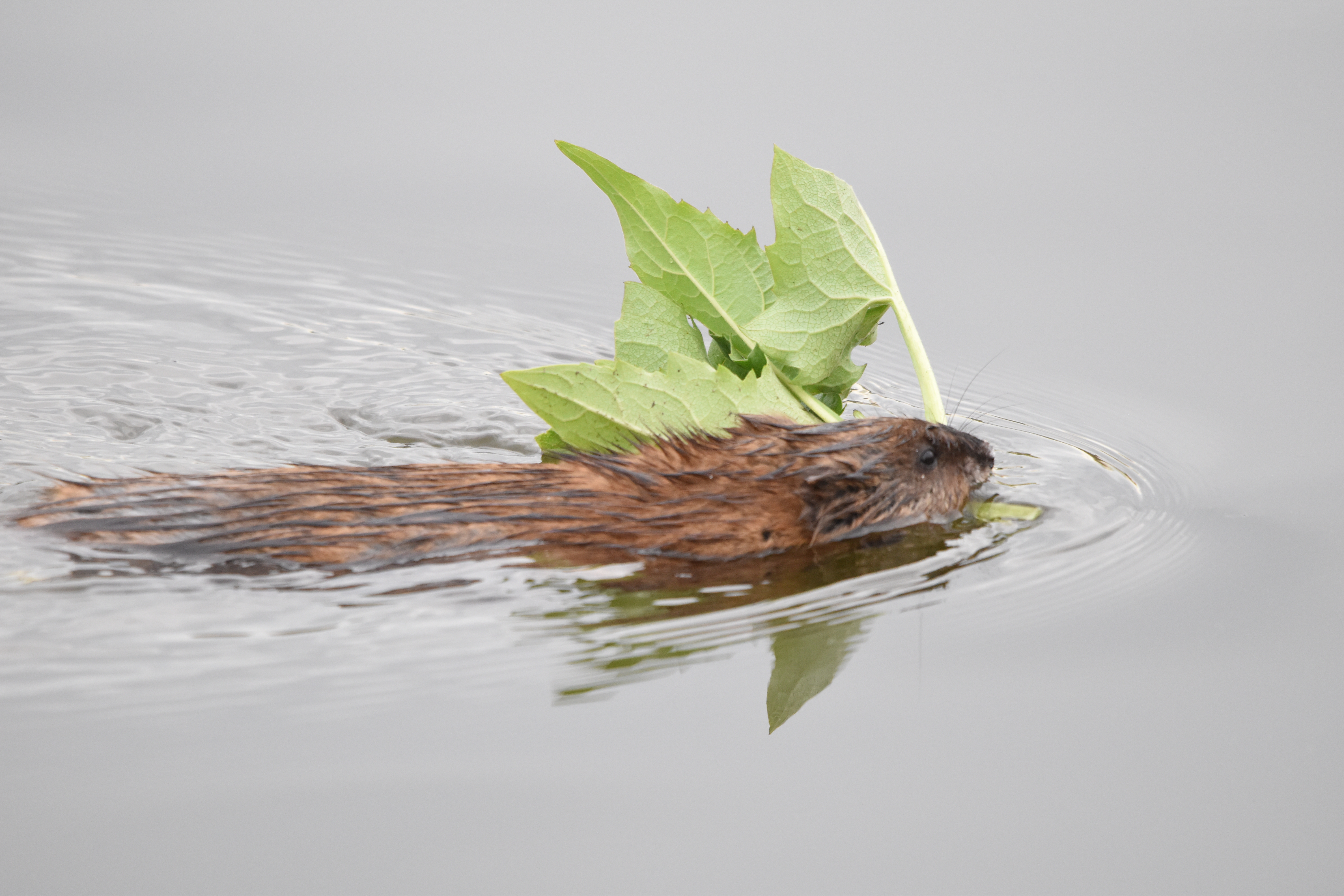
Mink and muskrats have almost identical body lengths (1-2 feet), so they look very similar when swimming, but mink have much darker fur than muskrats. It’s a rich, chocolatey brown and looks almost black when wet. A muskrat’s fur is lighter. Mink are also more streamlined than muskrats, and have smaller heads. If you’re lucky enough to see the tail of a mink or muskrat as it swims by, identification should be a dead giveaway. A mink’s tail is slender and furry while a muskrat’s tail is thin and hairless (just like a rat’s). Sometimes, when muskrats are swimming, their tail will be arched slightly out of the water, or even pointed upward like an antenna, making identification a slam dunk! Also, if you can see what they’re carrying in their mouths, you’ll have another great clue. Muskrats often swim with plants protruding from their mouth, like leaves, cattails, and water lilies. They are mainly plant eaters. Mink, on the other hand, are not! They might have a fish, but never a plant!
Muskrats are often mistaken for beavers, especially if they are swimming near a beaver’s lodge, but there are significant differences between the two. First of all, an adult beaver weighs between 40-70 pounds; a muskrat barely tips the scale at four! Both beavers and muskrats swim with most of their body length visible and they appear very flat along the surface of the water. A muskrat, though, is very compact in size and a beaver’s large body, unlike a muskrat’s, will extend far beyond its head. Beavers also have more prominent ears than muskrats, and they have bigger noses, both of which are visible as they swim through the water. If you can see their tails, it’s even easier to tell them apart. Beavers have wide, flat, hairless tails, and muskrats’ tails are long and skinny, but also hairless. Unfortunately, neither of their tails are easy to see in the water.
Mink are sometimes mistaken for river otters. Both are long and slender with short legs and long tails. The American river otter, at 2½ to 5 feet in length, is considerably longer than a mink which is barely 1½ feet long. The river otter is also much heavier than a mink. On average, a river otter weighs around 20 pounds, and the heaviest mink might top the scales at 3½! Both the otter and the mink have furry tails, but an otter’s tail is longer and more streamlined. Otters also have a prominent nose and a rounded jawline while the mink has a much smaller nose and a pointed jawline. As an otter swims through the water, its body is mostly submerged and the front of its rounded face creates a broad, U-shaped wave on the surface of the water. A mink, on the other hand, swims higher out of the water and the entire length of its back is visible. With its pointed face, the mink creates a narrow V-shaped wave.
Next time you’re out and about and see one of these furry mammals swimming through the water, try to guess which one it is. If you can, take a picture to confirm your sighting. You might find something important like the doctoral student from the University of Windsor did when he spotted a mammal swimming in the Detroit River a few years ago and determined that it was too big to be a muskrat or a mink, but it definitely wasn’t a beaver. What could it be? The student observer took a picture to confirm his observation and the mystery critter turned out to be the very first river otter found in the Detroit River in over 100 years!! This was a highly significant finding! River otters have a very low tolerance for polluted water and the fact that one was present meant that the Detroit River was clean enough for the otters to return!
You never know where your observations might lead you!