By Alisha Siebers, Director of the Vicksburg Cultural Arts Center
As a first-time judge for the Vicksburg Cultural Arts Center Tournament of Writers, I was impressed by the variety and quality of entries this year. The pandemic certainly opened up the wells of creativity in our region. We received a record number of entries, from writers ranging from age 5 to 93. As I read the entries, I noticed repeated themes of hope and depictions of lessons learned from the past. Our local writers captured deep beauty and wisdom in their images and stories.
We’d like to announce here the first-place winners for the 2021 Tournament of Writers. In the Fiction Category, the winners are: Hayden Moden, Junior Division; Sky Lester, Young Adult Division; Christine Webb, Adult Division; and Ralph Ackley, Senior Division. The Non-fiction first-place winners are: Eleanor Ross, Junior Division; Jacob Miller, Young Adult Division; Christine Webb, Adult Division; and Carol Braymer, Senior Division. Our first-place Poets are: Lillian Ross, Junior Division; Sydney Kaiser, Young Adult Division; Ross Landers, Adult Division; and Mark Stucky, Senior Division.
I encourage you to put your thoughts to paper and to consider entering our next tournament. Your stories need to be heard! I never cease to be amazed by the magic of storytelling. A few strokes of a pen and some details here and there – a description of a bumpy nose, an image of a greenish pond in a park, a memory of crushed mulberries – and a whole world is shared between reader and writer. If you want to be inspired and enriched, join us for our Tournament Celebration on Wednesday, September 15 at 5:30 at R & R. At that event you can experience the storytellers’ worlds yourself by hearing authors’ readings and by purchasing our 2021 Anthology of all of the entries. Join the VCAC in our mission to support and celebrate local writers! Together, as a community, we can educate, enrich, and inspire.
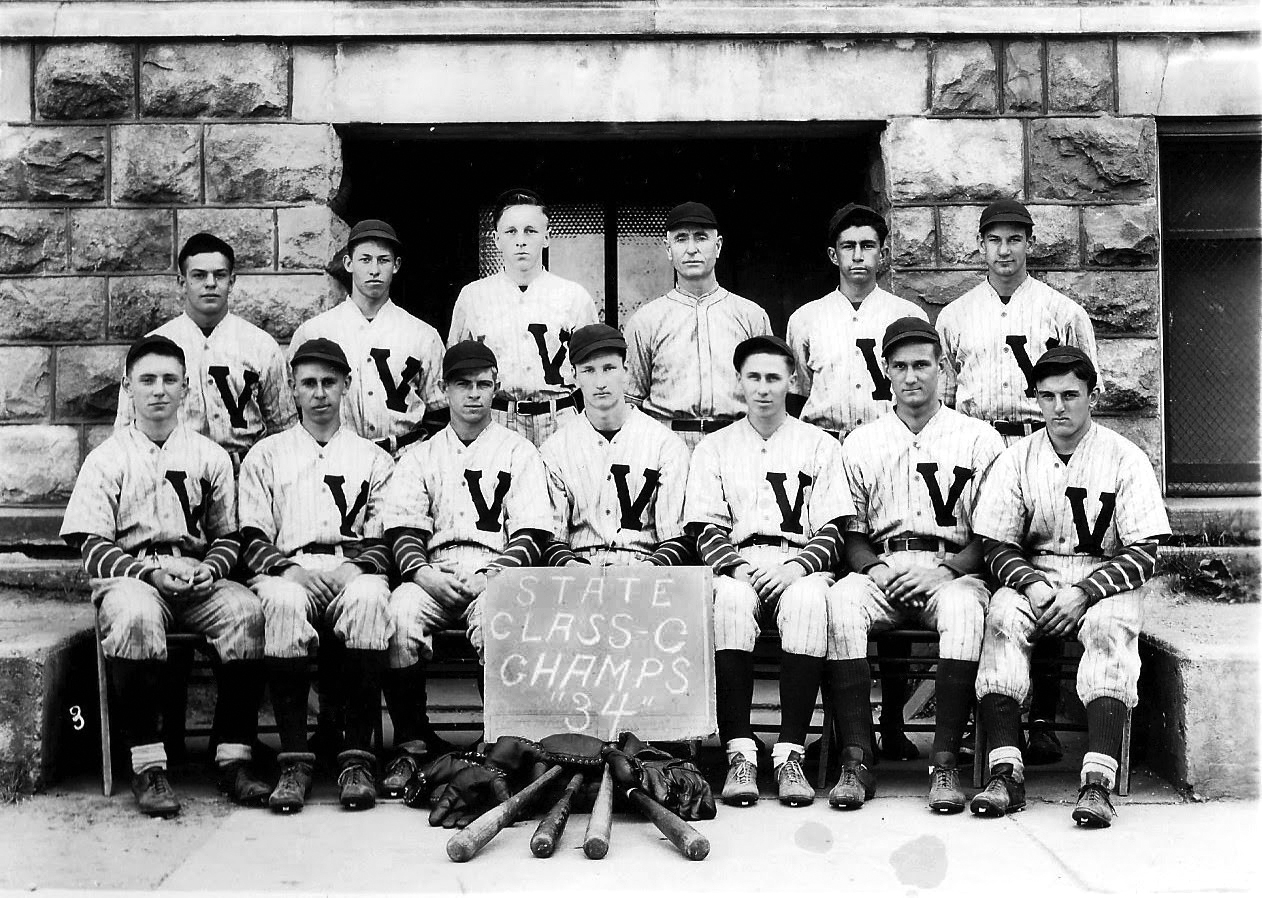
Vicksburg High School Baseball State Class C Champs, 1934. W. Crouch, G. Dailey, S. Griggs, Coach C. H. Andrews, George Zonyk, Bernard Barber, T. Andrews, Bob Breseman, J. Freeman, George Gembis, Stanley Penar, Frank Stafinski, Mason Bishop.
By Maggie Snyder, for Vicksburg Historical Society
Immigration has been a major source of population growth and cultural change throughout much of this country’s history. Nowhere was it more evident than in Vicksburg during the early 1900s.
Lee Paper Company was founded here in 1903 to produce high-quality rag-content paper at a time when other paper mills then operating in the Kalamazoo Valley were all producing lesser- quality, cellulose-based paper.
Once the mill was nearing completion in 1904, Mill Manager Charles Seitz began looking for the workers needed to make the mill operational. We don’t know why Polish immigrants were targeted, but history suggests possible reasons. The early 1900s saw a tidal wave of Polish heading to America due to years of religious and cultural persecution. Many Polish immigrants ended up in Chicago and soon proved themselves to be a hard-working, resilient, family-oriented people.
As Mr. Seitz had contacts in other mills employing the Polish, he was aware of their reputation. So he reached out to their community, hoping to encourage 50 to 100 girls and women to work in the new Vicksburg mill’s rag room. Five young ladies took him up on his offer.
By December of 1905, all departments of the mill were filled with workers. Most of them by that time were Polish – encouraged by those original five girls. Mill management encouraged workers to let their relatives in Poland know about the good jobs available here; they felt this was the best way to develop a reliable, stable work force.
For a while, night classes were held at the mill to teach the newcomers to read, write and speak English. To help ease the sudden housing shortage in the community, the mill built some low-rent housing close to the mill.
As there was no Catholic Church in Vicksburg and most of the Polish were Catholic, Mass was held in a room in the mill, officiated by the priest from Mendon. Because the company realized having a real church was important to their workers, the mill donated land and helped raise funds for the construction of Vicksburg’s first Catholic Church, St. Martin’s, on West Prairie Street. It was dedicated on Sunday, February 25, 1906.
In a 1983 interview with Bonnie Holmes, Mike Semenczuk, mill employee and Polish immigrant, remembered, “Gradually the townspeople came to know the immigrants and appreciate them…. It was a long time, though, before the Poles became completely assimilated. This was partly from choice. They were proud of their heritage and tried to instill that in their children.”
In many ways, the Polish community was like an enlarged family. Since almost all the younger men and women worked in the mill, it fell to the elderly to look after pre-school children. “If you didn’t have an older person living in your home,” Semenczuk explained, “the children went over to someone else’s house. A grandparent was a grandparent to everyone.”
Of course, over time, the Polish melted into the community – though it was not always easy. Stories of fights between teenage boys and unflattering nicknames abounded, as usually happens when something “different” is introduced into a community.
But for many years, the Polish managed to keep many of their unique traditions alive.
However, in the same 1983 interview, Mrs. Holmes asked Mary Grubka Makowski if her family still followed any of the old Polish traditions. Mrs. Makowski replied, “No…when the younger generation started growing up, they just went by the wayside. I don’t know, they kinda frowned –n it. They considered themselves Americans.”
The descendants of these Americans of Polish descent – Stafinski, Gembis, Wesoloski, Sikorski, Skrzypek, Ramza, Rapacz, and many more – are still contributing to our culture today, and so are the mill buildings where their ancestors first learned to be Americans.
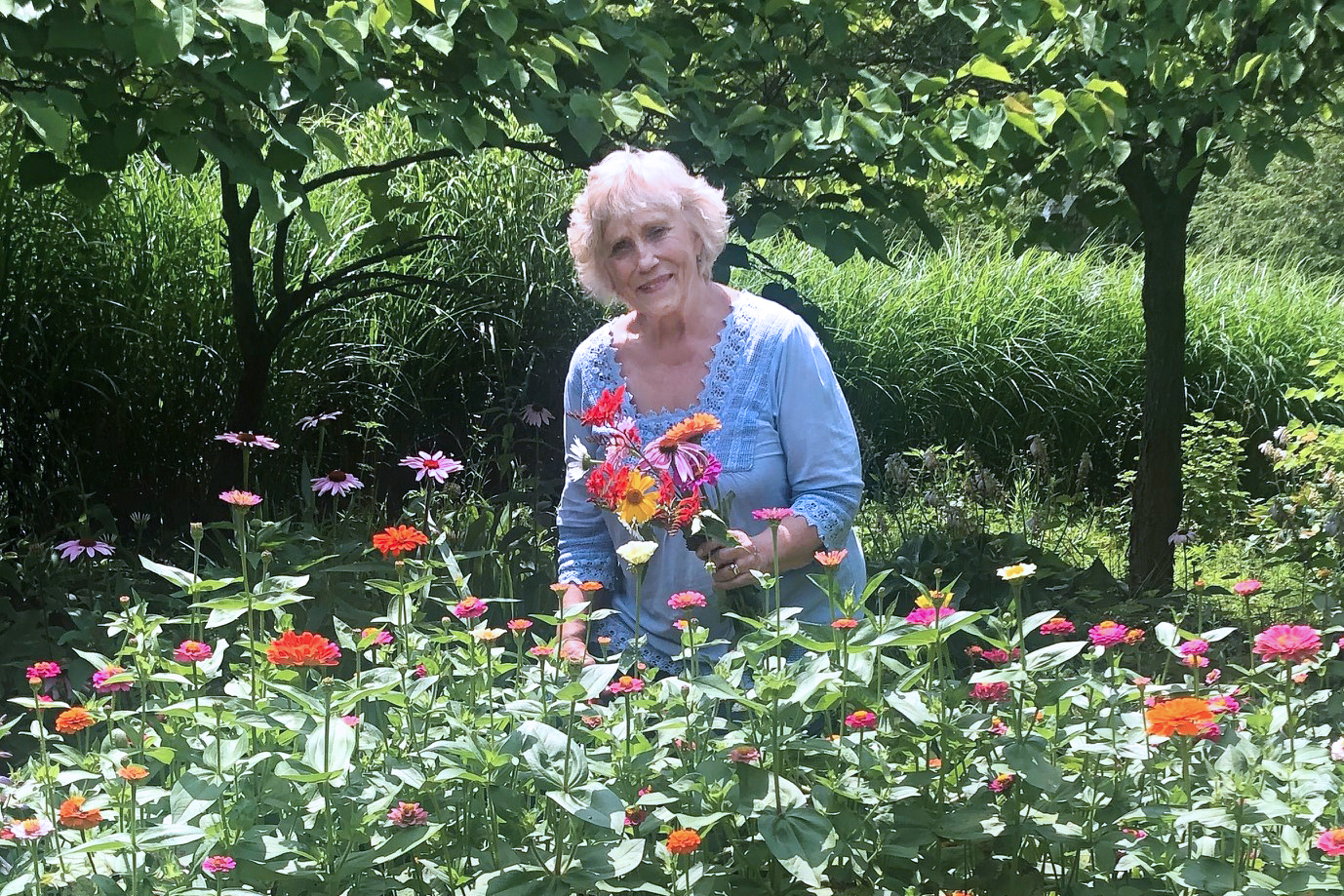
Cutting gardens and perennial beds thrive in Janet Cousins’ summer garden. Janet, a retired Vicksburg Community Schools employee, and her husband Tom, a semi-retired carpenter, built their home in 2000 on the edge of the Bear Creek Drain, a stream in Brady Township. Since that time, Janet has planned, developed and carefully tended her flowers.
The couple thoughtfully selected their home’s building site, a parcel on the family farm where Janet was raised. Four generations of Janet’s family lived and worked the farm. Janet is reminded daily of her childhood by a row of stumps along the back of the yard. These stumps are the remains of ash trees which marked a fencerow where Janet and her sisters moved sheep from one pasture to another. At one time, that fence row was clustered with ash trees and provided shade until disease destroyed them and nearly all the ash trees in this area.
There was no time for flower gardening when Janet grew up on the farm. Her family was busy with livestock and field crops. They did have a vegetable garden, and Janet’s mom did can foods, but there was neither time nor energy for flowers. When Janet and Tom were raising their own children, Janet tried some flowers, but it is in her retirement where her hobby and passion for gardening really blossomed.
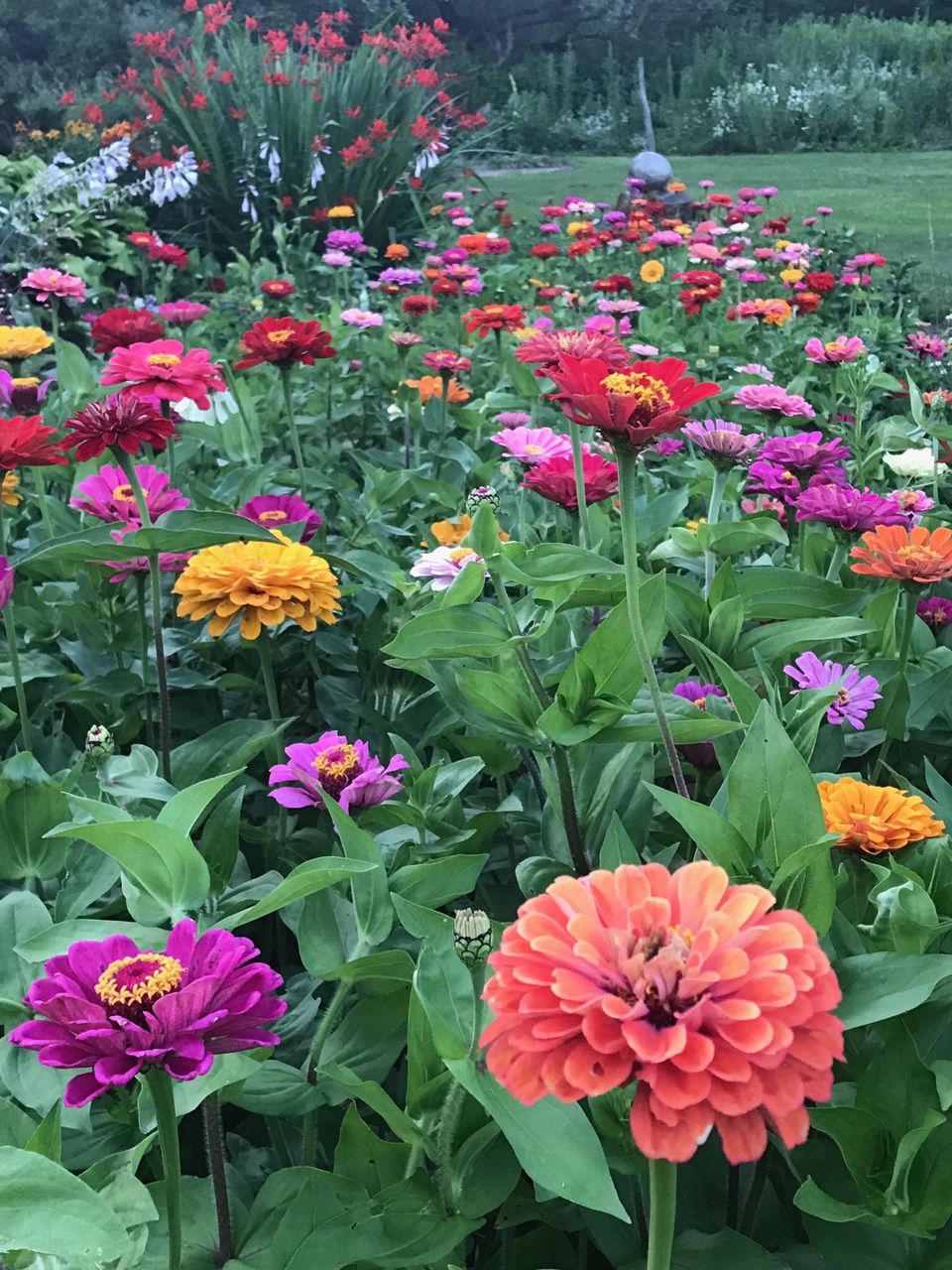
Today, Janet has created many beds of flowers: Shasta daisies, daylilies, coneflowers, Lucifer, black-eyed-Susan, and zinnias are her favorites and provide color throughout.
Rows of large canna lilies provide interest, as do birdbaths, birdhouses and garden statues.
A colorful line of hollyhocks and rows of various grasses sway in the breeze, and many varieties of hosta plants are tucked in the shade throughout the yard. A long wildflower garden stretches east along the old lane, and Janet says that the wildflowers surprise her each summer as they reseed and change.
Janet enjoys the garden view from their dining room table, and she finds tranquility in the flowers, butterflies, and birds at the feeders. She says that watching the activity, “always makes life interesting.”
Tom built a gazebo which family and friends enjoy. It is nestled among tall grasses and ferns, giving it the feeling of an oasis. He has built other structures, including a potting shed, duck houses, and bird houses. Tom appreciates and supports Janet’s love of flower gardening, and he has extensive vegetable gardens, fruit trees, and other unique trees that he has plants and nurtures.
Regular wildlife visitors are both a joy and a challenge to a gardener, but Janet and Tom’s two dogs keep the rabbit population out of the gardens and deer haven’t been a problem.
Janet is humble by nature, but when pushed to give gardening advice, she suggests “Start small. Make sure it is something you enjoy.” But she also goes on to share the benefits of gardening and the “relaxation and rewards” she finds when the weeding is finished and the flowering begins.
The smell of fresh coffee and the sound of quiet children’s giggles welcome a visitor to Mezanmi Play Cafe in downtown Vicksburg, a place to play, learn and connect with other caregivers and young children.
The cafe at 105 S. Kalamazoo is open to the public with a menu of hot and iced espresso drinks, teas, flavored lemonades, local baked treats, and now shaved ice in an assortment of flavors.
According to its owner, Vicksburg native Renee (Lash) Janofski, the word Mezanmi is a Haitian Creole expression that explains the purpose of this business. It means, she said, “Oh my goodness, I’m overwhelmed!” as well as “Wow, I can’t believe my eyes!” though the literal translation is “my friends”.
Renee has a degree in elementary education and said she understands the need for creative, imaginative play that supports motor, cognitive and language skills and social development. As a mom of two teenagers, she also understands that parenting is challenging at times and remembers the need she felt to get out of the house and connect with other caregivers in a clean environment.
These spaces were not easy to find; the idea of a play cafe took root.
She and her husband, Craig, lived and worked in Haiti for six years. After learning a lot working in orphan care, they switched their focus to orphan prevention through job creation. Craig and Renee continue to work with Extollo International, a non-profit that teaches skills and job training to Haitians, empowering them to provide for their own children and decrease the number of economic orphans. The boutique area of Mezanmi features beautiful handmade products made by Haitian mothers. Mezanmi’s coffee is grown in Haiti as well. The proceeds help families stay together and keep children out of orphanages.
To maximize play time and guarantee space, 90-minute play sessions for children 6 and under can be scheduled online at mezanmiplaycafe.com. The cafe is also open to the public Monday through Friday from 8 a.m.-4:30 p.m. and Saturday and Sunday from 8 a.m.-12:30 p.m. To help keep a clean and safe environment, the play area requires socks only for all participants.
Mezanmi offers memberships with discounted rates and passes that can be used by members or their guests. Special events, camps and interactive play areas are designed to spark imaginations and social development. The space can be rented for private birthday parties after hours.
Many children born during or shortly before COVID-19 have had limited time interacting with other children, especially if they are an only child. Their exposure to others was limited during a time that is important to their development. Mezanmi provides a safe place to explore and meet new friends, Janofski said. “My favorite part of Mezanmi is when I see moms come in, have a place to relax, make connections with other moms and feel encouraged.” She said caregivers have traveled from all over the state of Michigan and even Indiana just to connect with others in the unique environment.
How did your collection begin? I started in 2008, when my daughter-in-law bought me a Lego architectural set, and I just picked it up from there. The architectural sets were a good introduction but I soon found Lego’s modular sets, which are much larger and very detailed. Lego started modular sets in 2007 when they introduced two, then they released one a year beginning Jan. 1 in 2008.
What is your best source for acquiring/trading/selling? There are Lego stores in larger cities but I can get the modular sets and Lego pieces through Lego’s website. They don’t necessarily limit the modular sets but if you don’t order right away Jan. 1, it’ll go on backorder and you’ll have a very long wait. On average, a modular kit you’d buy directly from Lego’s website costs about $150.
Your most unusual item? I’m a fan of Batman and I just bought the 1989 Batmobile set … it’s about two feet long and has more than 2,000 pieces. I bought the Batwing, too, a separate piece that is also big, about 2,000 pieces. Most modulars are anywhere between 2,000 and 2,500 pieces. I’ve also built four houses just from my own design using spare pieces.
How long does it take to assemble a Lego modular? Well, I’m retired so I typically can put one together in about a week. I have the luxury of several hours during the day, if I choose, to spend on assembling the kits.
Some people buy the modular kits like they’re a collector’s item … they’ll keep the box sealed and never put the pieces together. I just can’t see the need to do that. I mean, you buy it for the fun and the challenge, to keep your mind sharp.
What item or items are missing from your collection? I don’t have the first three modular sets. They’re out there on the secondary market but at a price I’m not willing to pay. Also, I wish I had been involved in this when they were doing the Indiana Jones sets.
Are you on the web? There are clubs and we have one here in the area. It’s called West Michigan Lego User Club and I’m a member, but the majority of the members are in Grand Rapids.
What joy do you get from collecting Legos? It’s a great hobby and I get a lot of enjoyment from working on modulars. I was an architectural designer, so building these brings me a lot of enjoyment and the satisfaction that comes from the sense of accomplishment.
What’s the most you ever paid for an item? I spent $400 on the Disney Cinderella’s Castle from Lego’s website. It’s a piece my 9-year-old granddaughter really enjoys. There’s a Star Wars piece that’s close to $800 and has about 4,000 pieces, but I’m not into Star Wars.
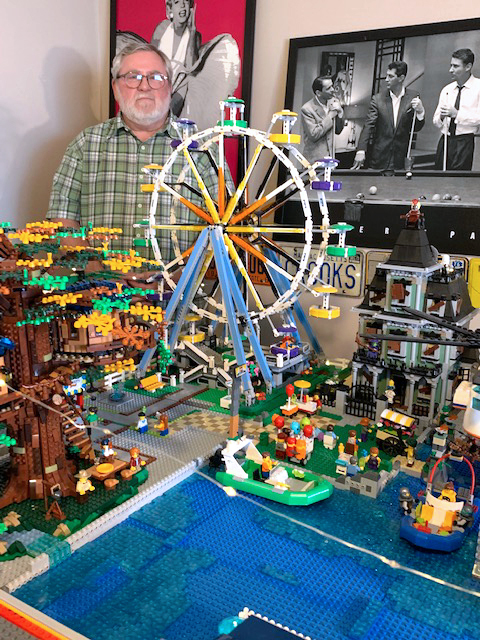
Footnotes: White, 65, said the most complex and largest item he has constructed is a 3,000-piece roller coaster. His Lego “community” display rests on two ping pong-sized tables and features illumination provided by a string of Christmas tree lights.
Collector Updates
Jeff Kik, whose collection of 25,000 logoed golf balls was featured in the May 2021 South County News, recently received a welcome surprise.
Kik mentioned several corporate logos he has been trying for years to secure. One he mentioned was Godfather’s Pizza.
Susan Hartmann, franchise marketing specialist for Godfather’s Nebraska-based corporate office, saw the story online and was eager to help.
“I read the story and thought it was very interesting, so I told my boss about it and asked her if we had any more (Godfather’s logoed) golf balls available,” Hartmann said. “She said she didn’t know. A few weeks passed and I’d sort of forgotten about it until I came into work one day and there was a sleeve of golf balls on my desk.”
Hartmann mailed the three-ball sleeve to South County News, which delivered the surprise to Kik on July 3. Kik was thrilled with the gift and said he has a special place to display his long-sought golf ball.
“The funny thing is, I was on my way home from golfing last night,” Kik said, moments after receiving the gift, “and I stopped and picked up a pizza from Godfather’s. How’s that for a coincidence?”
Angelo State University Morgan Preston of Vicksburg, named to Lone Star Conference Commissioner’s Honor Role
Kalamazoo College Dean’s List Shayla Dailey of Schoolcraft Kieya Kubert-Davis of Schoolcraft Jenna Beach of Vicksburg Austin Bresnahan of Vicksburg Erin Perkins of Vicksburg Tanner White of Vicksburg
Northcentral University Meagan Stiver, of Vicksburg, has been awarded the merit-based President’s Scholarship and the Pioneers of the Future Scholarship.
Saginaw Valley State University Deans’ List Taylor J. Dent of Vicksburg