Librarian under glass: Adrianne Schinkai behind the plexiglass.
By Adrianne M. Schinkai, Head of Reference & Circulation Services, Vicksburg District Library
It’s one year into the COVID-19 pandemic and the employees of the Vicksburg District Library are holding their own. However, the pandemic has left them all enervated.
A year ago, the Library closed down for over two months as numbers of cases for the virus quickly rose throughout the country and the state of Michigan. Since then, the Library has gone through various phases of being open and closed. The whole process, however, is cumbersome and very detailed. Libraries across the nation have never had to run this way before. “The circumstances of the prior year have been singular and completely unexpected,” states Library Director Eric Hansen. As a result, staff of the Library acknowledge that while they are still working to give the best service possible for the community, they have hit a wall with the pandemic, just as their patrons have.
Youth Services Librarian Stephanie Willoughby shares these sentiments. “It’s been hard not being able to see and interact with children and teens. I have been unable to visit school and daycares to lead live programs. I’m like so many of our children with being burned out on virtual programs.”
What exactly is going on behind the scenes at the Library during the pandemic?
Since late October, the Vicksburg District Library had been providing services at a limited capacity strictly by appointment only. The Library is currently operating at 25% capacity with a strict face mask policy in place. Changes have been abundant since last year.
With each new announced press release, mandate, or executive order issued by the Kalamazoo County Health Department, the Michigan Department of Health & Human Services, or Michigan Governor Gretchen Whitmer, the Library has needed to tailor its services to meet the latest guidelines. This is no easy task as it involves updated availability on circulating items, hours the library can provide services, and how those services are specifically handled. All programming has been changed from in-person to virtual/online. In addition, when items are returned to the library, they all are immediately quarantined for a period of seven days before they are checked in and available for patrons once more. All of this has been done with the safety and health of the staff and patrons in mind.
Hansen says, “The staff of the Vicksburg District Library have worked to incorporate the best advice from doctors and medical researchers, as well as legal requirements issued by the local and state governments, to assist in protecting our community…we have tried to be diligent in continuing services that we can safely offer.”
With each change put in place because of the pandemic, whether involving face mask policies, switching to curbside service only, or closing physical buildings entirely, libraries across the nation are in a constant state of adapting. They are universally sharing the same issues when it comes to quarantining items, adjusting services, and assisting patrons from a distance. Depending on the changes needed as stated by the government, the work can be tedious. With the vaccine rollout across the nation, some librarians have been left disheartened that they don’t qualify to receive the injections. Libraries are sometimes classified as educational, governmental, and/or retail institutions, but the State of Michigan has ruled libraries as non-essential at this time.
Locally, Vicksburg District Library staff is striving hard to serve the community as best they can through online programming, in-person services, and protocols that have everyone’s safety and health in mind. Hansen smiles. “We fervently look forward to a time when we can see all of our patrons again…we really look forward to providing a place where the community can gather.”
Willoughby agrees. “It certainly has been a year of throwing spaghetti on the wall and seeing what sticks!”
Those with questions or concerns about what is currently being provided by the library can contact the Vicksburg District Library at (269) 649-1648. The latest information is also always posted on the library’s website at vicksburglibrary.org and on its social media accounts.
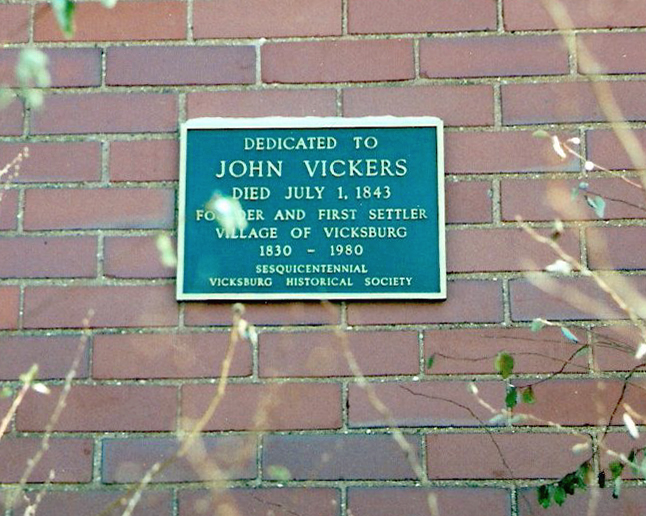
Provided by Vicksburg Historical Society and dedicated during the 1980 Sesquicentennial celebration, this marker is located high on the exterior wall directly to the left of the front entrance to the Vicksburg Schools Administration Building on Kalamazoo Avenue.
By Maggie Snyder, for the Vicksburg Historical Society
While the history of Vicksburg has been well recorded, some things need to be repeated every so often. And what better time to tell the story of how Vicksburg got its name than during the celebration of its 150th birthday?
One of the first settlers to come to the area was John Vickers. Vickers journeyed in 1829 from Ohio to Prairie Ronde, where he built a grist mill. Around 1830, Vickers moved to a location within the Nottawaseppi reservation on Portage Creek. He asked a friend, Joseph Frakes, who was on friendly terms with the reservation’s Potawatomi Indians, to help him obtain their permission to build a grist mill. Permission was granted, and Vickers built his mill on the southwest corner of present-day West Prairie Street and Michigan Avenue.
By 1834 Vickers had enlarged his mill and established a distillery, and a little community was forming around these two enterprises. The community needed a name and, he thought, why not Vicksburgh?
In 1836, Clark Briggs and John Noyes built a store on the present-day intersection of Main and Prairie Streets, and settlers for miles around started coming to Vicksburgh for groceries and supplies. Charles Kimble opened a blacksmith shop in 1837, Samuel Hawkins built a tavern and boarding house, and soon a log school was constructed on a parcel of land near today’s school administration building on Kalamazoo Avenue.
When the former reservation lands were offered for sale in 1841, John Vickers filed a property claim with the government. The land was surveyed by William Watson, who laid out 30 lots in what was commonly known as Vicksburgh. John Vickers received his abstract of title for 160 acres in Section 13 in February of 1843, but in July of that same year Vickers died. He was laid to rest in a grass-lined grave in a cemetery near the log school. Then suddenly, Vicksburgh wasn’t Vicksburgh anymore.
At the time, the U. S. Post Office was using “Brady” as a designation for the little village – it was the largest settlement in the township of the same name – even though ‘Vicksburgh’ was in common usage. Unfortunately, it turned out Vickers had neglected to record the platting of his town, so the name Vicksburgh was not official.
Enter Hugh Finley, who located here around 1846 and built a two-story building on the southeast corner of Main and Prairie where he operated a store for a short time. Mr. Finley was determined the village should be called Brady, and the first legally recorded plat was acknowledged in 1849 with Hugh Finley listed as proprietor and the name of the village listed as “Brady.” It is believed Mr. Finley wanted to honor General Hugh Brady, the man given the responsibility for the western relocation of the Potawatomi after their reservation land was sold to the Federal government.
Between 1849 and 1871 the village grew considerably, with the establishment of more mills, a post office, additional stores, an expanded school program, the introduction of mint as a local agricultural specialty, the beginning of regular stagecoach service, and, eventually, the coming of the railroad.
A petition was presented to the Kalamazoo County Board of Supervisors in October of 1871 asking for, the Kalamazoo Gazette reported, “…the incorporation and organization of a village….to be known as Brady.” But the next day an amendment was adopted to change the name of the village from Brady back to Vicksburgh, and the Board of Supervisors approved the change.
And what happened to the ‘h’ in Vicksburgh? It was in common usage as late as 1880, then just seemed to fade away.
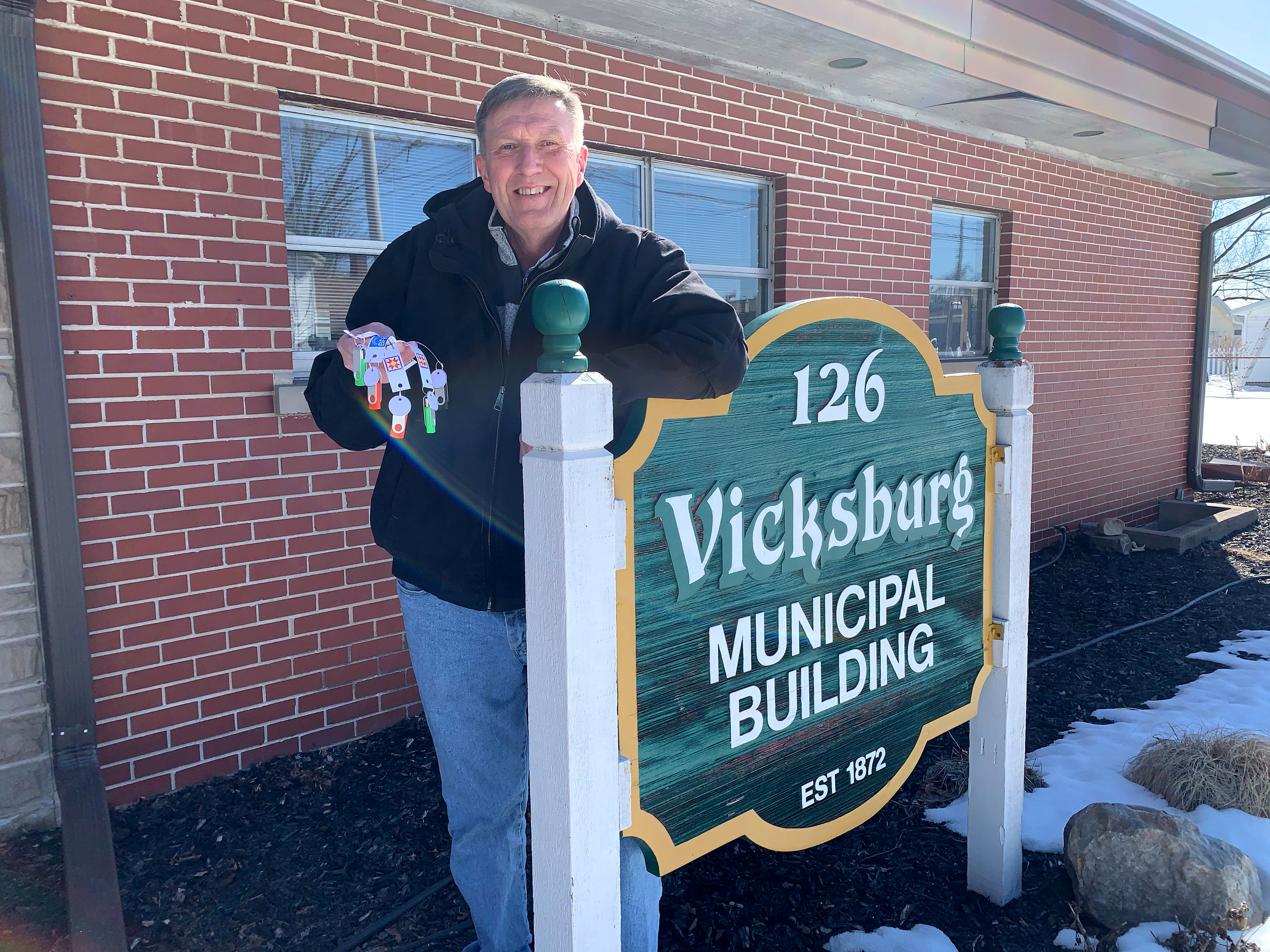
Alex Lee holds thumb drives containing Vicksburg area video files donated by Bike Friendly Kalamazoo to Vicksburg-area civic organizations.
By Paul Selden
Bike Friendly Kalamazoo (BFK) has donated 300 professionally produced video segments featuring highlights of Vicksburg and South County on thumb drives that will soon be available at the Vicksburg District Library.
The segments, or “B-Roll” as they are known in the industry, were shot by Public Media Network (PMN) as part of BFK’s annual Fall Bike Celebration Weekend. Bike Friendly Kalamazoo engaged Public Media Network to shoot the segments with support from The Vicksburg Foundation and PMN. The video files consist of brief scenes that can be woven into creative productions, copyright free.
Paul Selden, chair of Bike Celebration, presented thumb drives in February to Alex Lee at the Vicksburg Village offices and Kitch Rinehart, co-founder with husband Hugh of the Vicksburg Quilt Trial. Selden said, “I want to offer special thanks to The Vicksburg Foundation and Public Media Network for their role in making possible these very contemporary video segments, and to Tim Fuller and Charlie Church of our Fall Bike Celebration planning committee for suggesting a list of area highlights to be shot.”
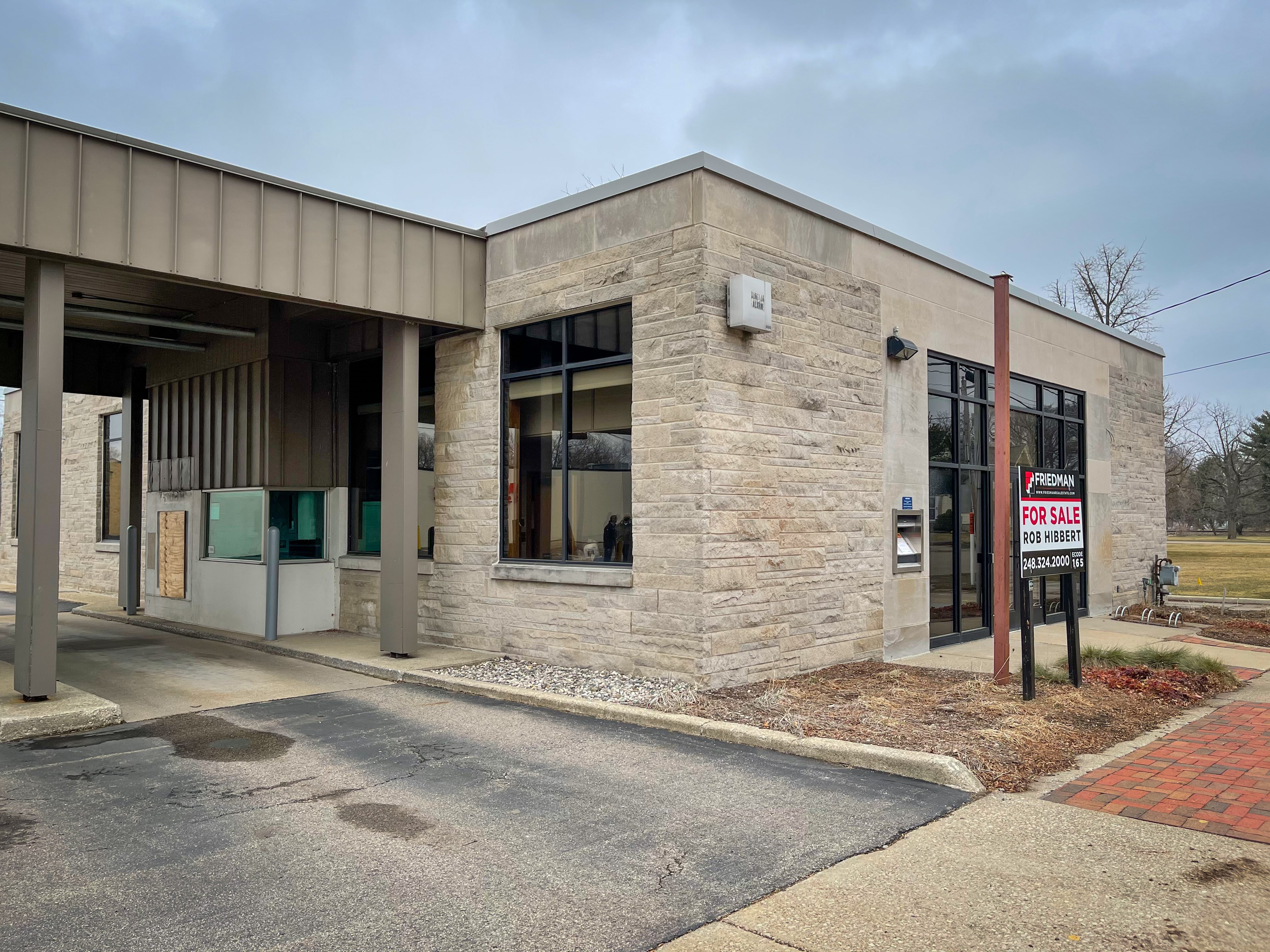
Kalsee Credit Union has purchased the former PNC bank branch at 119 North Main Street in Vicksburg. After remodeling, it’s set to open this fall.
The remodel will include changes to the drive-through with interactive teller machines and some updates to the interior décor including new lobby flooring. Kalsee is currently hiring tellers, a member service representative/loan officer, and branch manager for this location.
“Vicksburg exemplifies the midwestern small-town ideal,” said Kalsee’s chief executive officer, Matt Lahman. “The community is a great fit for the way we do business, where we get to know our members personally and invest ourselves in their financial well-being. It’s our privilege to contribute to the community’s growth and wellness.”
“We look forward to welcoming Kalsee into our community and appreciate the opportunity for our residents to bank with a truly local, mission-driven financial institution that values community involvement,” said Vicksburg Village Manager Jim Mallery.
Vicksburg will be the first of three new Kalsee branches opening soon. Two new construction projects include branches in Kalamazoo at the northeast corner of Portage Road and Cork Street in late 2021 and on Gull Road west of Sprinkle in 2022.
Trees along downtown Vicksburg sidewalks were cut down because the sidewalks must be removed as part of the coming water and sewer infrastructure project, Vicksburg Village Manager Jim Mallery said at a March village council meeting.
New trees will be planted.
The manager responded to social media posts questioning removal of the downtown-area trees. He said the village gave public notice as far back as January that the trees would be coming down at the onset of the infrastructure work.
“Once this project gets downtown, all of the sidewalks eventually are going to be dug up and those trees appropriately had to come down before April 1,” he said. “On a positive note, there are going to be trees downtown, in a downtown that is going to be as progressive as any small village downtown is currently.”
“Every tree that came down was connected to the infrastructure project,” he said. “There are going to be additional trees that come down as sidewalks along the area of Spruce Street are getting replaced. Staff makes contact with the actual home’s residents and homeowners well in advance.”
He said Spruce Street sidewalks are more than 50 years old and are buckled in many sections.
On another subject, Vicksburg will once again fund a goose round-up in an effort to control the Canada geese population in the village.
Mallery said the round-up will take place in the vicinity of Sunset Lake. During the village council’s March 1 meeting, Mallery said he feels past round-ups have had a positive impact.
“In the summer of 2017, we unfortunately had to shut down Sunset Lake beach for a time period due to the testing results of the water,” he said. “We’ve looked at an all-encompassing plan – DPW continues to implement that plan by quite frequent clean-ups of the beach – but one of the key things we thought we were successful in was the annual goose round-up, which has moved to the addition of capturing eggs.”
Mallery said the company charged with the task repopulates the geese elsewhere in the state. He said the process is regulated by the state and that this is the second consecutive year the procedure includes gathering eggs.
“It is a live capture; the animals are just placed in new homes in another location in the state of Michigan,” Mallery said.
A resolution in support of the process is required and was approved unanimously.
In other business, Mallery outlined the process leading up to approval of the village’s 2021-22 fiscal-year budget beginning July 1. He said the procedure involves internal meetings with department heads for their input on needs, wants and wishes for the 12-month period.
Mallery said input will be sought from business owners and Vicksburg residents before the council approves the budget, probably on June 28.
Council member Denny Olsen said the former Plainsman Motel in Schoolcraft Township will be intentionally set on fire to provide training for the South County Fire Authority and other area fire departments.
Olsen said the burn will take place over the May 1-2 weekend. Coordination will involve Kalamazoo County Sheriff’s Department, the Michigan Department of Transportation, Schoolcraft Police and other agencies.
“(U.S.) 131 speed limit is probably going to have to be cut down to 30 to 35 miles an hour simply for the fact we’re going to have gawkers,” Olsen said. “In fact, we may have to detour off of 131 … that’s all a possibility.”
He said the procedure is scheduled on a weekend to allow fire personnel to manage the blaze a room at a time and allow for a follow-up investigation.
Vicksburg Community Schools officials are preparing for a busy summer at some of its buildings.
In addition to juggling a few significant construction projects, administrators face the task of coordinating summer-learning programs.
“We have ramped up our discussions around the summer … one of the big maneuvering aspects of summer services is, as we’re doing construction, where can we put the kids?” Superintendent Keevin O’Neill said. “We certainly will be working through that and we’re confident we can put together a plan. We’re working with our staff right now to see the interest in doing some summer school, so, stay tuned.”
Board member David Schriemer acknowledged the district’s staff has gone above and beyond this year, and deserves a break. Still, Schriemer said he hopes there are some enthusiastic teachers willing to help out this summer.
“I think it’s so critical and if we have more dollars available to do something, I really hope we’re able to do something even bigger than we’ve done before,” Schriemer said. “I think that’d be fantastic.”
In response, O’Neill referenced House Bill 4048, which would provide funding from the state for teachers and support staff involved in K-8 summer programs or high school credit-recovery programs.
Assistant Superintendent Steve Goss elaborated on the pending construction work taking place this summer at Sunset Lake and Tobey schools, financed through last year’s voter-approved bond issue.
“The work is about $5.2 million worth of construction and it’s going to relate primarily to upgrading the mechanical systems at those two buildings. There’s a lot of work that goes along with that,” Goss said.
He said the work will include new windows, replacing curtain walls, a stucco-like façade, mechanical upgrades to bring cooling systems into the buildings, new piping, electrical upgrades including a conversion to LED lighting and acoustic ceilings.
“It’s very daunting when you look at the summer construction season and every year the needs to use the building for the summer go up and up and up,” he said, adding that a number of discussions have taken place with principals, O’Neill, the district’s curriculum director and others in an attempt to coordinate summer-instruction options. “I feel like we’re walking a tightrope because we have a limited amount of time to do a lot of work, and we have a limited amount of time to work with our students.”
Goss said the added expense of running air conditioning at the schools will be largely offset by savings realized through the installation of energy-efficient windows, exterior insulation and LED lighting. Replacing the single-pane, glass windows – which are original from the building’s opening – at the east side of Sunset Lake, for example, will result in a substantial degree of energy efficiency.
Work at Sunset Lake will be done over two summers considering the magnitude of construction there.
Sixteen bid packages related to the summer work were subsequently approved by the board. The board in coming months is expected to review bids related to stadium improvements at the high school. The work will include replacement turf on the football field, and replacement asphalt and track coating.
Meanwhile, O’Neill said the majority of the district’s employees have had their second COVID-19 vaccination. As a result, some parents have inquired about class sizes, as some families want to move their children from virtual back into in-person learning.
He said the district has capped its elementary rooms to 23 students and is has started to add potential returning students to a waiting list.
“If there’s no room in their home elementary school in that grade level, we ask them if they would like to attend a different elementary for this school year only,” he said. “We’ve had some success there.”
O’Neill said there has been no consideration given to increasing class sizes beyond 23 students per room.