

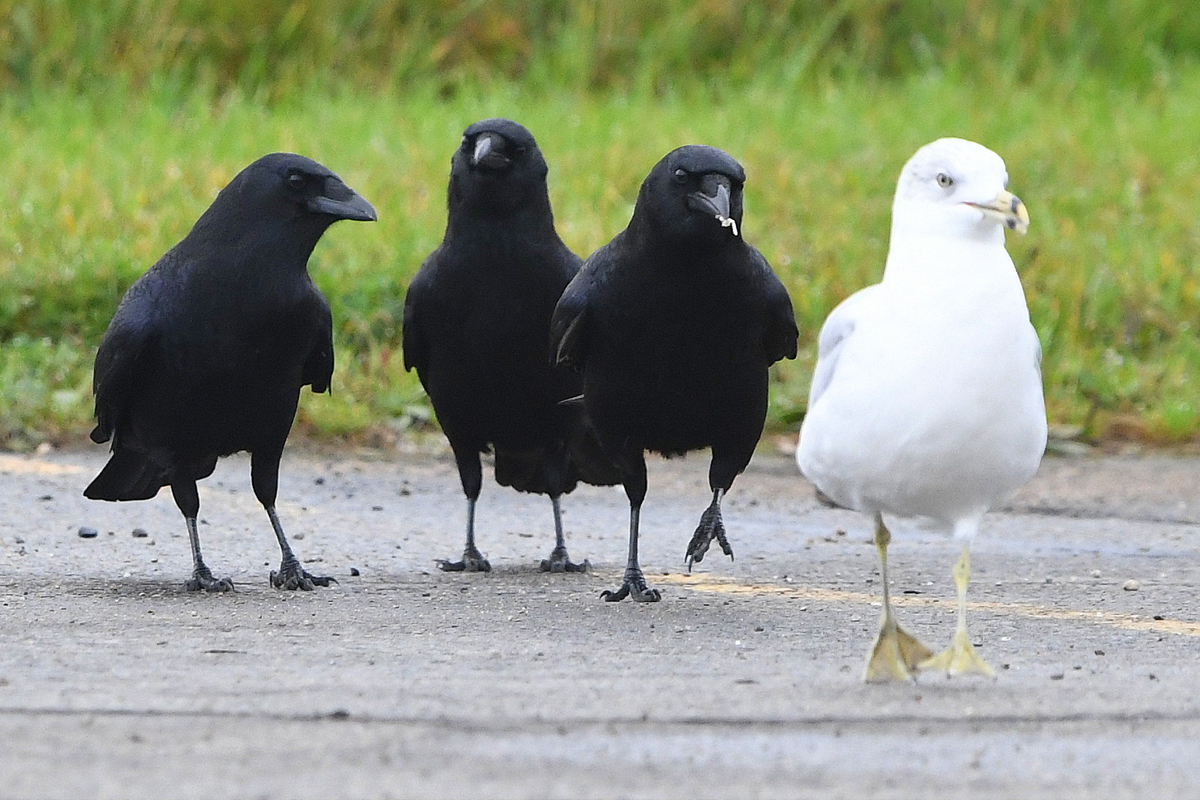
What comes to mind when you see a crow? Do you see a noisy, messy, destructive bird, or do you see a beautiful, intelligent creature? I’m firmly planted in the second camp, and totally awestruck by a crow’s ability to figure out complicated tasks and to thrive in virtually any environment.
Worldwide, there are over 40 different species of crows. Sometimes, they are mistaken for ravens, and ravens are sometimes mistaken for crows. The distinction between the two birds is based mostly on size rather than on any clear genetic differences. Both crows and ravens belong to the genus, Corvus, but ravens are considerably larger. They are comparable in size to a red-tailed hawk, while crows are more similar in size to blue jays or pigeons.
Whether you live in a busy city environment, a quiet suburban neighborhood, or out in the country, you’ve undoubtedly seen a crow at one time or another. They are resourceful, opportunistic birds that have learned to survive just about anywhere. If one food source disappears, crows quickly adapt and find another source; and they aren’t the least bit picky! They’ll eat earthworms, insects, small animals, seeds, fruit, fish, baby birds, dog food, waste grain, carrion, and garbage!
Crows are not only great scavengers when it comes to finding food, they are beyond creative when it comes to obtaining specific foods they want, even if those foods seem impossible to retrieve. In one of the best-known experiments of crow intelligence, researchers dropped a small, floatable treat into a narrow water-filled tube. The water level was too low for the crow to reach the treat, so it figured out how to raise the level and ultimately grab its reward!
For that particular study, researchers provided the test crows with a variety of objects to choose from; heavy things, like stones, that would sink to the bottom of the tube and raise the water level, and lightweight things like corks and cotton balls that would only float. After a short period of trial and error, the crows in the study would consistently choose the stones to displace the water. When the water level was high enough, the crows retrieved their coveted reward. Even more amazing to me is the fact that this experiment was based on Aesop’s fable, “The Crow and the Pitcher”, from the 6th century BCE! Today, this experiment is commonly referred to as the “Aesop’s Fable Paradigm”.
The Aesop’s Fable Paradigm demonstrates that crows understand cause-and-effect relationships, water displacement theory, and the concept that heavy objects will get the job done, while lightweight ones will not. The crows in this study also knew to eliminate objects that were too large for the container even if those objects were capable of sinking. Human children don’t gain this understanding of volume displacement until around the age of seven!!
Another fascinating experiment involved a captive New Caledonian crow named Betty. Researchers presented Betty with a tiny basket of food located inside a short, transparent, vertical tube. They also placed a straight piece of wire next to the tube. Betty couldn’t reach the food directly, so she picked up the wire with her beak and made a few unsuccessful attempts to retrieve the food basket by poking it. When that didn’t work, she took the wire and jammed it into the tape at the base of the tube to hold the wire in place while she bent it around the base forming a hook! When the hook was finished, Betty pulled the wire loose from the tape, dipped the hook into the tube, and pulled out the basket containing her reward!
I find this level of intelligence in birds to be totally amazing! Betty created a hook without any prior training or experience with wire, or without any prior experience watching other crows create hooks! At some level, she understood that a curved tool was necessary to get the job done, and that the wire could be bent. She then used a multiple step process to anchor it, bend it, and “fish” with it. Incredible!
There are many, many more examples in the literature and online demonstrating the intelligence of crows, but one video in particular really captured my attention: “Testing the World’s Smartest Crow”. It was both entertaining and informative and can be found on YouTube using the title or this link.
Enjoy!