


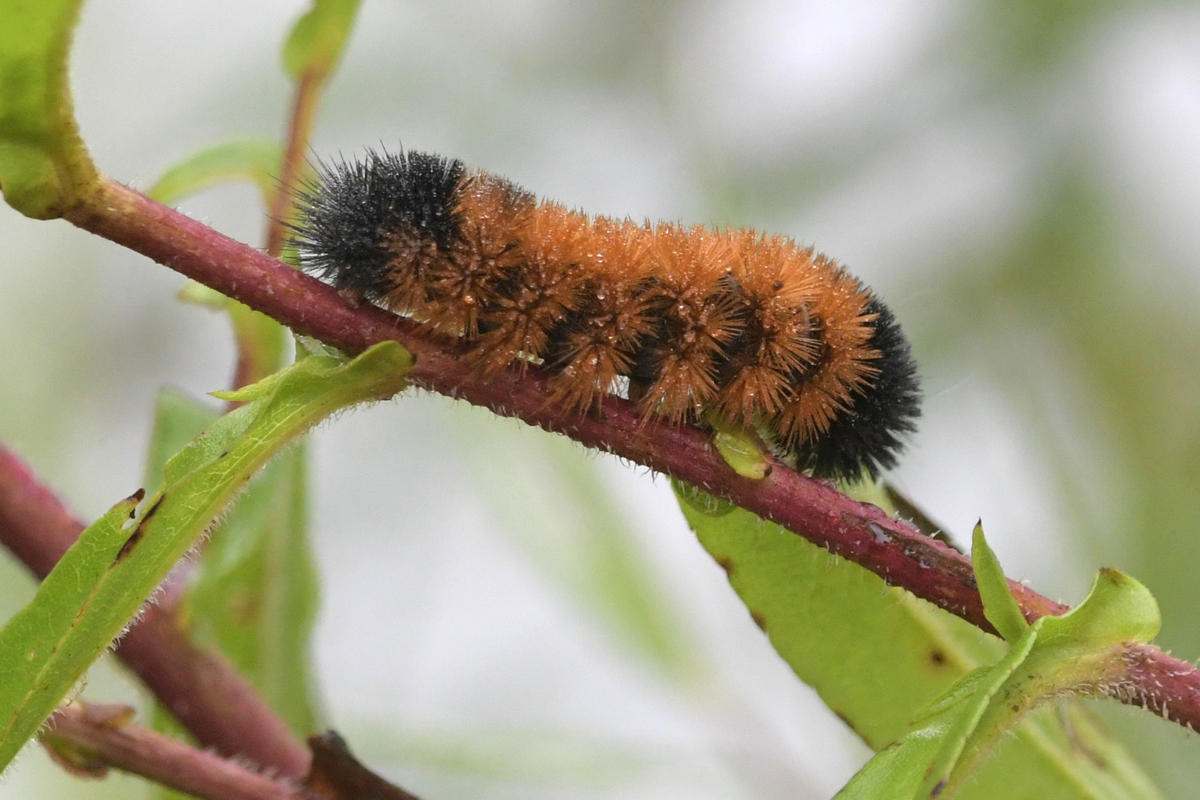
It was late September when I took this photo of a woolly bear caterpillar at the Wolf Lake State Fish Hatchery in Mattawan. I thought it might make an interesting subject for a story, but I also wondered if I could find enough information to write about. This was, after all, just a caterpillar. I needn’t have worried. The woolly bear has a long history and a huge fan base!
If you’re not familiar with woolly bears, they’re fuzzy black and brown caterpillars that we usually see in the fall crawling along the sidewalk or inching their way across the road. Generally speaking, they’re black at both ends and rusty brown in the middle. Sometimes, though, woolly bear caterpillars can be mostly black or mostly rusty.
We call them “woolly bears” here in the Midwest, but other parts of the country, particularly the south, call them “woolly worms.” They’re also known as “banded woolly bears,” or “hedgehog caterpillars” because they curl up in a ball like a hedgehog when they’re frightened.
The name of this caterpillar may vary from region to region, but the folklore surrounding its weather predicting abilities is basically the same wherever you go: If the rusty brown band of the woolly bear is wide, the upcoming winter will be mild. If the band is narrow, the winter will be harsh.
This myth is rooted in colonial American folklore and could have remained just a quaint little story had it not been for the work of Dr. C. H. Curran, curator of insects at the American Museum of Natural History in New York City. From 1948 to 1956, Curran studied a handful of woolly bear caterpillars each year to scientifically confirm or refute the prevailing folklore. He ultimately concluded that there might be some truth to the legend even though his time frame was relatively short and his sample size much too small to even suggest such a possibility. Nevertheless, his findings were published in the New York Herald Tribune and later picked up by the national press, making the once obscure woolly bear the most recognizable and celebrated caterpillar in all of North America!
As a result of the woolly bear’s new-found notoriety, cities and towns across the United States gradually began holding big celebratory festivals in honor of their local woolly bears and woolly worms. The oldest of these festivals is held every year in Banner Elk, North Carolina on the third weekend in October. This year marked its 48th anniversary and 20,000 woolly worm fans descended on the small town of Banner Elk to participate in the event!
The most interesting activity at the festival might very well be the woolly worm races! How do you even race a worm, I wondered? The answer is: Use string! Banner Elk fair organizers constructed a woolly worm racing venue that consisted of a 3-foot-high frame with 25 “racing” strings attached securely to the top and bottom of the frame at small intervals across the width of the structure.
The competing caterpillars are placed at the bottom of each string and expected to crawl to the top while an enthusiastic crowd and the worm “handlers” cheer them on. All of the worms have been given clever and endearing names like Patsy Climb, Woolly Wonka, Woollburt, Wormzilla, and Obi Worm Kenobi!
Some of the “racing” worms never move up the string at all, others quit halfway through the race, and a few just fall off. The most ambitious ones, though, make it to the top in 60 seconds or less! The woolly worm that wins all of the heats has the honor of predicting Banner Elk’s upcoming winter weather while the worm’s handler walks away with $1,000 in prize money!
In late fall, woolly bear caterpillars search for a place to spend the winter. They might pick a pile of leaves, a cozy spot under the loose bark of a tree, or the security of a hollow log. As the weather becomes more and more frigid, the woolly bear slowly freezes. Its heart stops beating and its blood stops flowing — but it doesn’t die! Woolly bears have glycerol in their system that acts like an antifreeze which allows them to survive in temperatures as low as minus 90 degrees Fahrenheit!
Once spring returns, the frozen woolly bear thaws out, spends a few days devouring all the grass and weeds it can find, then spins a cocoon made of silk and its own body hairs. Within a few weeks, the woolly worm emerges as a beautiful yellow-orange Isabella tiger moth!
What an amazing worm!