


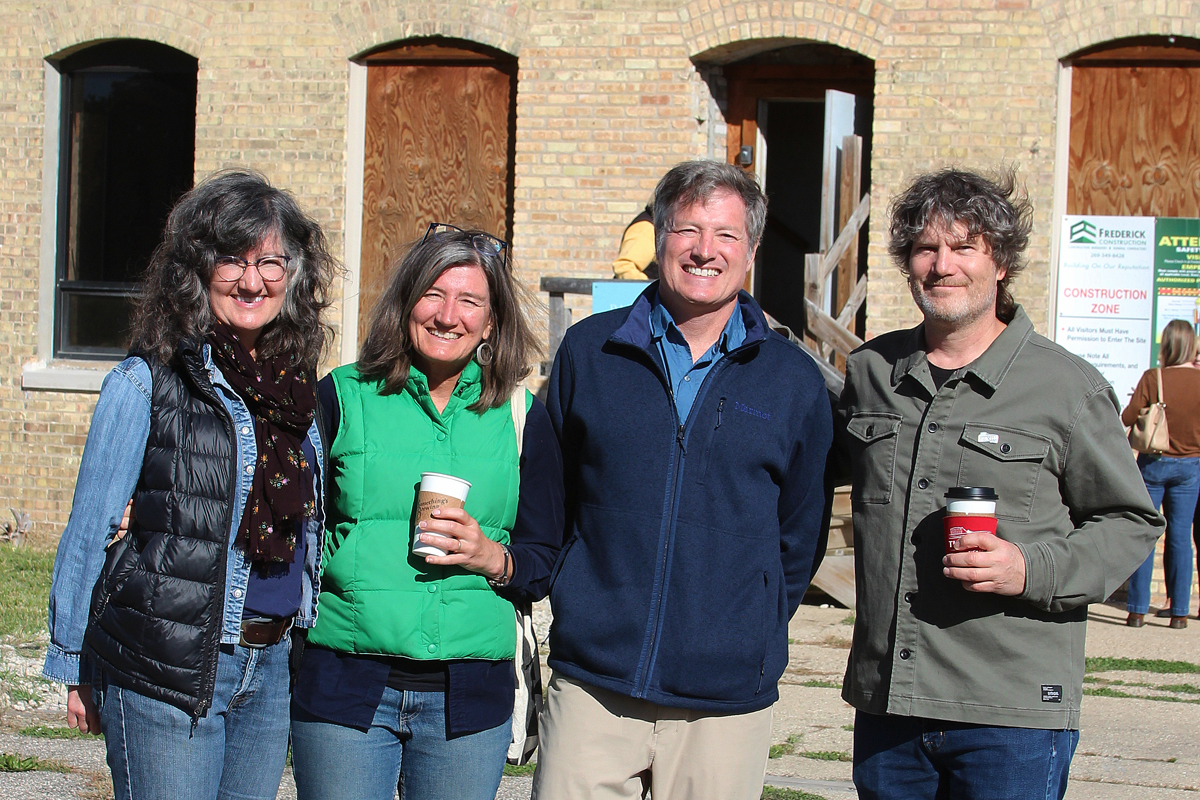
Chris Moore (far right) with Christopher, Sarah, and Jenny Bardeen (far left) at the Mill Family Reunion in 2025.
Among the guests gathered for the sixth annual “Family Reunion” at the old Vicksburg mill on October 11, 2025, were three out-of-towners whose roots go back to the planting of the Lee Paper Mill family tree more than 120 years ago. Christopher, Sarah, and Jenny Bardeen were in town for their annual pilgrimage to Schoolcraft Township Cemetery, where their father Charles William Bardeen, grandfather Maxwell Dickerman Bardeen Sr., and great-grandfather Norman Bardeen are all buried.
After cleaning up the graves and leaving flowers, “we went across the street to look at the mill,” Sarah explained. “Tom (Hardy) and John (Kern) drove up—no doubt to intercept the interlopers! When they realized our connection to the mill, they took us on a short tour and then invited us out to the (reunion) pancake breakfast the following Saturday.”
The Bardeens have a long history with Vicksburg’s paper mill starting with George E. Bardeen, brother of their great-great grandfather Charles William Bardeen. George Bardeen, a founder of Olivet College and wealthy owner of the paper mill in Otsego, was drawn by the location and abundance of natural resources when he joined Fred Lee, William Howard, and Charles Seitz in proposing to build a new paper mill in Vicksburg. The village got behind the plan. They broke ground in 1903, and by 1905, the Lee Paper Mill, then the largest in America, opened for business making high quality paper from rag pulp.
Although the mill was named after Fred Lee, the biggest capital investor in the project, the Bardeen name would become better known in the community. From 1953 to 1988, the Mill’s president, Max Bardeen Sr., was a trustee of the Vicksburg Foundation and a noted humanitarian. Max carried his lunch to work every day and “he made a point to walk through the Mill and call his employees by name,” said Mary Grubka Makowski, a retired mill worker who was quoted from a 1993 interview. “Everyone respected him. He was the finest person you could find.” During Max’s tenure with the Vicksburg Foundation, numerous educational projects were begun including student scholarships through the Vicksburg Community Schools Foundation. Since 1986, Bardeen Grants are given annually to educators in Vicksburg schools for creative, innovative teaching and classroom projects. Foundation trustee Lloyd Appell, MD, remembered well how “Max made it very clear: We are not the people doing things, we are here to help the people who are doing things in this community.”
In 2013, the Vicksburg Foundation granted $100,000 to the village to buy the Lee Paper Mill back from the auction block after its last owners abandoned it. In 2014, local son Chris Moore, whose family worked at the mill for three generations, invested in the derelict property. Today, the Mill at Vicksburg is under restoration with a promising future as once again a cultural and economic engine of southwestern Michigan.
The Bardeens — Max, his brother Norman, and his son Bill — remain associated with the history of respected leadership and stewardship of the venerable institution that was the paper mill. They earned the respect of their employees and their peers. For Bill Oswalt, who was a teenager working at the mill during summer vacations in the 1950s, Max in particular earned extra points for his good humor.
“Max and (my stepdad) John Weimer apparently built themselves a still at some point,” Oswalt recalled. “Later, I made my own brew and ran it through that still—it came out perfectly clear. I told Max that story and he said, ‘My God man, you didn’t drink that did you?!’ Well, of course I did have a sip of that but at 170 proof, a sip was all you’d need! A friend added a bit of food coloring and it looked just like Seagram’s!”
At the annual Mill Family Reunion, such tales abound. Although Sarah, Christopher, and Jenny didn’t know there was such an event, their serendipitous timing opened the floodgates for storytelling. “The atmosphere was so congenial and we saw the evident pride that people took in their work,” Sarah affirmed. “I loved that people could talk about each machine by number, even so many years after the mill had closed. And I loved hearing about how when Fox (River, the last owners) tried to replicate the Vicksburg paper elsewhere, the quality just wasn’t as good. It means a lot to see Chris Moore working to bring the place back to life.”
Christopher Bardeen agreed. “We always heard stories about Vicksburg and the paper mill, so it became part of our lives indirectly. Jenny and I still remember when our grandfather Max took us on a tour of the mill sometime around 1976, which involved going through the whole papermaking process, from mixing tanks to paper machines to roll storage. We even got some paper samples to take home. My dad and grandfather always emphasized paper quality. Even now I appreciate a good high-rag content note paper.”
The Bardeens had ample opportunity to watch the mill fall into disrepair over the years of visiting the family plot in the nearby cemetery. “So we were very happy to see the recent repairs and learn about the renovation plans,” Christopher Bardeen said. “I think Chris Moore’s vision for the property is spot on. I know that my dad Bill and grandfather Max would be very happy to see the old mill coming back for a new life. I also know that they would probably spend hours asking all sorts of questions ranging from financial projections to construction plans to traffic control. I think they never completely left Vicksburg and the mill, at least in their minds, and that is why my dad wanted to be buried there, even though he had not lived there since he was about 5 years old.”
Sarah Bardeen added, “It was very moving for us to get to tour the mill and meet people who’d worked there. We were very grateful to be included. It’s been many years since our family was involved in the mill, but as you can imagine, it loomed large in our family stories and history.”


