

Jonathan Hoffman, of Vicksburg, Michigan, is a master gardener. One story of a plant in his garden will convince you and eliminate the need for written verification. He’ll tell you what continent the plant started on, provide a detailed map of where and when it went from there, and provide a historical accounting of the effect on populations along the way.
Hoffman is quick to point to a mass starvation and disease period in Ireland from 1845 to 1852, known as the Irish potato famine which resulted in many Irish people arriving in America.
Hoffman is also a historian in his own right. Several minutes into a conversation about the plants in his backyard and you are on the Lewis and Clark expedition. He’s quick to point out that Meriwether Lewis and William Clark collected over 200 plant specimens on their expedition. Today more than 200 of these historic, dried herbarium sheets survive and are housed at Drexel University’s Academy of Natural Sciences in Philadelphia. You won’t be surprised to know that Hoffman has been there, and he’ll describe the experience to you with the enthusiasm of a youngster describing a visit to Disneyland.
Hoffman also shared the importance of Lewis and Clark’s young Indian translator, Sacagawea, who was taken from the Shoshone tribe by a Hidatsa raiding party at an early age. When the party wintered with the Hidatsa Indians they learned planting, harvesting and storage used by the Indians to survive the winters.
Sacagawea was instrumental to the survival of the Lewis and Clark expedition through foraging, language, and presence. The Indians didn’t see a group with a young woman and a baby as having war intentions. And in the end, when the expedition had reached the headwaters of the Missouri River and the Shoshone Indians had decided to stop the group, it was learned that Sacagawea’s lost brother was the chief of the Shoshone tribe, saving the group once again.
When Hoffman is done with the story, you’re convinced that the Lewis and Clark expedition went right through his backyard garden.
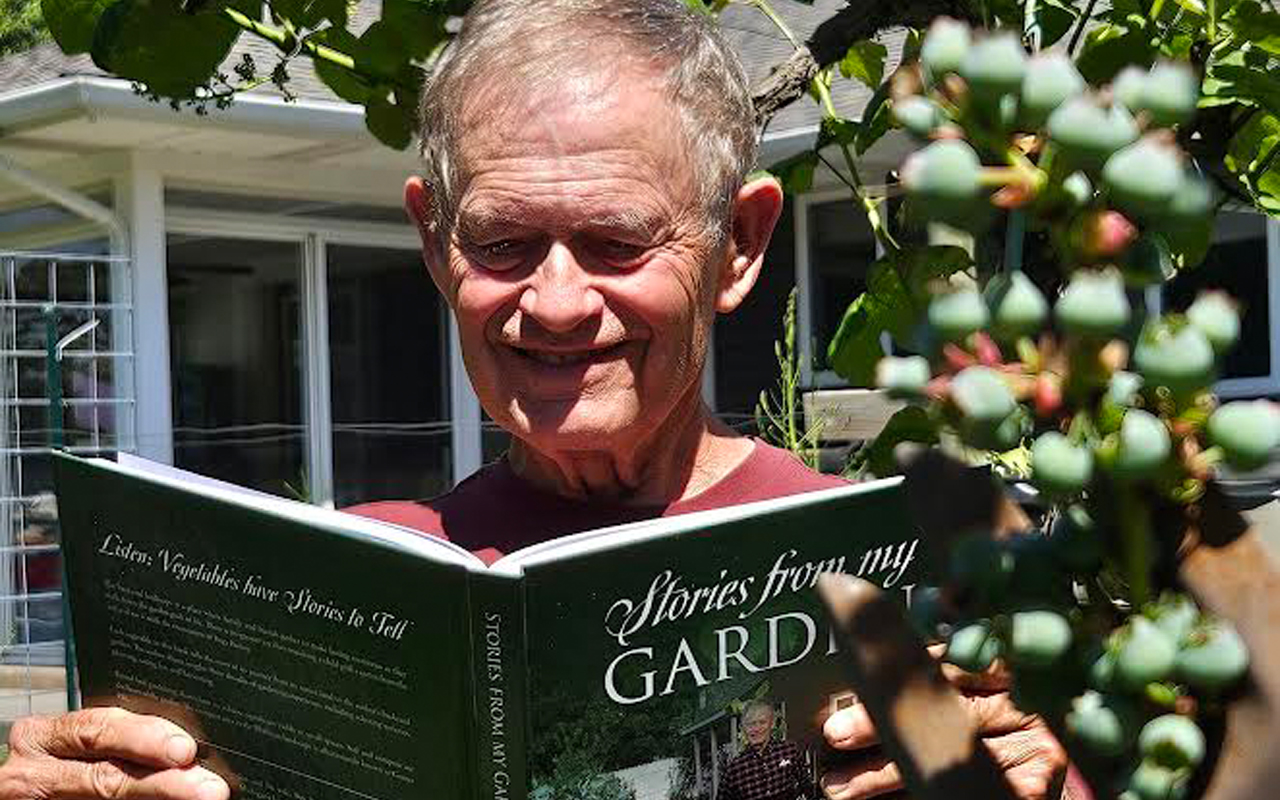
Hoffman is also an author and storyteller. His recently published book, “Stories from My Garden,” in which each vegetable tells its own story and history of how it arrived in Hoffman’s garden, is available online and locally at Gilbert and Ivy in downtown Vicksburg. Hoffman says, “The original title of the book didn’t include the word stories, but my publisher insisted after reviewing the book and labeling me a storyteller.”
The garden from which the stories are written is nothing short of amazing. Contained in the backyard of a residential lot, and sharing space with a swimming pool and pumphouse, a deck, a small greenhouse, a gardening shed, and a composting operation aptly named “Gomer Pile,” the garden consists of a handful of raised beds and produces an almost unbelievable bounty.
Between his fall and spring gardens, Hoffman grows asparagus, ginseng, garlic, peppers, leeks, onions, radishes, potatoes, brussels sprouts, mint, three varieties of lettuce, beans, grapes, apples, blueberries, and lemons. Hoffman says, “I grow everything from seed, and the raised beds help with yield, watering, and maintaining the integrity of the soil.”
Hoffman has had a tobacco plant in the past and plans to plant another. I questioned the labeling of tobacco as an herb, and once again get a couple of quick history lessons. According to Hoffman, “It was Columbus who sent the first tobacco leaves back to Europe where smoking them made people feel better, probably due to the nicotine.”
Hoffman is also quick to point out that, “In Indian culture all gardening is handled by the women, except for the tobacco plants.” It’s amazing how much history one can learn in a small, almost magical, garden in a small backyard in Vicksburg, Michigan.
Hoffman will discuss his book at Gilbert and Ivy’s Summer Author Series on Wednesday, July 8, 2026, at 6 p.m. at the bookstore, 100 South Main Street, Vicksburg.