


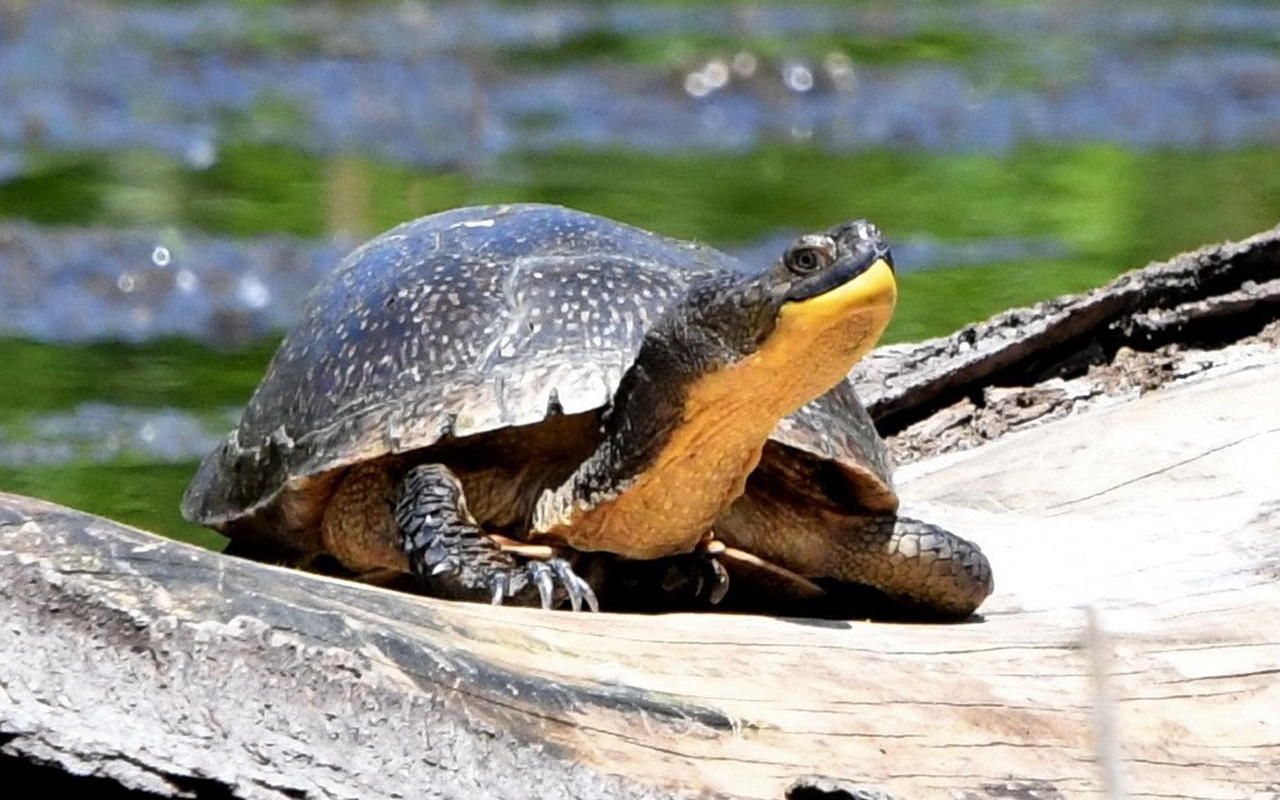
The Blanding’s turtle is difficult to find but easy to identify with its long yellow throat and domed helmet-like shell. Sadly, this remarkable creature is listed as either endangered, threatened, or a species of special concern in nearly every state where it occurs, including Michigan. The biggest threats to the Blanding’s turtle include habitat loss and fragmentation, road mortality, and predation.
Blanding’s turtles require large, intact tracts of land with a variety of wetlands (like ponds, marshes, swamps, and bogs) with sandy, open areas for nesting, and limited human disturbance or activity.
Habitat loss and fragmentation are responsible for most of the Blanding’s decline over the years. Housing developments, commercial buildings, and roads destroy their preferred habitats or break those habitats into smaller fragments, threatening their very existence and continued survival as a species. Researchers have recorded female Blanding’s turtles traveling nearly two miles in search of a dry, sandy area suitable for nesting. If they have to cross a road to find a good nesting spot, they are at high risk of being hit by a car. Since Blanding’s turtles don’t become sexually mature until 15-20 years of age, their populations depend on adults reproducing throughout their relatively long lifespan. The loss of even a single female turtle due to a car collision can have a major impact on the survival of the species.
If the female turtle is lucky enough to finally make it to her nesting site and bury a clutch of eggs, there are more dangers ahead! Raccoons, foxes, skunks, coyotes, and opossums will eat most of those eggs. Even chipmunks, squirrels, and birds like to eat them. If any of the eggs do survive to become hatchlings, most will become food for fish, frogs, and wading birds when the little turtles enter the water. Fewer than 1% of Blanding’s turtle eggs survive to adulthood! If they do make it to adulthood, most Blanding’s turtles can live to the ripe old age of 70 or older!
In fact, the most remarkable thing about Blanding’s turtles is their ability to defy aging! Unlike most animals, Blanding’s turtles show virtually no signs of biological decline as they age. A 90-year-old turtle remains as healthy, active, and reproductively viable as a 20-year-old!! Older females actually become more productive as they age; reproducing more frequently, laying larger clutches, and producing slightly larger eggs!
The world’s oldest known Blanding’s turtle lives right here in Michigan! She turned 96 this year, is still producing eggs, and lives a quiet, unpretentious existence at the University of Michigan’s Edwin S. George Reserve, 25 miles northwest of Ann Arbor. The turtle, named 3R11L, was first marked in 1954 when she was already considered an adult!
Interestingly, scientists have not been able to use what they know about this turtle’s amazing “fountain of youth” to reverse or delay our own aging process. But they have applied some discoveries to drug development and regenerative medicine. By studying this non-aging phenomenon in turtles, researchers are looking for ways to delay age-related diseases in humans, such as hypertension, type 2 diabetes, cataracts, macular degeneration, Alzheimer’s disease, and Parkinson’s.
It’s easy sometimes to disregard a creature like this as insignificant; to not worry about the habitats we destroy with housing developments, malls, roads, and golf courses. But it all matters. What impacts them ultimately impacts us.
If you are interested in helping these vulnerable creatures, here are a few simple things you can do:
Watch out for them on the road! If you see a turtle crossing the road, you can help it along its way by carefully picking it up and moving it in the direction it was already heading. See https://www.fws.gov/story/tips-helping-turtle-cross-road
Let it be: If a turtle is in a safe spot, observe it from a distance and leave it undisturbed. Blanding’s turtles in particular are very shy.
Don’t keep it: Blanding’s turtles are protected, and it is illegal to collect, possess, or move them from their natural habitat.
If you find a Blanding’s turtle in Michigan and want to help researchers compile information and data about these turtles, you can enter your findings online at www.miherpatlas.org.
The Blanding’s turtles in our area have already laid their eggs and the hatchlings will be emerging this month or early September.
Keep your eyes open for the adults with their bright yellow throats, or their tiny hatchlings heading to the water!