


I spent 25 years working in the healthcare arena. I learned a lot in that environment about getting older and staying healthy. I have also seen many changes in medicine that are encouraging for all of us as we grow older.
When I first started at Bronson the idea of an impending “Age Wave” was a hot topic and warned of all the upcoming Baby Boomers who were going to impact the healthcare system. The notion of trained geriatricians and lifelong medicine emerged as did the notion of palliative care. The analysis of how people change health habits was studied as well, leading to tested protocols for helping people change, which were adopted by anyone who was trying to assist another person to change dangerous behaviors, including physicians. Research shows us that 50% of our future health depends on inherited risk factors and that almost 50% of our future health depends on our environment and lifestyle behaviors. We have come a long way, indeed.
Proof of point lies in meeting and learning from Dr. Katie Grossman who is now board certified in both Internal Medicine and Lifestyle Medicine. Knowing about health risks is not enough. People need help to engage in the behavior change process.
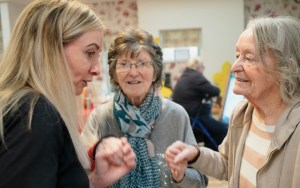
Katie is well known in South County and has been hosted several times by the South County Senior Center Active Living (SCSC). I was fortunate to attend a recent presentation she did as a part of her Healthy You Series at SCSC. The program was about the power of social bonds. It was a professionally researched and powerful presentation. On top of that, Dr. Katie provided a healthy and tasty light lunch with recipes to help the audience find ways to improve their nutrition. Her talk provided solid proof of the power of medical research as well. With Dr. Grossman’s permission, I would like to share some highlights from that talk. I would also like to follow up with some relevant thoughts about taking steps to avoid loneliness.
We have a troubling problem in the world. Twenty percent of Americans report feeling lonely. Twenty-five percent of Americans say they have no one to depend upon or in whom to confide a concern or problem. Changes in communities and living options for older adults are making social isolation more common. Research shows that isolation and loneliness can be as detrimental to our health as smoking, alcoholism, obesity, or high blood pressure for some of us.
The Harvard Study of Adult Development is the longest longitudinal study of adult life history. It began in 1938 and involved Harvard College males and inner-city Boston men. It has recently expanded to include the spouses of the original participants. The research also includes periodic personal interviews, brain scans, and lab tests. There are detailed analyses in the book, “The Good Life: Lessons from the World’s Largest Scientific Study of Happiness.” Listed below are four key lessons learned:
- Close relationships are what keep people happy throughout their lives.
- Strong relationships protect us from discontent, help delay mental and physical decline and are better predictors of long and happy lives than social class, IQ, or genes.
- The level of satisfaction at age 50 is a better predictor of health than cholesterol levels.
In addition, the Yale Course called “The Science of Well-Being” was recommended for young adults and even teens. The online course is available FREE to individuals. Professionals looking for professional development skills may access the course for a $49 fee. Stanford University’s Center for Longevity is also a valuable resource you might want to explore.
My big takeaway was that is not about the quantity of your relationships. It is much more about the quality of your relationships. Even if you have lost your spouse or some other committed relationship, you can build meaningful relationships. Even if you can no longer drive, you can learn how to connect with social media of some sort. I still write letters and enjoy receiving letters in the mail. If you are a reader, it is proven that well written books are a critical way of staying connected to lives of others. This month, I would like to recommend a slender and powerful novel entitled “Sipsworth” by Simon Van Booy. After reading it, I found a review of the book by someone named Barbette. See if her words strike a chord with you. “Like many who have lost a loved one, I’ll read anything that touches on grief. Watching fictional characters navigate the murky waters of bereavement, seeing them traverse the illogical backward and forward paths of mourning, makes me feel understood, and less alone on my journey. So, when I heard about “Sipsworth”, I jumped at the chance to read it in spite of a fictional mouse giving the book its title.”
Even casual conversations with people in your community can be a source of human connection. They help us stay engaged and open to the benefits of exposure to the ideas, fun, and inspiration that others can offer to lift us up in the world.