



My son Sam was married in Asheville, North Carolina last year. Jackie and I loved exploring the area and one of the highlights was visiting the Biltmore Estate.
Like most popular attractions, you must buy your ticket online for a specific tour time and pay in advance. Tickets are around $100, but well worth it.
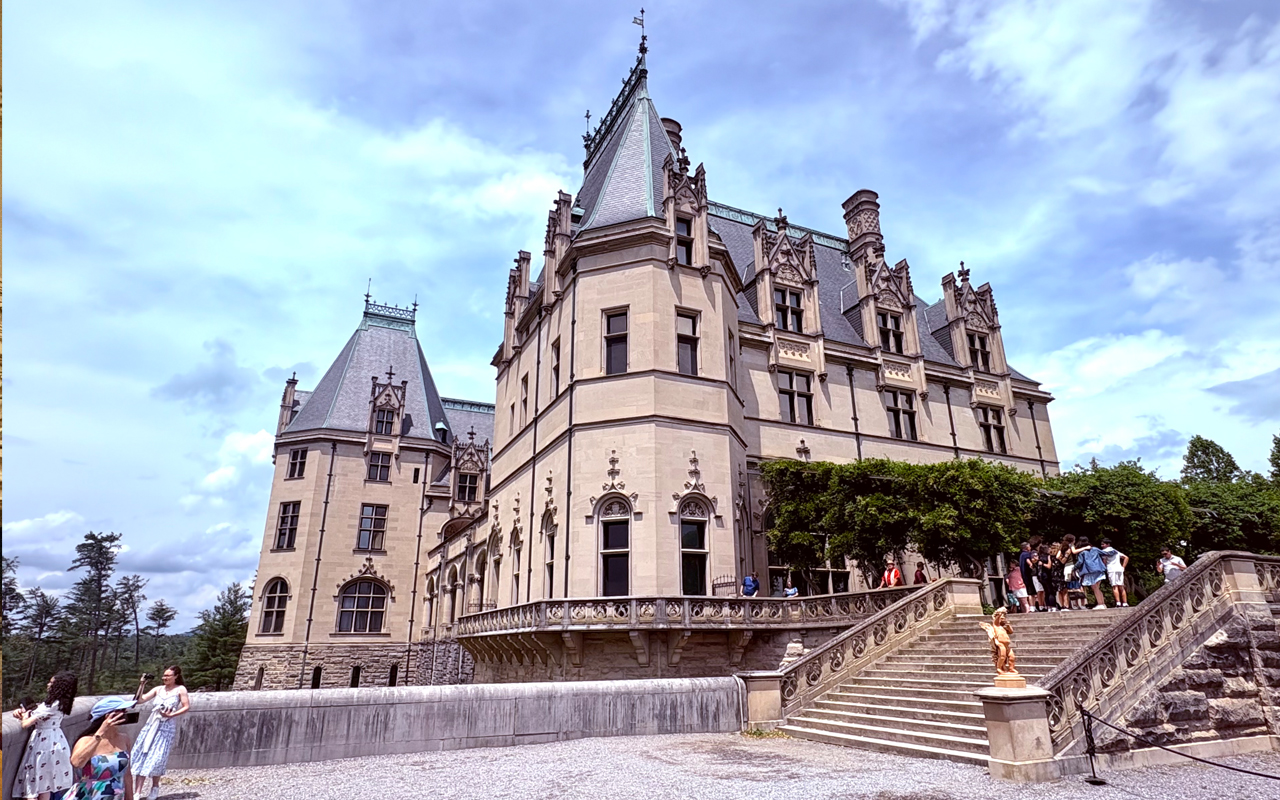
The residence was built for George Washington Vanderbilt II between 1889 and 1895. It is the largest privately owned house in the United States at 178,926 square feet of floor space and remains one of the most prominent examples of Gilded Age mansions.
Vanderbilt loved the area and began by purchasing 125,000 acres, comprising nearly 700 parcels, including over 50 farms and five cemeteries.
Construction of the home required the labor of 1,000 workers and 60 stonemasons.
Vanderbilt made extensive trips overseas during construction to purchase thousands of furnishings, including tapestries, carpets, prints, linens, and decorative objects.
He opened his estate on Christmas Eve of 1895 to family and friends from across the country who were encouraged to enjoy leisure and country pursuits. The Biltmore mansion cost $5 million (equivalent to about $189 million today) to construct.
Vanderbilt died unexpectedly in 1914 of complications from an emergency appendectomy.
Vanderbilt’s wife, Edith, carried on with the family estate, while selling off some land and buildings. She intermittently occupied the house, until the marriage of her daughter Cornelia to John Francis Amherst Cecil in April 1924. The Cecils had two sons. Cornelia and her husband opened Biltmore to the public at the request of the City of Asheville in March 1930.
The Cecils divorced in 1934. Cornelia left the estate never to return, but John Cecil maintained his residence in the mansion until his death in 1954.
The Biltmore Estate has been managed over the years by various family members. It now encompasses 8,000 acres and attracts around 1.4 million visitors per year.
The estate has been used as a filming location for movies such as Being There, The Last of the Mohicans, Forrest Gump, Richie Rich and Patch Adams.
Our tour of the estate began with a rustic four-mile drive through thick woods up to the mansion. We imagined what this drive must have been like more than 125 years ago with horses and buggies making the trek.
Upon leaving the parking area, while walking towards the mansion, we saw a large bear in the woods. What an exciting way to begin our visit!
Our first stop was at the large building to the right of the mansion. It was once a stable but now houses a large restaurant, restrooms and gift store.
Entering the mansion, the principal rooms of the house are located on the ground floor. To the right of the marbled entrance hall, the octagonal sunken Winter Garden is surrounded by stone archways with a ceiling of sculptured wood and glass. The Banquet Hall is the largest room in the house, measuring 42 ft × 72 ft, with a 70-foot high barrel-vaulted ceiling. The table can seat 64 guests and is surrounded by rare Flemish tapestries and a triple fireplace that spans one end of the hall.
The two-story library contains over 10,000 volumes in eight languages. We wondered how many had ever been read or even touched in decades.
On the second floor in the south tower is George Vanderbilt’s gilded bedroom with furniture. His bedroom connects to his wife’s Louis XV-style, oval-shaped bedroom in the north tower through a carved oak paneled sitting room. The large sitting room, between the two bedrooms, is where the Vanderbilts would meet and talk in the evening.
The third floor includes a number of guest rooms with names that describe the furnishing or artist that they were decorated with. The fourth floor has 21 bedrooms that were inhabited by housemaids, laundresses, and other female servants. Male servants were not housed here, but instead, in rooms above the stable and complex.
The Bachelors Wing includes the large billiard room, with rich oak paneling and a custom-made pool table and a carom table (without pockets).
The basement includes activity rooms, including an indoor, 70,000-gallon heated swimming pool with underwater lighting. We were told that most folks at the time couldn’t swim so they simply held onto ropes at the side of the pool. And we were surprised to learn that it was emptied and cleaned after every use.
The basement also houses a bowling alley, and a gymnasium with state-of-the-art fitness equipment. The service section of the house is also found in the basement. It holds the main kitchen, pastry kitchen, rotisserie kitchen, walk-in refrigerators that provided an early form of mechanical refrigeration, the servants’ dining hall, laundry rooms, and additional bedrooms for staff.
After our tour of the mansion, we walked the gorgeous grounds.
Originally, the grounds included 75 acres of formal gardens including a Roman formal garden, a bush and tulip garden, water fountains, and a conservatory with individual rooms for palms and roses. There was also a bowling green and an outdoor tea room.
The grounds also include The Inn on Biltmore Estate and the Biltmore Estate Winery.
The Biltmore Estate is a bucket list attraction for many, that is well worth a visit. We hope to return and spend more time someday.