



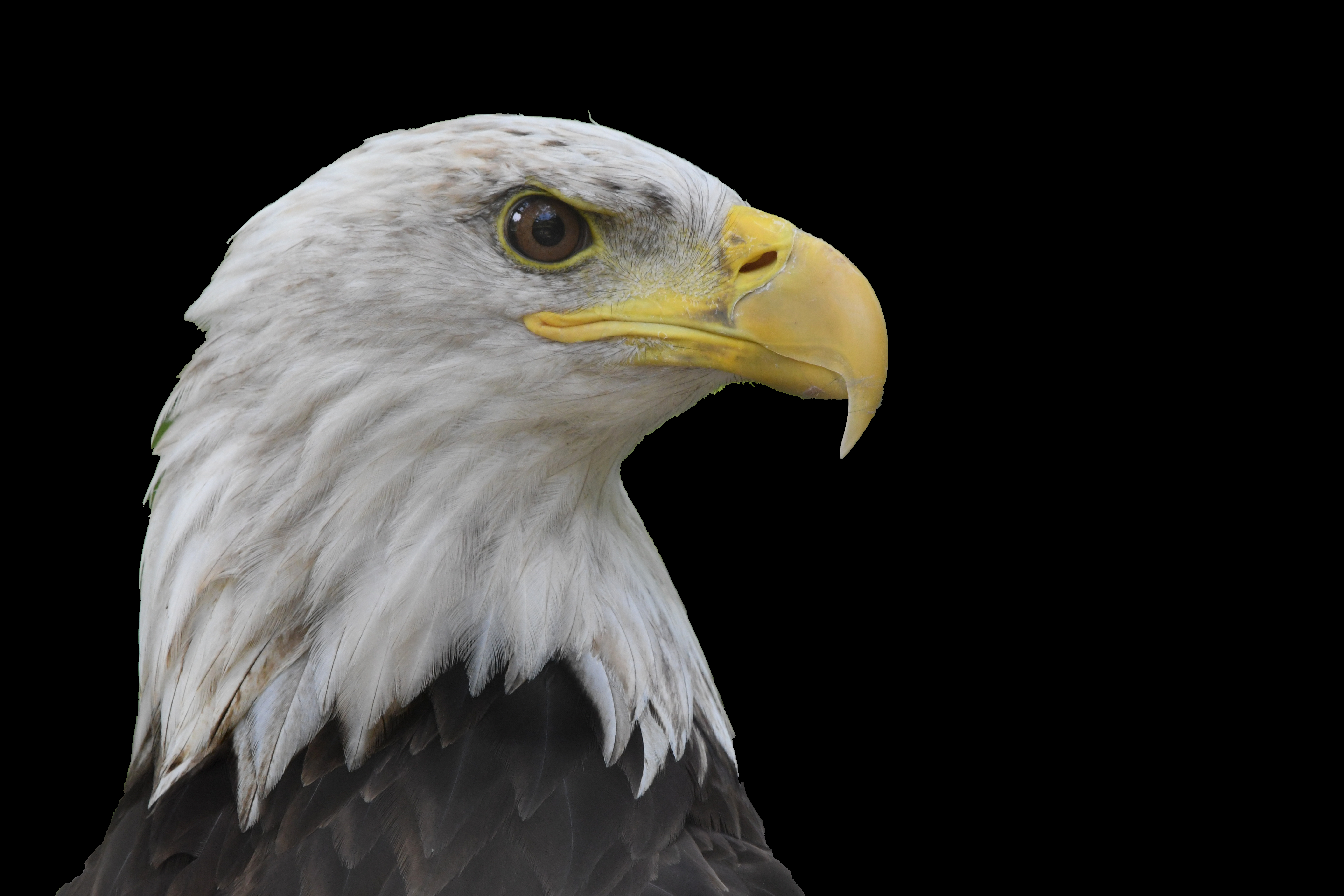
There was a time not too long ago when I didn’t know we even had bald eagles in Michigan. I had mostly associated them with the Pacific Northwest, where I envisioned them soaring high above majestic pine trees, with pristine mountains and blue skies in the background. The bald eagle is, in fact, found in every single state except Hawaii, with the greatest number of nesting eagles found in Florida!
The bald eagle became our national symbol in 1782. If Benjamin Franklin had prevailed, however, our national symbol would have been a wild turkey! He didn’t like that eagles stole food from other birds or that they could be easily intimidated by smaller birds! He thought they were lazy and cowardly and not a good representation of our great country. In a letter to his daughter after the decision had already been made, Franklin wrote, “I wish the bald eagle had not been chosen the representative of our country. He is a bird of bad moral character. He does not get his living honestly. Besides, he is a rank coward!” I love wild turkeys, but I’m really glad Franklin didn’t get his way on this one!
Do you ever wonder why it’s called a bald eagle when the bird is obviously not bald? The name comes from the Old English word “balde” which means white-headed and refers to the colors of the feathers on an eagle’s head, rather than its lack of feathers altogether. Interestingly, bald eagles don’t become “bald” or have a white head until they are four or five years old.
I was thrilled the first time I saw a bald eagle in Michigan as it flew high overhead at the Wolf Lake State Fish Hatchery in Mattawan. A year or so later, while I was taking pictures at the Portman Preserve, also in Mattawan, a bald eagle swooped down in front of me as I stood at the edge of a small lake and deftly grabbed a fish out of the water with its powerful talons — and I got the picture!
Fish are the bald eagle’s favorite food, but they will eat almost anything — including birds, reptiles, amphibians, turtles, snakes, and small mammals, often taking the weakest or the most vulnerable individuals. Whenever possible, eagles will actually let somebody else do the work for them which is probably why Franklin thought they were too lazy to be symbols of our country! If another raptor has a fish in its talons, the eagle will harass that bird until the fish is dropped and the eagle can swoop in to grab it. Sometimes, eagles will just snatch the fish directly from the bird’s talons! They have also been known to feast on carrion and to congregate on garbage dumps hoping for more free snacks. They are the ultimate opportunists when it comes to food, which has enabled them to not only survive but to thrive.
Unfortunately, it was the bald eagle’s diet, particularly fish, that brought it to the brink of extinction. In the late 1960s and early 1970s, there were only about 500 breeding pairs of bald eagles left within the continental United States. It was Rachel Carson’s book, “Silent Spring”, that really brought to light the damaging effects on birds of a widely used pesticide called DDT. Environmental activists took note and went to work getting DDT banned from our environment, and getting the Environmental Protection Act passed in 1973. As a direct result of their efforts, bald eagles made a miraculous comeback. Their recovery is considered one of the greatest conservation success stories ever achieved. The bald eagle’s journey from near extinction to a flourishing population is a powerful testament to the human impact on wildlife—both negative and positive. But our job is not yet done.
Once fledged, bald eagles have very few threats to their existence, except for us. We are their greatest challenge, and are responsible in one way or another for their loss of habitat, lead poisoning from lead shot in the dead mammals they eat, environmental contaminants such as mercury and PCBs, buildings with reflective facades, power lines that cause electrocutions, and collisions with vehicles. Their very newest threat, and ours, is avian influenza!
It’s imperative that we pay attention to these threats and to the animals that are at risk. Our survival is dependent on theirs and any small steps we can take to improve their lives will improve ours.