


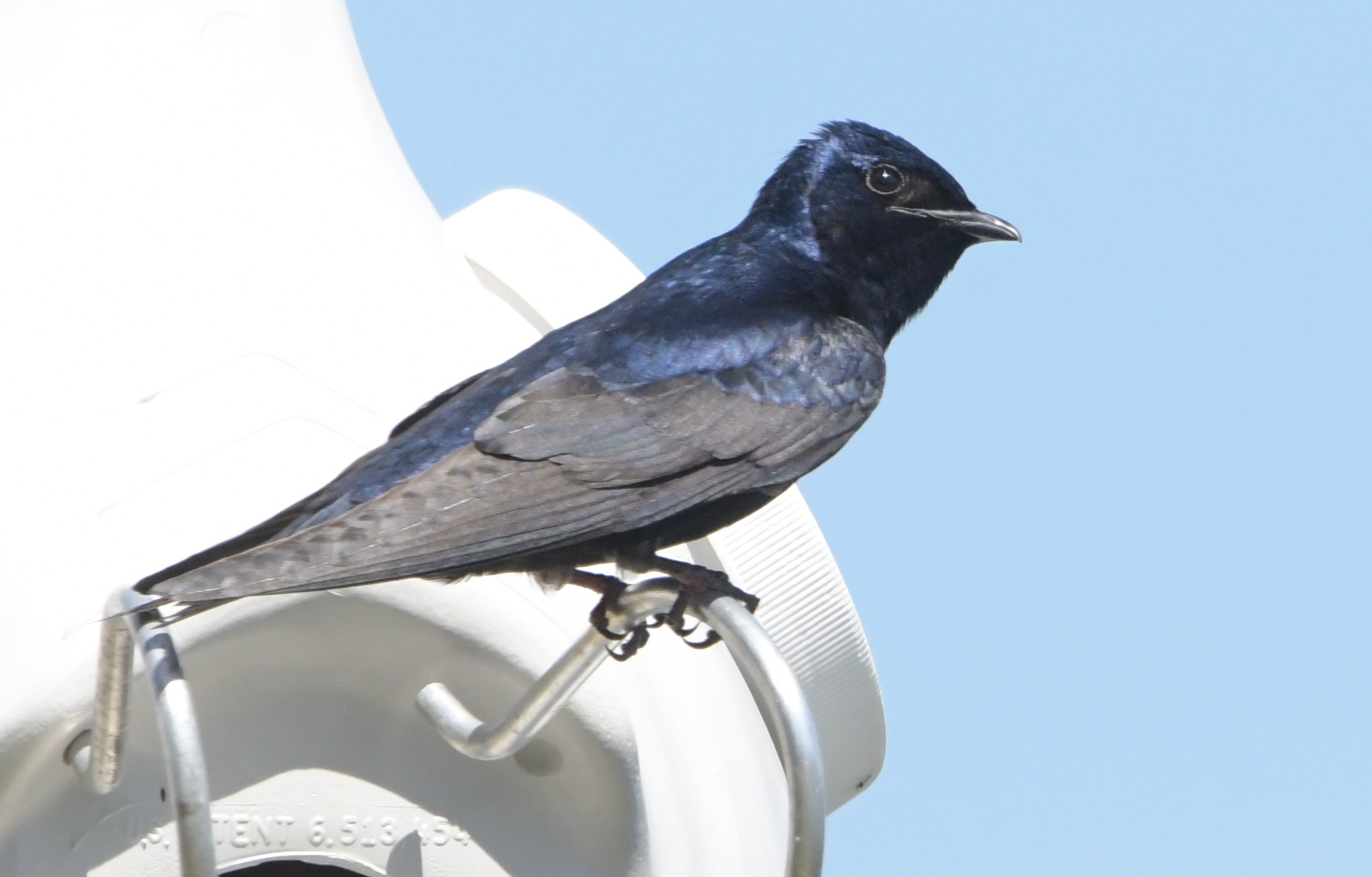
I have visited the Kellogg Bird Sanctuary in Augusta, Michigan, many, many times over the years, but last April was the first time I had the joy of seeing purple martins. They are one of the earliest birds to arrive here in the spring and one of the earliest to leave in the summer. By next month, they will start heading back to their wintering grounds in South America!
Purple martins are rather large, broad-chested swallows with stout, slightly hooked bills, short, forked tails, and long, tapered wings. The adult males are a beautiful iridescent blue-purple overall with brownish-black wings and tail. Females are grayish-brown overall with small patches of iridescent dark purple on their heads and backs. At 8 inches in length and with a 16-inch wingspan, the purple martin is North America’s largest swallow; slightly smaller than the American robin but larger than a tree swallow.
These stunning birds are known as aerial insectivores. Their diet consists almost entirely of insects all of which they capture in mid-air at heights of 150 feet or more; much higher than any other swallow! Dragonflies are their preferred snack but they aren’t very fussy eaters. Their diet also includes beetles, damselflies, leafhoppers, flies, grasshoppers, crickets, butterflies, moths, wasps, bees, caddisflies, cicadas, termites, and mayflies—but rarely mosquitoes! Mosquitoes usually stay close to the ground and purple martins like to catch their meals high in the air, so the two rarely cross paths. Surprisingly, though, the myth about purple martins consuming thousands of mosquitoes a day still persists!
For me, the most interesting and somewhat concerning, thing about purple martins is how dependent they are on human beings for their survival, particularly those birds east of the Rocky Mountains. Virtually every purple martin in eastern North America nests in a man-made birdhouse, while those in the West use mostly natural cavities like woodpecker holes. Why is this?
One possible answer goes back hundreds of years to precolonial times when Native Americans considered the purple martin a sentinel that would warn them of dangers. To encourage their presence, Native Americans constructed bird houses made of gourds and hung them high up on poles. Later, when the first European settlers arrived and learned about these friendly birds, they continued the practice of building bird houses for them. Over time, purple martins, especially those in the eastern part of the United States came to rely on humans to provide these nesting sites.
Purple martins in the east may have also become dependent on human-made birdhouses because so much of their habitat has been lost to deforestation. Historically, these birds nested in the natural cavities of dead trees. According to the Purple Martin Conservation Association, human-provided nest boxes are the only thing keeping this species alive east of the Rocky Mountains.
Nest availability is not the only threat to the survival of this species. Pesticide use, prolonged weather extremes, and climate change have also played a significant role. These birds are almost entirely dependent on the availability of insects for their survival and pesticides kill those insects. Purple martins are also vulnerable to sudden extremes of weather. When bad weather lasts for more than three or four days, they starve to death for lack of insects. Ultimately, bad weather kills more purple martins than all other sources of mortality combined.
The Purple martins I saw at the Kellogg Bird Sanctuary arrived here from South America sometime in April and will be heading back during July and August. Their migration route can cover between 5,000 and 7,000 miles over varying terrain and large expanses of water. That’s an incredible feat in my book!
If you want to see these beautiful birds for yourself, head out to the Kellogg Bird Sanctuary no later than the middle of August! It might also be good to call first to see if they’re still around. You’ll find them near a large, white “gourd condo” down by the lake not too far from the Visitor’s Center.
If you’re interested in learning more about purple martins and how to best ensure their survival, a good place to start is the Michigan Audubon website or the Purple Martin Conservation Association website.
Happy birding!