


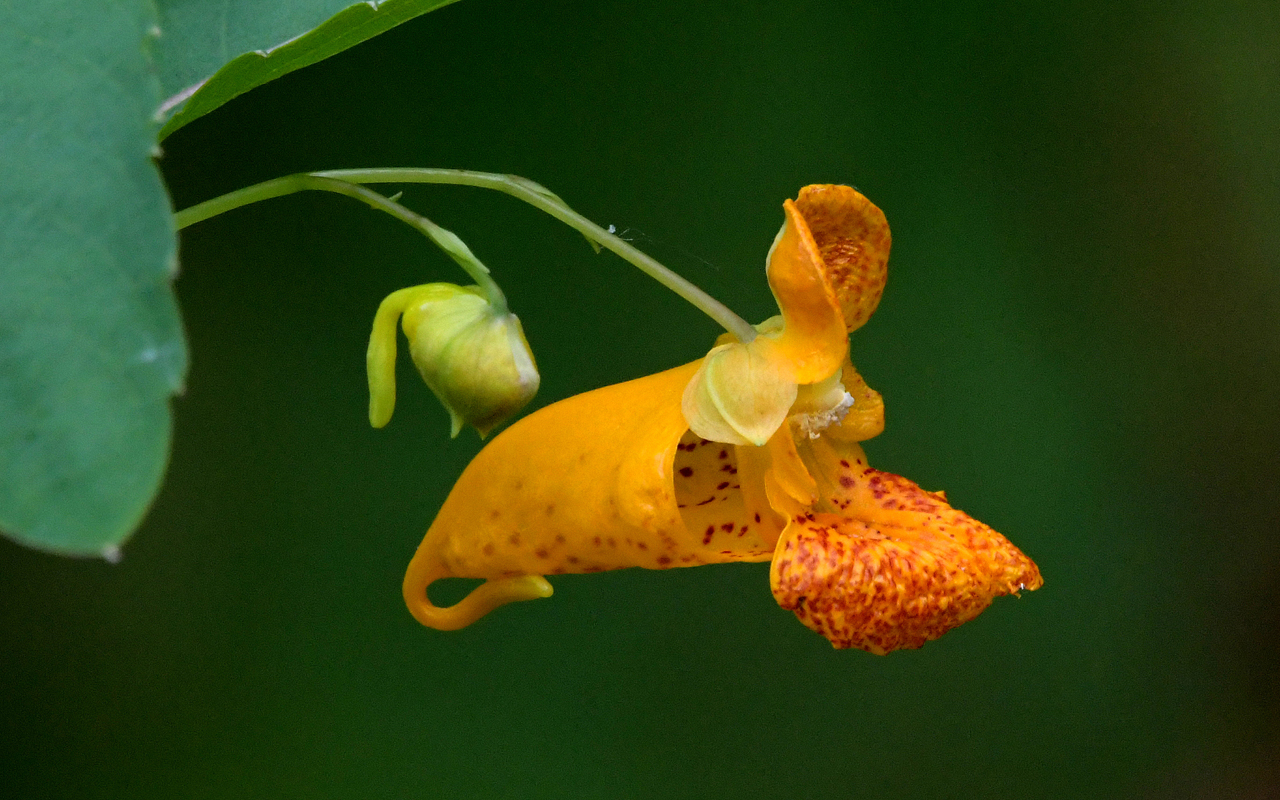
Jewelweed is an amazing but often over-looked plant that grows prolifically along shady, wet creek beds and in the damp recesses of our local woods. It happily exists just about anywhere that’s both shady and moist.
I love taking pictures of jewelweed, particularly on wet, dewy mornings when dozens of tiny water droplets bead up on its leaves, stems and flowers giving it a sparkly, jewel-like appearance, and its descriptive name, jewelweed. It’s also known as “touch-me-not” or “spotted-touch-me not” for the explosive way its ripe seed pods burst open and eject all its tiny seeds whenever you touch them. The best time of year to get jewelweed seeds to pop is late August through late September. It’s too late in the season now, but keep it in mind for next year. Getting jewelweed seeds to pop is a fun activity, especially for kids!
Jewelweed is native to much of the United States and large parts of Canada. It can be orange or yellow, but the one you’re most likely to find is orange. Look for a small, trumpet-shaped flower with mottled reddish-brown spots that hangs delicately from a thin, threadlike stem. The leaves of the jewelweed plant are bluish-green and oval shaped, with coarsely toothed edges. The plant will be two to five feet tall and have an abundant array of little orange flowers which bloom from mid-summer until first frost.
As an avid hiker and photographer, I have known about jewelweed for many years but only recently learned that it is one of the very few native North American plants that can successfully compete against our non-native garlic mustard; that invasive little weed we’ve been endlessly yanking out of the ground so it doesn’t overwhelm our native plants! With that knowledge in mind, I wondered why it wasn’t common practice to just remove the garlic mustard and plant jewelweed; or plant jewelweed nearby and let it overtake the garlic mustard. Apparently, it’s not that simple!
Jewelweed has proven to be a strong native competitor for garlic mustard, but researchers and conservationists alike don’t consider it to be a “one and done” eradication tool. Jewelweed has very specific growth requirements (moisture and shade for starters), and before the seeds can sprout, they require a cold-moist period followed by a warm-moist period, followed by another cold period! In other words, you can’t just take a bunch of jewelweed seeds and toss them on the problem to eradicate garlic mustard. Jewelweed also doesn’t transplant easily once it’s reached maturity. Unfortunately, eradicating garlic mustard using jewelweed takes a long-range, well-thought-out management plan to be successful. Darn.
Over the years, I’ve often heard or read that jewelweed was a good antidote for poison ivy and wondered if that were actually true. Native Americans have a long history of using jewelweed for medicinal purposes. The watery sap from the stem and leaves was used to relieve itching and pain from a variety of ailments including hives, poison ivy, stinging nettle, insect bites and other skin irritations. Today, you can find dozens of resources on line with recipes for extracts, mashes, and soaps made from jewelweed that claim to relieve skin irritations caused by any of the same culprits identified by Native Americans. But do these methods work
After much digging, I found a reputable medical study where poison ivy was intentionally brushed onto the forearms of several volunteers. The exposed areas were treated with either jewelweed extracts, fresh plant mashes, soaps made from plant extracts, or a simple mixture of water and Dawn® dish soap. The jewelweed mash (crushed stems and leaves), applied topically, was indeed effective in reducing poison ivy dermatitis, but soap and water proved more effective, especially when it was applied immediately after contact. So, if you’re out in the woods and don’t have access to soap and water, use a mash-up of jewelweed sap, stems, and leaves. Otherwise, wash the exposed area as soon as possible with soap and water, preferably Dawn®.
If you have an area of your yard that’s damp and shady, jewelweed might be the perfect solution for filling in empty spaces that might otherwise be taken over by non-native weeds. Take note, however, that jewelweed is a particularly aggressive plant that spreads easily and, once established, is hard to eradicate. Given the right conditions, jewelweed will return year after year with pretty orange flowers that you can enjoy for four or five months. As a bonus, your jewelweed plants will provide nourishment to a host of hummingbirds, butterflies, bees, and birds! In fact, hummingbirds actually synchronize their fall migration with the maximum flowering phase of jewelweed from late July through September! Those little orange flowers provide the high-energy nectar hummingbirds need to build fat reserves for their long autumn migration to Mexico and Central America.
What an amazing plant!